
Djibouti renewable share of final energy use and of electricity
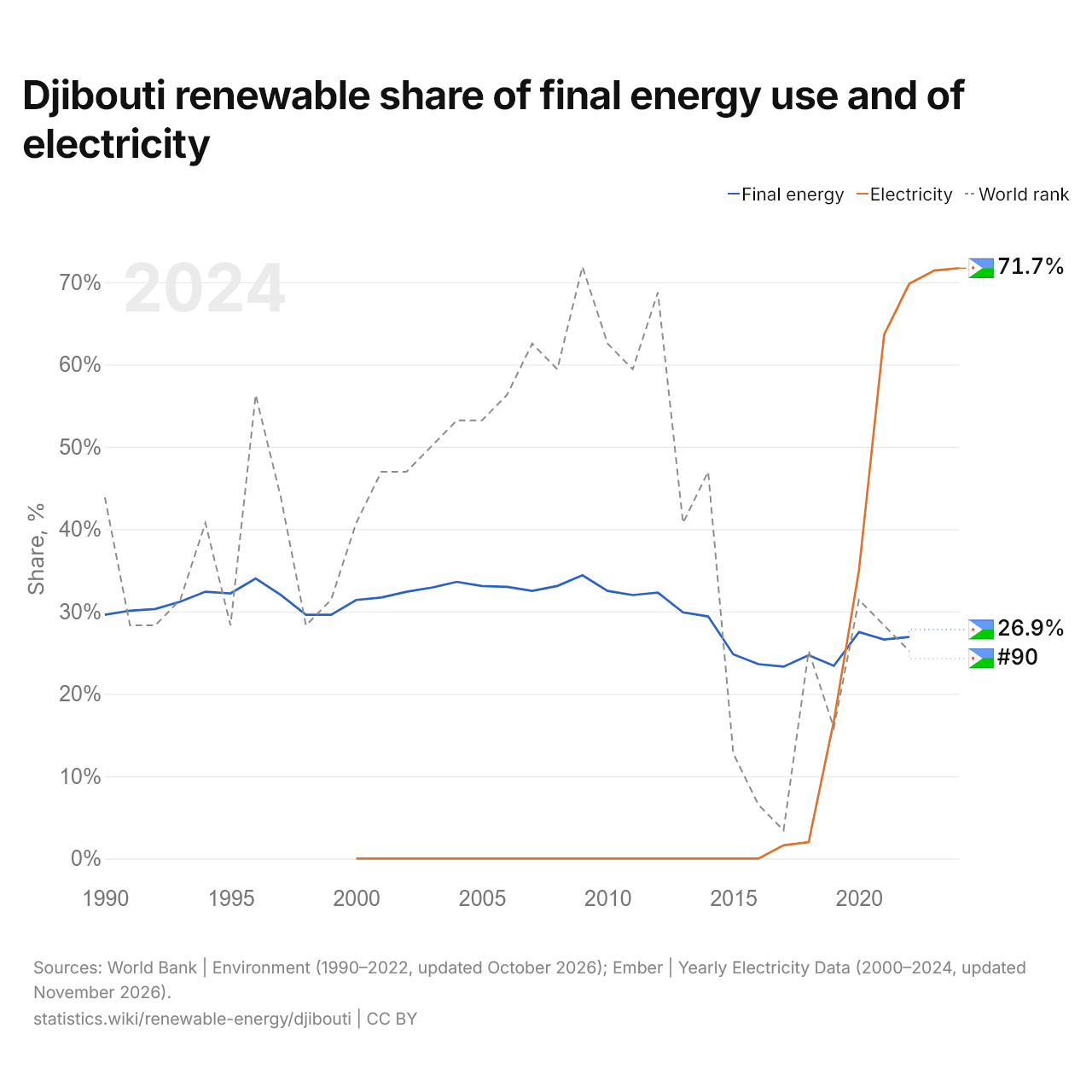
Renewables make up 26.9% of Djibouti's final energy consumption, down from 29.6% in 1990. The share was highest in 2009, at 34.4%. It is the 90th highest in the world, down from 89th the year before. Its highest rank was 75th, last held in 2009. Renewables produce 71.7% of Djibouti's electricity, up from 0.0% in 2000.
Djibouti's renewable share of final energy consumption is the 43rd highest of the 54 countries of Africa, where it ranges from Algeria's 0.1% to the DR Congo's 96.3%. The largest ten-year fall in Djibouti's renewable share was from 2010 to 2020, by 5.0 percentage points; the largest ten-year rise was from 1990 to 2000, by 1.8 percentage points. CO2 emissions per person in Djibouti are 0.766 tonnes, the 139th highest in the world.
Djibouti renewable electricity production by source, TWh
| Year | TWh |
|---|---|
| Renewables excl. hydro | |
| 2024 | 0.33 |
| 2023 | 0.32 |
| 2022 | 0.3 |
| 2021 | 0.23 |
| 2020 | 0.07 |
| 2019 | 0.02 |
| 2018 | 0.001 |
| 2017 | 0.001 |
| 2016 | 0 |
| 2015 | 0 |
| 2014 | 0 |
| 2013 | 0 |
| 2012 | 0 |
| 2011 | 0 |
| 2010 | 0 |
| 2009 | 0 |
| 2008 | 0 |
| 2007 | 0 |
| 2006 | 0 |
| 2005 | 0 |
| 2004 | 0 |
| 2003 | 0 |
| 2002 | 0 |
| 2001 | 0 |
| 2000 | 0 |
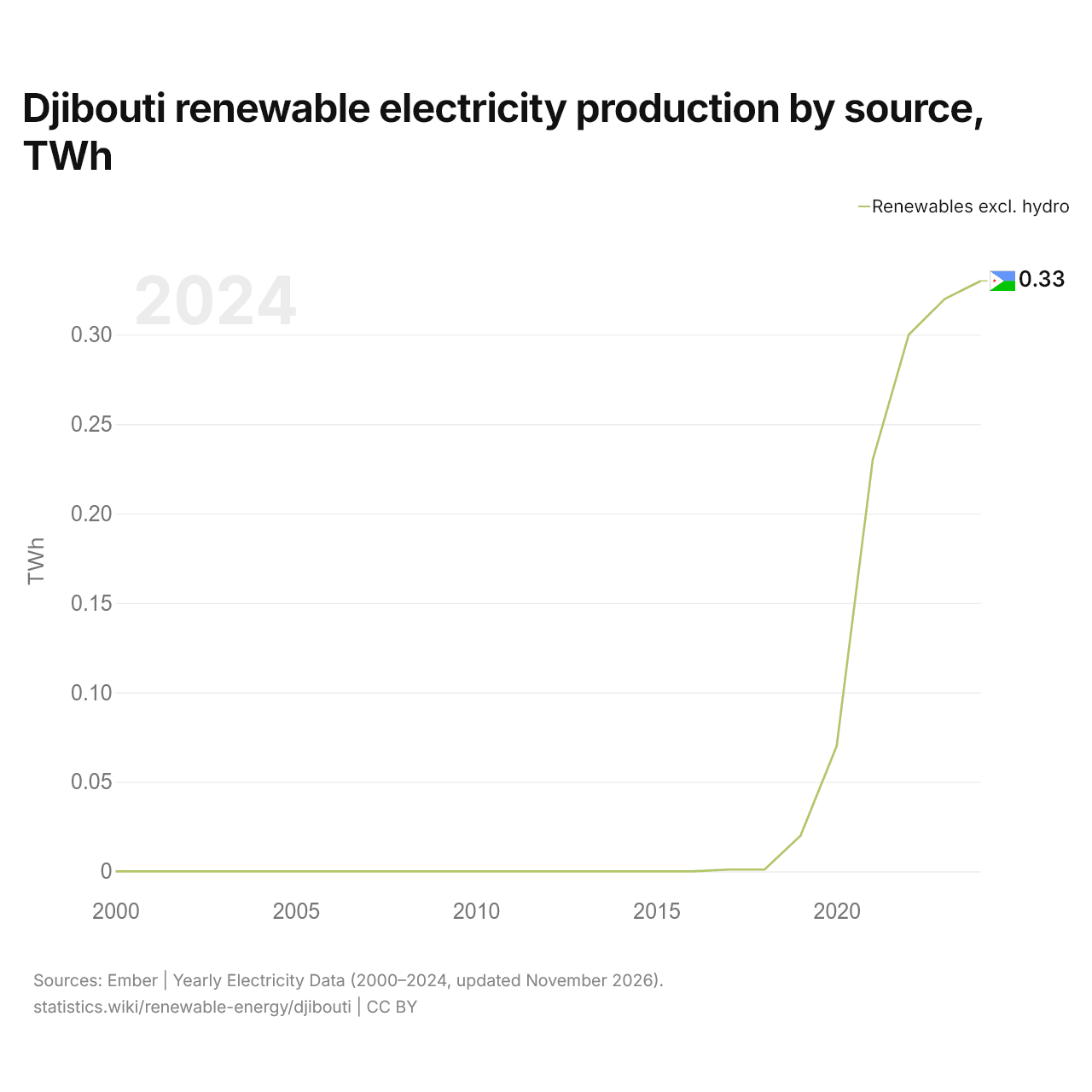
Renewables other than hydropower produce 0.329 TWh of electricity in Djibouti.
Djibouti in the world renewable energy ranking
| Rank | Country | Share of final energy | Share of electricity (2025) | Renewable electricity, TWh (2025) | |
|---|---|---|---|---|---|
| 87 |
 Kyrgyzstan |
27.6% (2021) | 93.5% | 12.1 | |
| 88 |
 Botswana |
27.4% (2021) | 1.9% (2024) | 0.07 (2024) | |
| 89 |
 Serbia |
27.2% (2021) | 28.5% | 10.4 | |
| 90 |
 Djibouti |
26.9% | 71.7% (2024) | 0.33 (2024) | |
| 91 |
 Georgia |
25.2% (2021) | 80.6% | 11.5 | |
| 92 |
 Bangladesh |
25.0% (2021) | 3.0% | 3.14 | |
| 92 |
 Vanuatu |
25.0% | 24.1% (2023) | 0.02 (2023) |
Compare the renewable energy of Djibouti with other countries
Sources:
- Ember | Yearly Electricity Data (2000–2025, updated November 2026)
- World Bank | Environment (1990–2022, updated October 2026)
Creative Commons Attribution (CC BY): you may copy, share, adapt and reuse this content, also commercially, as long as you credit statistics.wiki and note any changes you made. The sources listed above may have their own license terms.