
Djibouti electricity production by year
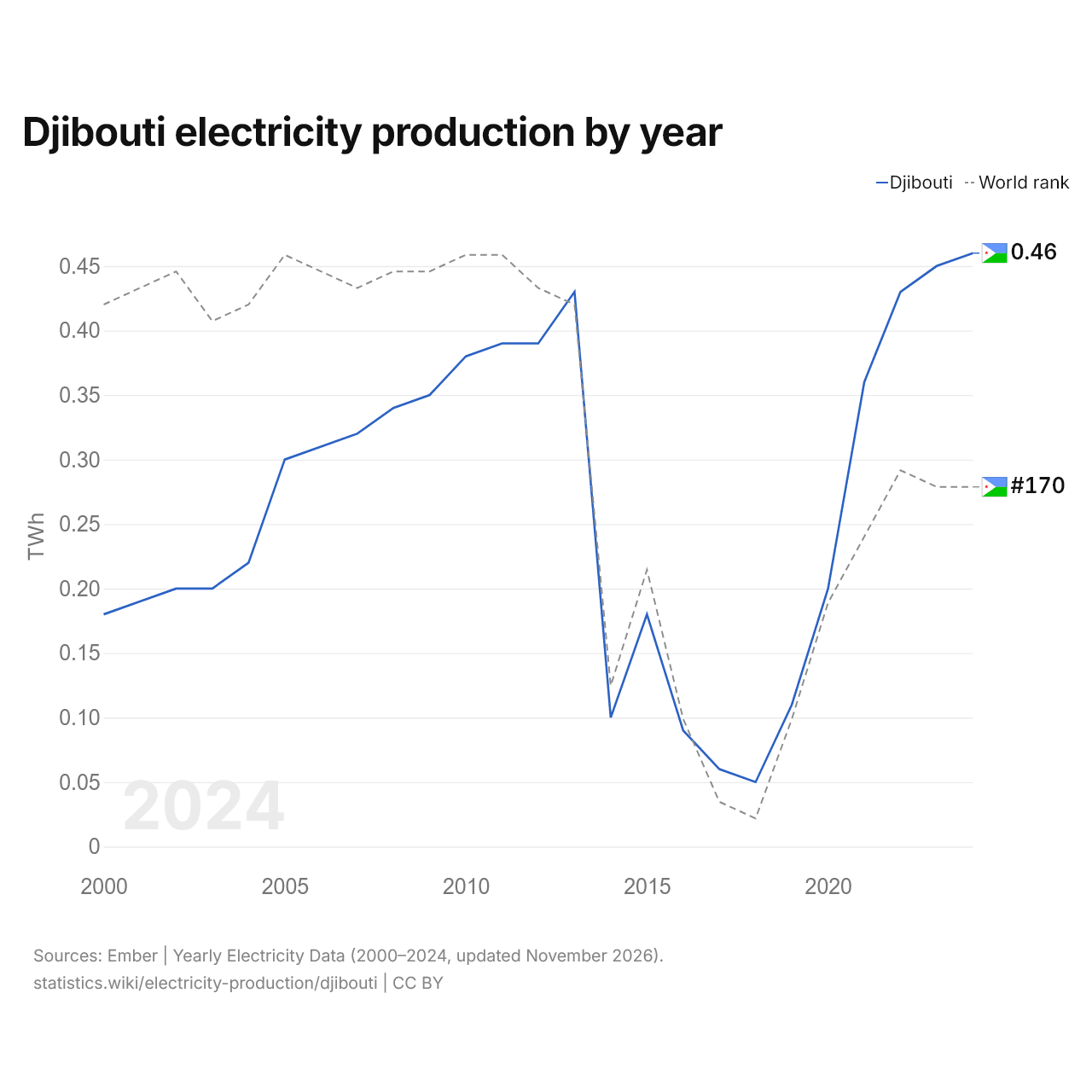
| Year | TWh | World rank |
|---|---|---|
| Djibouti | ||
| 2024 | 0.46 | #170 |
| 2023 | 0.45 | #170 |
| 2022 | 0.43 | #169 |
| 2021 | 0.36 | #173 |
| 2020 | 0.2 | #177 |
| 2019 | 0.11 | #184 |
| 2018 | 0.05 | #190 |
| 2017 | 0.06 | #189 |
| 2016 | 0.09 | #184 |
| 2015 | 0.18 | #175 |
| 2014 | 0.1 | #182 |
| 2013 | 0.43 | #159 |
| 2012 | 0.39 | #158 |
| 2011 | 0.39 | #156 |
| 2010 | 0.38 | #156 |
| 2009 | 0.35 | #157 |
| 2008 | 0.34 | #157 |
| 2007 | 0.32 | #158 |
| 2006 | 0.31 | #157 |
| 2005 | 0.3 | #156 |
| 2004 | 0.22 | #159 |
| 2003 | 0.2 | #160 |
| 2002 | 0.2 | #157 |
| 2001 | 0.19 | #158 |
| 2000 | 0.18 | #159 |
Electricity production in Djibouti is 0.459 TWh, up from 0.18 TWh in 2000. Its production was lowest in 2018, at 0.051 TWh. It is the 170th largest producer in the world, a rank it has held since 2023. Its highest rank was 156th, last held in 2011.
Djibouti's electricity production is the 47th largest of the 54 countries of Africa. Production per person in Djibouti is 393 kWh.
Djibouti electricity production by source, %
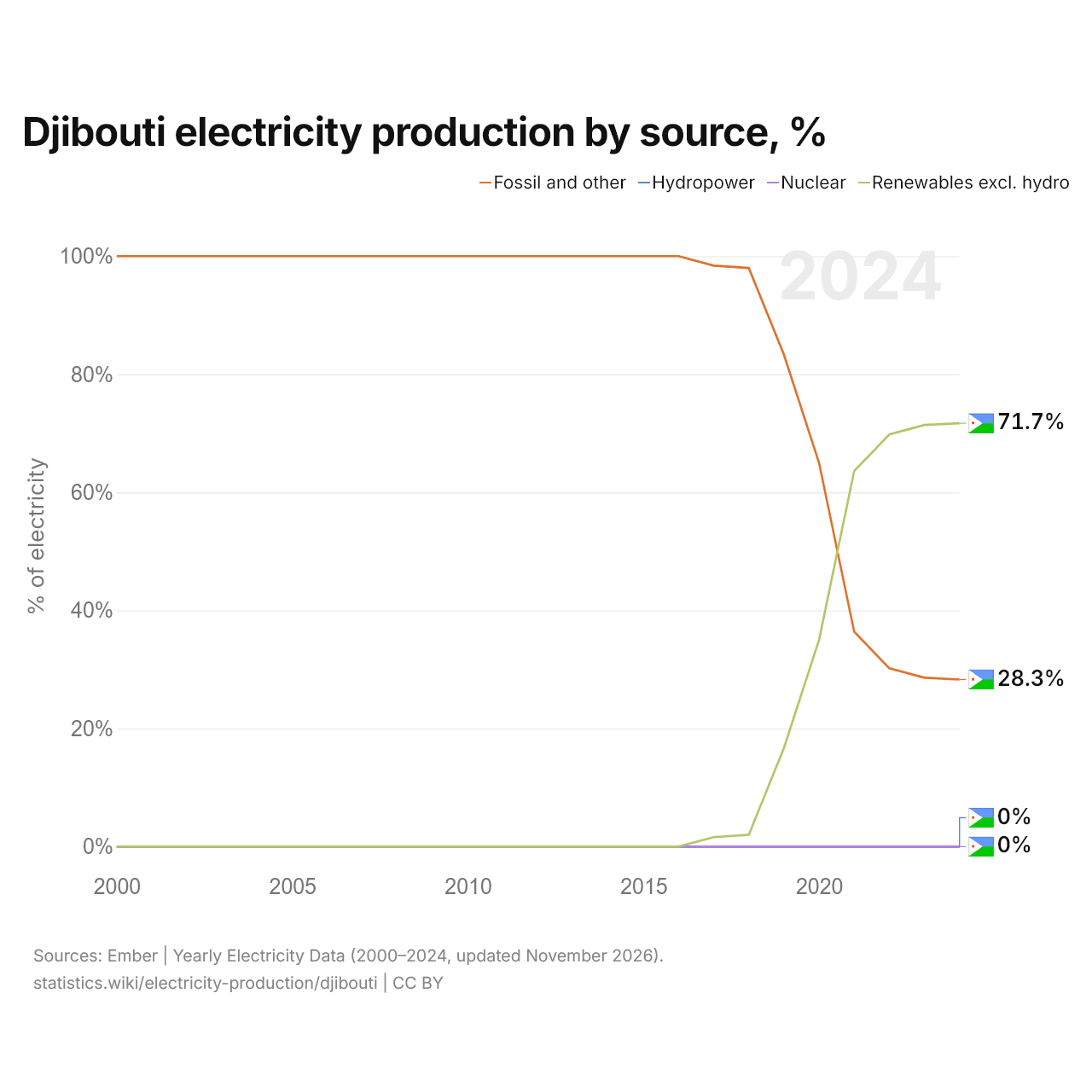
| Year | % of electricity | |||
|---|---|---|---|---|
| Fossil and other | Hydropower | Nuclear | Renewables excl. hydro | |
| 2024 | 28.3% | 0% | 0% | 71.7% |
| 2023 | 28.6% | 0% | 0% | 71.4% |
| 2022 | 30.2% | 0% | 0% | 69.8% |
| 2021 | 36.4% | 0% | 0% | 63.6% |
| 2020 | 65% | 0% | 0% | 35% |
| 2019 | 83.3% | 0% | 0% | 16.7% |
| 2018 | 98% | 0% | 0% | 2% |
| 2017 | 98.4% | 0% | 0% | 1.6% |
| 2016 | 100% | 0% | 0% | 0% |
| 2015 | 100% | 0% | 0% | 0% |
| 2014 | 100% | 0% | 0% | 0% |
| 2013 | 100% | 0% | 0% | 0% |
| 2012 | 100% | 0% | 0% | 0% |
| 2011 | 100% | 0% | 0% | 0% |
| 2010 | 100% | 0% | 0% | 0% |
| 2009 | 100% | 0% | 0% | 0% |
| 2008 | 100% | 0% | 0% | 0% |
| 2007 | 100% | 0% | 0% | 0% |
| 2006 | 100% | 0% | 0% | 0% |
| 2005 | 100% | 0% | 0% | 0% |
| 2004 | 100% | 0% | 0% | 0% |
| 2003 | 100% | 0% | 0% | 0% |
| 2002 | 100% | 0% | 0% | 0% |
| 2001 | 100% | 0% | 0% | 0% |
| 2000 | 100% | 0% | 0% | 0% |
Fossil fuels and other sources produce 28.3% of Djibouti's electricity, hydropower 0.0%, nuclear power 0.0% and the other renewables 71.7%. In 2000, Djibouti's shares were 100.0%, 0.0%, 0.0% and 0.0%.
Djibouti in the world electricity production ranking
| Rank | Country | TWh | kWh per person | |
|---|---|---|---|---|
| 167 |
 Belize |
0.49 | 1,168 | |
| 168 |
 Cape Verde |
0.49 | 924 | |
| 169 |
 Eritrea |
0.48 | 135 | vs Eritrea |
| 170 |
 Djibouti |
0.46 | 393 | |
| 171 |
 Chad |
0.44 | 21 | |
| 172 |
 Saint Lucia |
0.4 | 2,214 | |
| 173 |
 Antigua |
0.37 | 3,914 |
Compare the electricity production of Djibouti with other countries
Sources:
- Ember | Yearly Electricity Data (2000–2024, updated November 2026)
- World Bank | Health (2024, updated October 2026)
Creative Commons Attribution (CC BY): you may copy, share, adapt and reuse this content, also commercially, as long as you credit statistics.wiki and note any changes you made. The sources listed above may have their own license terms.