
Rwanda vs Israel energy consumption per capita by year
1x
| Year | Energy consumption, kWh per person | |
|---|---|---|
| Rwanda | Israel | |
| 2024 | 4,181 | 28,411 |
| 2023 | 4,209 | 28,599 |
| 2022 | 4,213 | 29,117 |
| 2021 | 4,173 | 28,287 |
| 2020 | 4,166 | 28,535 |
| 2019 | 4,237 | 28,005 |
| 2018 | 4,292 | 28,959 |
| 2017 | 4,322 | 28,860 |
| 2016 | 4,332 | 29,880 |
| 2015 | 4,385 | 30,329 |
| 2014 | 4,428 | 29,401 |
| 2013 | 4,473 | 30,966 |
| 2012 | 4,469 | 34,525 |
| 2011 | 4,425 | 34,673 |
| 2010 | 4,411 | 35,397 |
| 2009 | 4,424 | 33,435 |
| 2008 | 4,390 | 36,410 |
| 2007 | 4,398 | 33,719 |
| 2006 | 4,434 | 33,529 |
| 2005 | 4,443 | 30,959 |
| 2004 | 4,872 | 32,824 |
| 2003 | 4,968 | 34,301 |
| 2002 | 5,091 | 33,291 |
| 2001 | 5,080 | 34,576 |
| 2000 | 5,122 | 33,718 |
| 1999 | 6,580 | 31,838 |
| 1998 | 6,465 | 33,560 |
| 1997 | 12,600 | 33,508 |
| 1996 | 12,661 | 32,578 |
| 1995 | 14,444 | 32,521 |
| 1994 | 10,820 | 31,848 |
| 1993 | 8,664 | 30,641 |
| 1992 | 9,567 | 30,016 |
| 1991 | 10,597 | 27,035 |
| 1990 | 11,486 | 28,615 |
| 1989 | - | 28,946 |
| 1988 | - | 28,514 |
| 1987 | - | 26,499 |
| 1986 | - | 24,449 |
| 1985 | - | 20,806 |
| 1984 | - | 21,266 |
| 1983 | - | 20,863 |
| 1982 | - | 22,775 |
| 1981 | - | 21,408 |
| 1980 | - | 23,461 |
| 1979 | - | 23,328 |
| 1978 | - | 21,509 |
| 1977 | - | 20,777 |
| 1976 | - | 21,308 |
| 1975 | - | 23,641 |
| 1974 | - | 20,154 |
| 1973 | - | 27,545 |
| 1972 | - | 20,426 |
| 1971 | - | 21,749 |
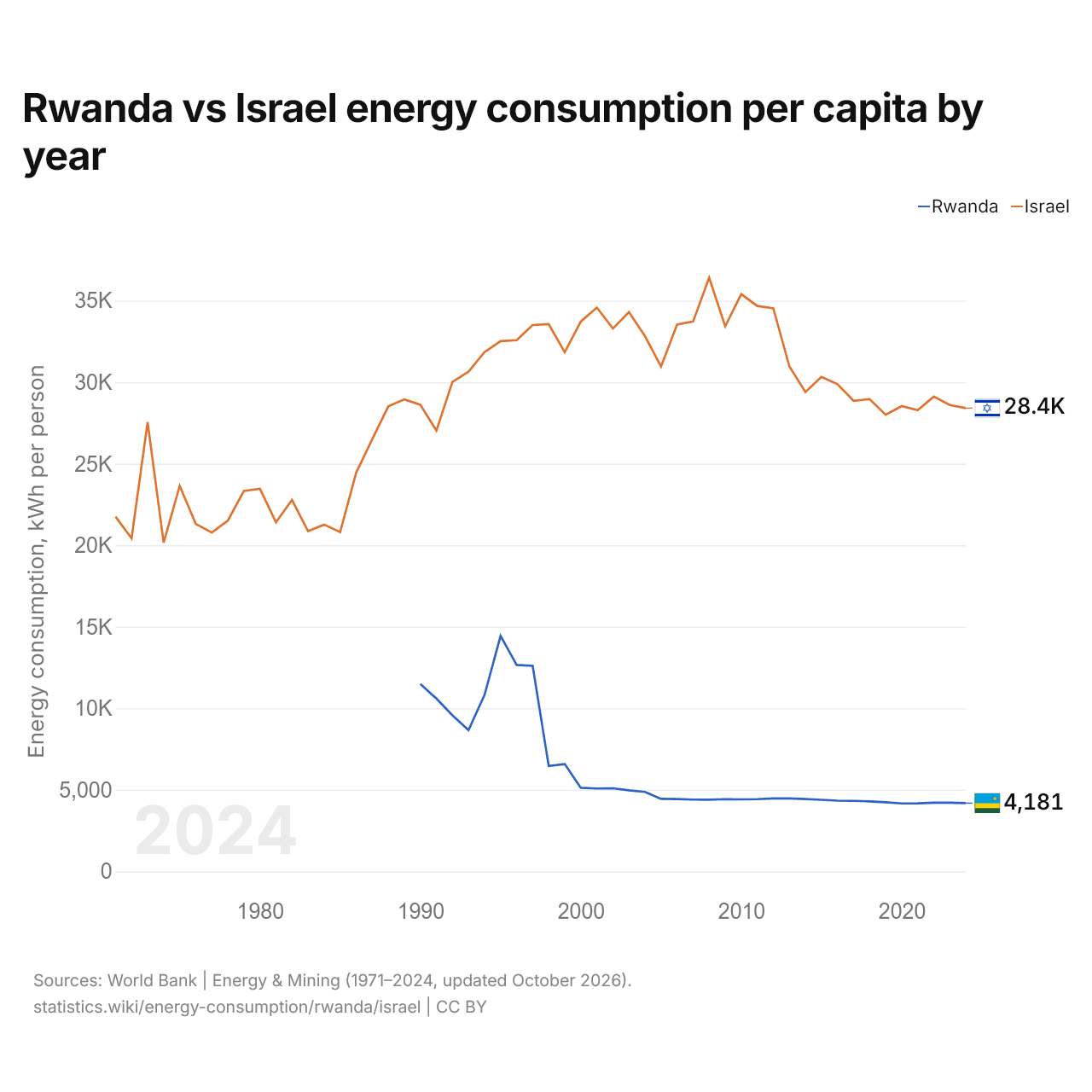
Energy consumption is 4,181 kWh per person in Rwanda and 28,411 kWh in Israel: 24,230 kWh more in Israel. In 1990, it was 11,486 kWh in Rwanda and 28,615 kWh in Israel, a difference of 17,129 kWh.
Israel's energy consumption per person has been higher than Rwanda's every year since 1990. The gap was widest in 2008, when Israel's energy consumption per person was 32,020 kWh above Rwanda's.
Rwanda vs Israel: total energy use, use per person and energy mix


Compare the energy consumption of any 2 countries
Sources:
- World Bank | Energy & Mining (1971–2024, updated October 2026)
Creative Commons Attribution (CC BY): you may copy, share, adapt and reuse this content, also commercially, as long as you credit statistics.wiki and note any changes you made. The sources listed above may have their own license terms.