
Turkey energy consumption by year
| Year | Energy consumption, TWh | World rank |
|---|---|---|
| Turkey | ||
| 2024 | 1,925 | #15 |
| 2023 | 1,835 | #15 |
| 2022 | 1,820 | #15 |
| 2021 | 1,854 | #15 |
| 2020 | 1,709 | #16 |
| 2019 | 1,704 | #17 |
| 2018 | 1,677 | #17 |
| 2017 | 1,707 | #17 |
| 2016 | 1,590 | #18 |
| 2015 | 1,498 | #18 |
| 2014 | 1,385 | #20 |
| 2013 | 1,338 | #22 |
| 2012 | 1,370 | #22 |
| 2011 | 1,309 | #22 |
| 2010 | 1,230 | #22 |
| 2009 | 1,143 | #22 |
| 2008 | 1,145 | #22 |
| 2007 | 1,167 | #22 |
| 2006 | 1,082 | #23 |
| 2005 | 977 | #23 |
| 2004 | 939 | #24 |
| 2003 | 915 | #24 |
| 2002 | 863 | #24 |
| 2001 | 817 | #24 |
| 2000 | 887 | #22 |
| 1999 | 811 | #24 |
| 1998 | 824 | #23 |
| 1997 | 811 | #24 |
| 1996 | 773 | #24 |
| 1995 | 708 | #24 |
| 1994 | 647 | #25 |
| 1993 | 655 | #24 |
| 1992 | 615 | #24 |
| 1991 | 588 | #25 |
| 1990 | 598 | #25 |
| 1989 | 571 | #23 |
| 1988 | 550 | #26 |
| 1987 | 546 | #25 |
| 1986 | 493 | #27 |
| 1985 | 457 | #27 |
| 1984 | 432 | #27 |
| 1983 | 415 | #28 |
| 1982 | 392 | #28 |
| 1981 | 369 | #28 |
| 1980 | 366 | #27 |
| 1979 | 352 | #26 |
| 1978 | 370 | #26 |
| 1977 | 371 | #25 |
| 1976 | 339 | #25 |
| 1975 | 311 | #24 |
| 1974 | 293.1 | #24 |
| 1973 | 283.2 | #24 |
| 1972 | 256.7 | #24 |
| 1971 | 227.3 | #24 |
| 1970 | 211.8 | - |
| 1969 | 202.6 | - |
| 1968 | 192.2 | - |
| 1967 | 182.8 | - |
| 1966 | 176.4 | - |
| 1965 | 160.6 | - |
| 1964 | 152.6 | - |
| 1963 | 144.8 | - |
| 1962 | 137.9 | - |
| 1961 | 126.2 | - |
| 1960 | 124.3 | - |
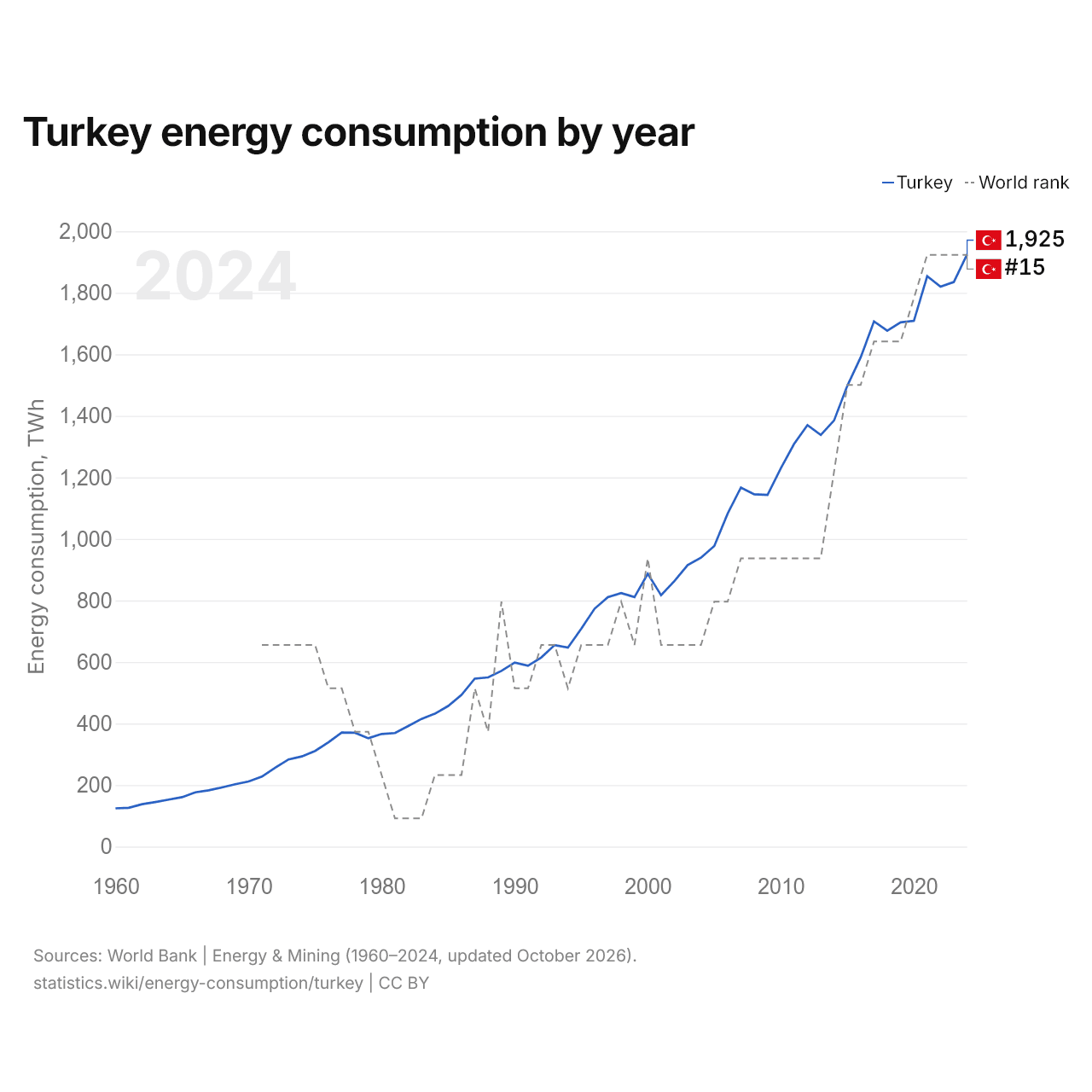
Energy consumption in Turkey is 1,925 TWh, up from 124 TWh in 1960. It is the 15th largest energy consumer in the world, a rank it has held since 2021.
Turkey's energy consumption is the 8th largest of 43 countries in Asia. Turkey's electricity consumption was 3,873 kWh per person in 2025, the 59th highest in the world. The renewable share of final energy consumption in Turkey is 12.0%, the 135th highest in the world.
Turkey energy consumption per capita by year
| Year | Energy consumption, kWh per person | World rank |
|---|---|---|
| Turkey | ||
| 2024 | 22,513 | #59 |
| 2023 | 21,510 | #62 |
| 2022 | 21,417 | #62 |
| 2021 | 22,035 | #62 |
| 2020 | 20,492 | #63 |
| 2019 | 20,634 | #64 |
| 2018 | 20,601 | #65 |
| 2017 | 21,260 | #66 |
| 2016 | 20,056 | #70 |
| 2015 | 19,153 | #69 |
| 2014 | 17,946 | #74 |
| 2013 | 17,571 | #76 |
| 2012 | 18,228 | #74 |
| 2011 | 17,630 | #77 |
| 2010 | 16,810 | #76 |
| 2009 | 15,864 | #78 |
| 2008 | 16,110 | #77 |
| 2007 | 16,630 | #77 |
| 2006 | 15,453 | #78 |
| 2005 | 14,089 | #80 |
| 2004 | 13,686 | #76 |
| 2003 | 13,491 | #69 |
| 2002 | 12,878 | #70 |
| 2001 | 12,334 | #74 |
| 2000 | 13,561 | #72 |
| 1999 | 12,559 | #75 |
| 1998 | 12,921 | #75 |
| 1997 | 12,907 | #76 |
| 1996 | 12,480 | #77 |
| 1995 | 11,606 | #79 |
| 1994 | 10,783 | #83 |
| 1993 | 11,108 | #78 |
| 1992 | 10,599 | #86 |
| 1991 | 10,318 | #88 |
| 1990 | 10,679 | #86 |
| 1989 | 10,387 | #61 |
| 1988 | 10,201 | #61 |
| 1987 | 10,338 | #59 |
| 1986 | 9,514 | #60 |
| 1985 | 9,022 | #60 |
| 1984 | 8,707 | #65 |
| 1983 | 8,565 | #65 |
| 1982 | 8,282 | #64 |
| 1981 | 7,961 | #65 |
| 1980 | 8,055 | #63 |
| 1979 | 7,904 | #63 |
| 1978 | 8,474 | #61 |
| 1977 | 8,682 | #60 |
| 1976 | 8,082 | #60 |
| 1975 | 7,580 | #63 |
| 1974 | 7,290 | #64 |
| 1973 | 7,202 | #64 |
| 1972 | 6,680 | #64 |
| 1971 | 6,058 | #68 |
| 1970 | 5,781 | - |
| 1969 | 5,661 | - |
| 1968 | 5,504 | - |
| 1967 | 5,368 | - |
| 1966 | 5,317 | - |
| 1965 | 4,966 | - |
| 1964 | 4,839 | - |
| 1963 | 4,712 | - |
| 1962 | 4,608 | - |
| 1961 | 4,333 | - |
| 1960 | 4,388 | - |
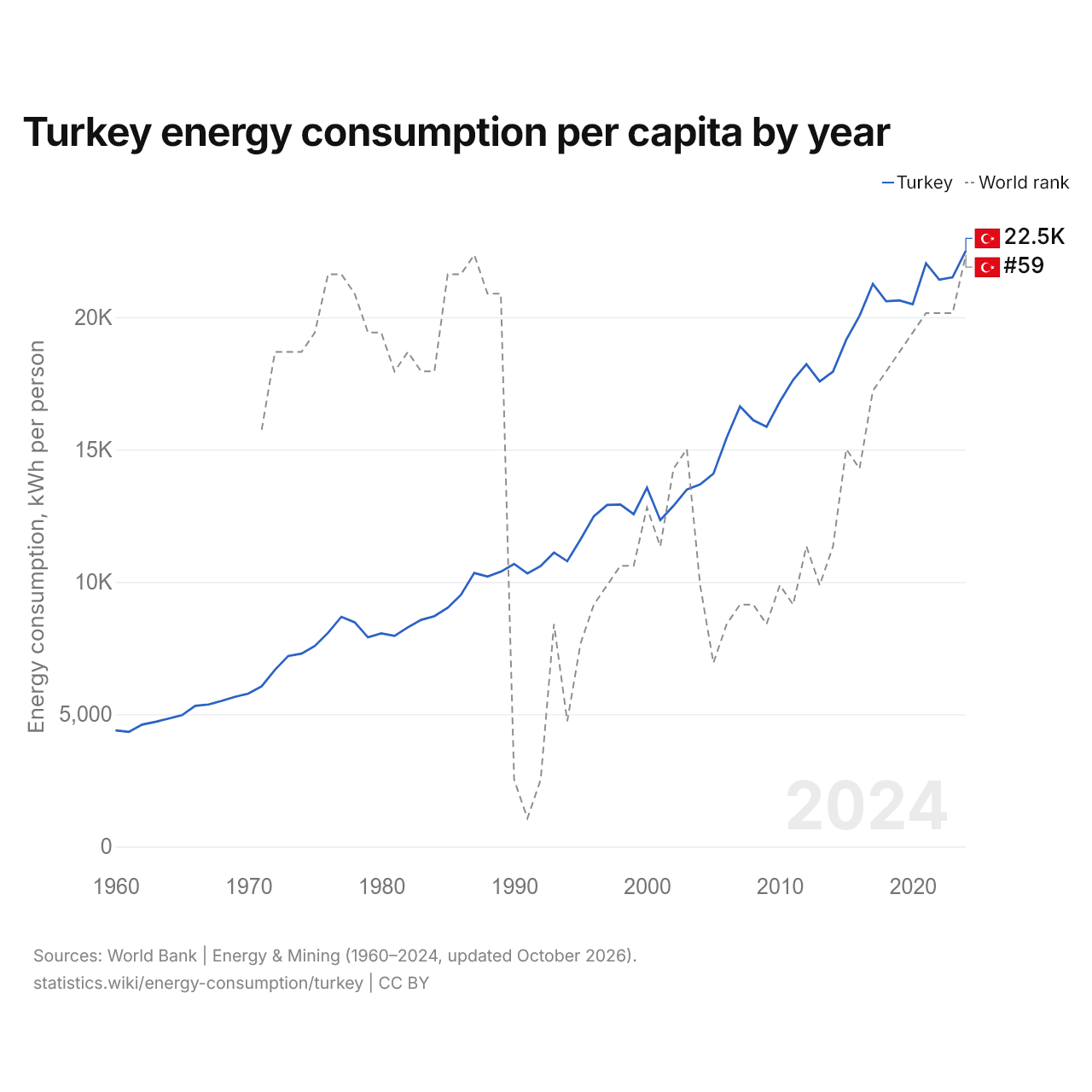
Energy consumption in Turkey is 22,513 kWh per person, up from 4,388 kWh in 1960. Its consumption per person was lowest in 1961, at 4,333 kWh. It is the 59th highest in the world, up from 62nd the year before.
Turkey energy use by source: fossil fuels vs alternative and nuclear, %
| Year | Share of energy use, % | |
|---|---|---|
| Fossil fuels | Alternative and nuclear | |
| 2024 | - | 15.8% |
| 2023 | 81.4% | 15.3% |
| 2022 | 81.8% | 14.8% |
| 2021 | 83.8% | 13.4% |
| 2020 | 82.6% | 14.9% |
| 2019 | 83.2% | 14.5% |
| 2018 | 85.9% | 11.9% |
| 2017 | 87.6% | 10.3% |
| 2016 | 86.8% | 10.6% |
| 2015 | 87.4% | 9.8% |
| 2014 | 89.4% | 7.3% |
| 2013 | 88.1% | 8.1% |
| 2012 | 89.4% | 7.2% |
| 2011 | 89.9% | 6.8% |
| 2010 | 89% | 6.8% |
| 2009 | 89.9% | 5.4% |
| 2008 | 90.5% | 4.6% |
| 2007 | 90.5% | 4.6% |
| 2006 | 89% | 5.6% |
| 2005 | 88% | 5.8% |
| 2004 | 86.7% | 6.5% |
| 2003 | 87.2% | 5.4% |
| 2002 | 86.1% | 5.5% |
| 2001 | 86.1% | 4.5% |
| 2000 | 86.4% | 4.8% |
| 1999 | 84.4% | 5.6% |
| 1998 | 83.4% | 6.4% |
| 1997 | 83.6% | 6% |
| 1996 | 83.1% | 6.3% |
| 1995 | 82.4% | 6.1% |
| 1994 | 81.4% | 5.8% |
| 1993 | 81.2% | 6.2% |
| 1992 | 81.1% | 5.3% |
| 1991 | 80.9% | 4.8% |
| 1990 | 81.4% | 4.8% |
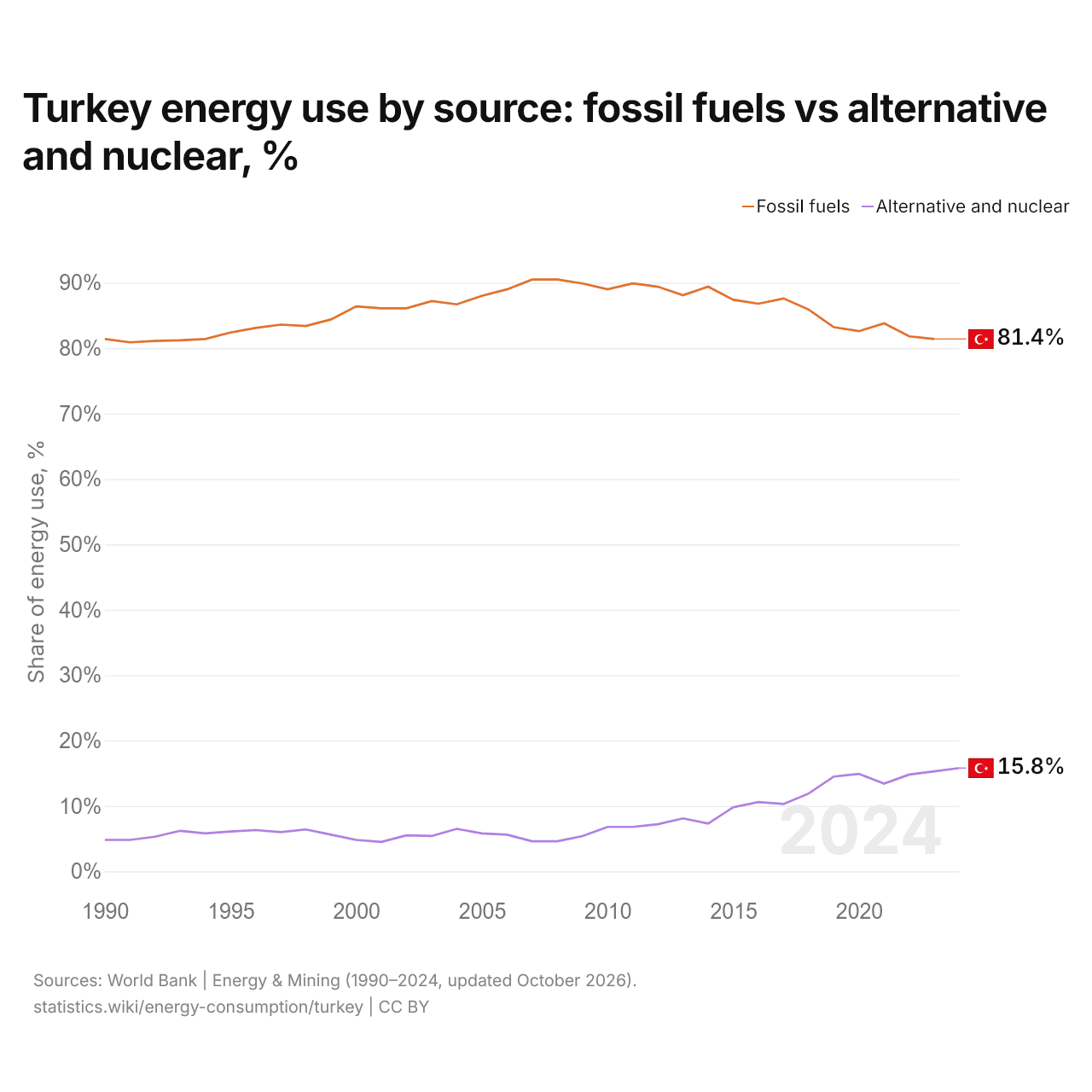
Fossil fuels made up 81.4% of Turkey's energy use and alternative and nuclear energy 15.3%. In 1990, Turkey's shares were 81.4% and 4.8%.
Turkey net energy imports (imports minus exports), % of energy use
| Year | % of energy use |
|---|---|
| Turkey | |
| 2024 | 70.1% |
| 2023 | 72% |
| 2022 | 72.7% |
| 2021 | 72.1% |
| 2020 | 71.3% |
| 2019 | 72.2% |
| 2018 | 75.8% |
| 2017 | 79.2% |
| 2016 | 77.3% |
| 2015 | 80.4% |
| 2014 | 78.7% |
| 2013 | 76.7% |
| 2012 | 76.5% |
| 2011 | 72.3% |
| 2010 | 71.8% |
| 2009 | 71.6% |
| 2008 | 73.7% |
| 2007 | 75.6% |
| 2006 | 74.2% |
| 2005 | 73.6% |
| 2004 | 72% |
| 2003 | 71.8% |
| 2002 | 68.8% |
| 2001 | 65.4% |
| 2000 | 66.4% |
| 1999 | 61.4% |
| 1998 | 60.6% |
| 1997 | 60.7% |
| 1996 | 60.9% |
| 1995 | 59.7% |
| 1994 | 56.2% |
| 1993 | 55.7% |
| 1992 | 50.8% |
| 1991 | 48.2% |
| 1990 | 54% |
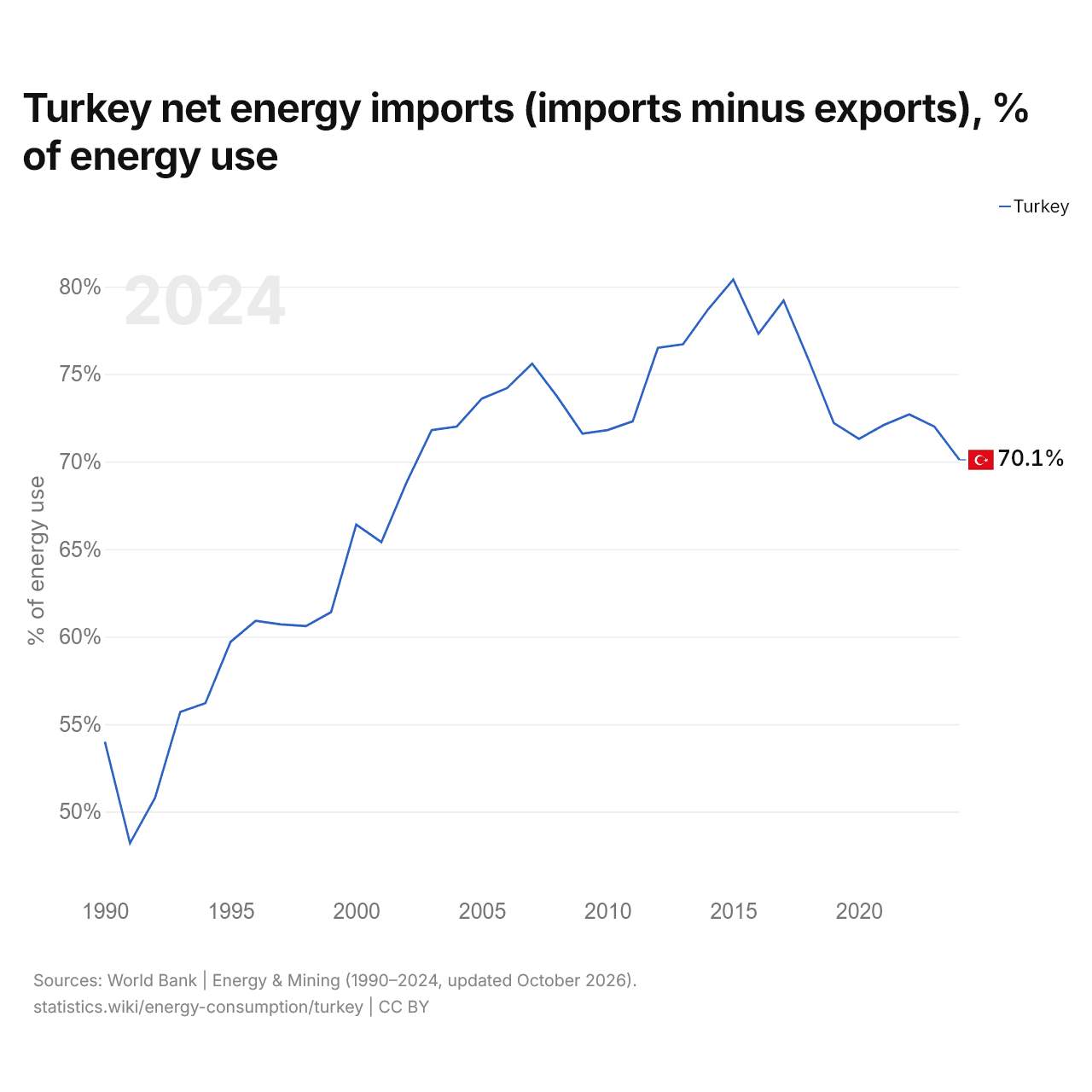
Turkey's net energy imports equal 70.1% of its energy use; in 1990, its net imports equaled 54.0%.
Turkey in the world energy consumption ranking
| Rank | Country | TWh | kWh per person | |
|---|---|---|---|---|
| 12 |
 Saudi Arabia |
2,741 | 77,640 | vs Saudi Arabia |
| 13 |
 France |
2,537 | 37,015 | vs France |
| 14 |
 Mexico |
2,280 | 17,422 | vs Mexico |
| 15 |
 Turkey |
1,925 | 22,513 | |
| 16 |
 United Kingdom |
1,688 | 24,370 | vs UK |
| 17 |
 Australia |
1,581 | 58,148 | vs Australia |
| 18 |
 Italy |
1,542 | 26,148 | vs Italy |
Compare the energy consumption of Turkey with other countries
Sources:
- World Bank | Energy & Mining (1960–2024, updated October 2026)
Creative Commons Attribution (CC BY): you may copy, share, adapt and reuse this content, also commercially, as long as you credit statistics.wiki and note any changes you made. The sources listed above may have their own license terms.