
Brazil vs Australia unemployment rate chart: % of the labor force, 1972–2025
1x
| Year | Unemployment rate | |
|---|---|---|
 Brazil |
 Australia |
|
| 2025 | 5.8% | 4.2% |
| 2024 | 6.8% | 3.9% |
| 2023 | 7.9% | 3.7% |
| 2022 | 9.2% | 3.7% |
| 2021 | 13.2% | 5% |
| 2020 | 13.7% | 6.4% |
| 2019 | 11.9% | 5.1% |
| 2018 | 12.3% | 5.3% |
| 2017 | 12.8% | 5.6% |
| 2016 | 11.6% | 5.7% |
| 2015 | 8.5% | 6.1% |
| 2014 | 6.8% | 6.1% |
| 2013 | 7.1% | 5.7% |
| 2012 | 7.3% | 5.2% |
| 2011 | 7.6% | 5.1% |
| 2010 | - | 5.2% |
| 2009 | 9.4% | 5.6% |
| 2008 | 8.3% | 4.2% |
| 2007 | 9.3% | 4.4% |
| 2006 | 9.7% | 4.8% |
| 2005 | 10.6% | 5% |
| 2004 | 10.1% | 5.4% |
| 2003 | 11.2% | 5.9% |
| 2002 | 10.6% | 6.4% |
| 2001 | 10.6% | 6.7% |
| 2000 | - | 6.3% |
| 1999 | 11.1% | 6.9% |
| 1998 | 10.2% | 7.7% |
| 1997 | 9% | 8.4% |
| 1996 | 8% | 8.5% |
| 1995 | 7.1% | 8.5% |
| 1994 | - | 9.7% |
| 1993 | 6% | 10.9% |
| 1992 | 7.1% | 10.7% |
| 1991 | - | 9.6% |
| 1990 | 4.7% | 6.9% |
| 1989 | 4.1% | 6.2% |
| 1988 | 3.8% | 7.2% |
| 1987 | 3.6% | 8.1% |
| 1986 | 2.4% | 8.1% |
| 1985 | 3.4% | 8.3% |
| 1984 | 4% | 9% |
| 1983 | 4.6% | 10% |
| 1982 | 3.9% | 7.2% |
| 1981 | 4% | 5.8% |
| 1980 | - | 6.1% |
| 1979 | 2.8% | 6.3% |
| 1978 | 2.4% | - |
| 1977 | 2.3% | - |
| 1976 | 1.9% | - |
| 1975 | - | - |
| 1974 | - | - |
| 1973 | 6.3% | - |
| 1972 | 3.1% | - |
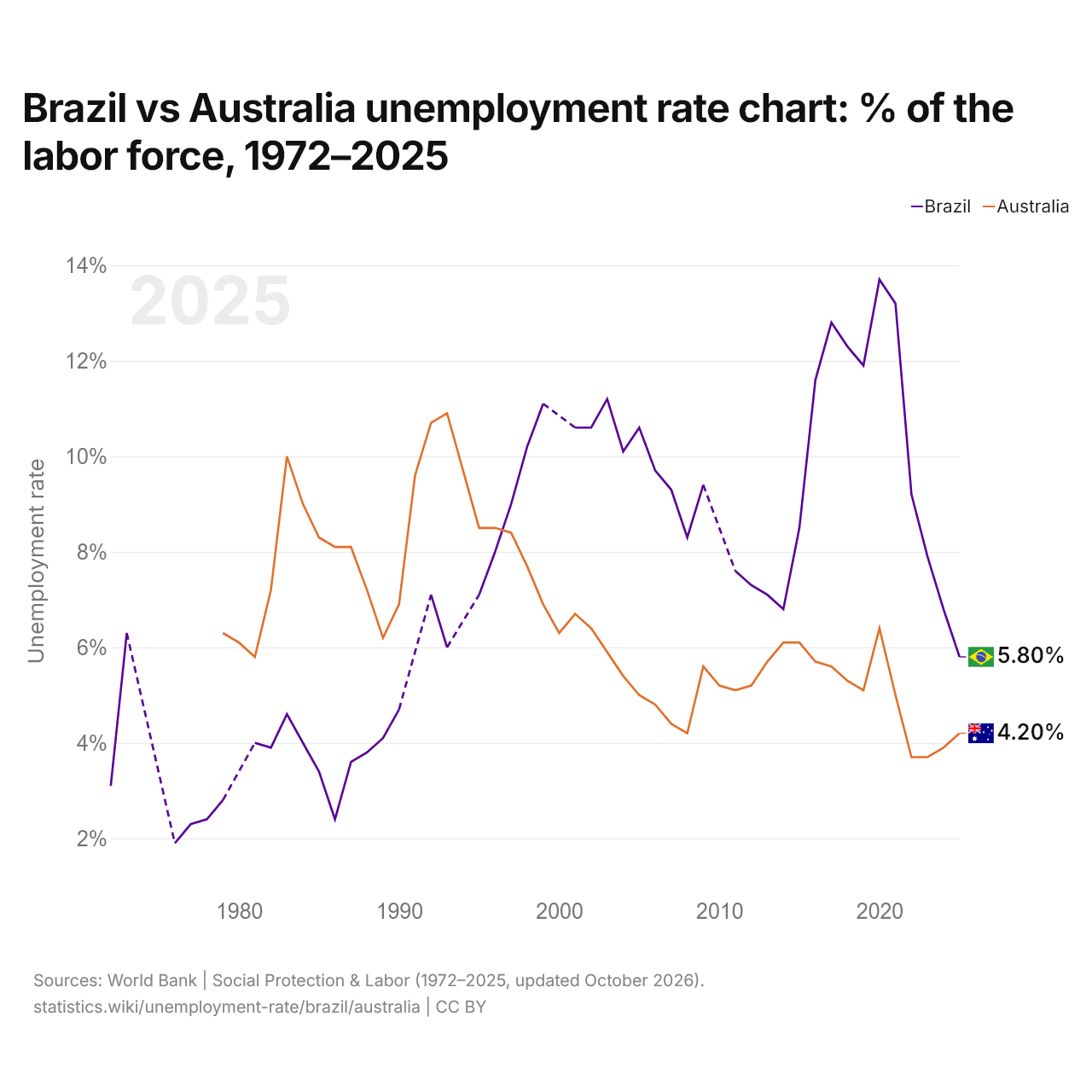
In 2025, the unemployment rate was 5.8% in Brazil and 4.2% in Australia: 1.6 percentage points higher in Brazil. In 2015, it was 8.5% in Brazil and 6.1% in Australia, 2.4 percentage points higher in Brazil.
Brazil's unemployment rate has been higher than Australia's in every year since 1997 that both countries reported. The gap was widest in 2021, when Brazil's unemployment rate was 8.2 percentage points above Australia's.
Brazil vs Australia: latest unemployment figures
Compare the unemployment rate of any 2 countries
Sources:
- World Bank | Social Protection & Labor (1972–2025, updated October 2026)
Creative Commons Attribution (CC BY): you may copy, share, adapt and reuse this content, also commercially, as long as you credit statistics.wiki and note any changes you made. The sources listed above may have their own license terms.