
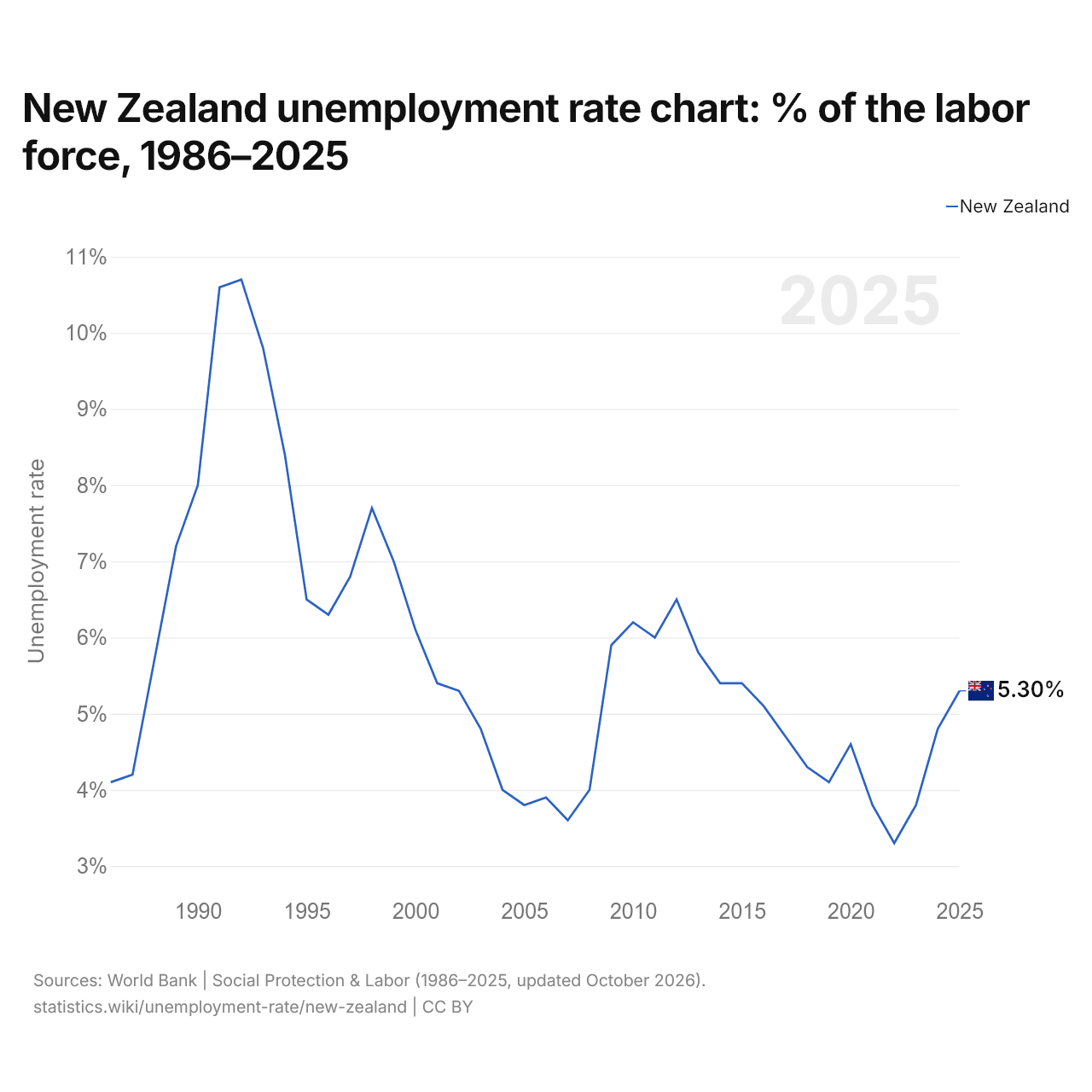
New Zealand unemployment rate chart: % of the labor force, 1986–2025
| Year | Unemployment rate |
|---|---|
 New Zealand |
|
| 2025 | 5.3% |
| 2024 | 4.8% |
| 2023 | 3.8% |
| 2022 | 3.3% |
| 2021 | 3.8% |
| 2020 | 4.6% |
| 2019 | 4.1% |
| 2018 | 4.3% |
| 2017 | 4.7% |
| 2016 | 5.1% |
| 2015 | 5.4% |
| 2014 | 5.4% |
| 2013 | 5.8% |
| 2012 | 6.5% |
| 2011 | 6% |
| 2010 | 6.2% |
| 2009 | 5.9% |
| 2008 | 4% |
| 2007 | 3.6% |
| 2006 | 3.9% |
| 2005 | 3.8% |
| 2004 | 4% |
| 2003 | 4.8% |
| 2002 | 5.3% |
| 2001 | 5.4% |
| 2000 | 6.1% |
| 1999 | 7% |
| 1998 | 7.7% |
| 1997 | 6.8% |
| 1996 | 6.3% |
| 1995 | 6.5% |
| 1994 | 8.4% |
| 1993 | 9.8% |
| 1992 | 10.7% |
| 1991 | 10.6% |
| 1990 | 8% |
| 1989 | 7.2% |
| 1988 | 5.7% |
| 1987 | 4.2% |
| 1986 | 4.1% |
In 2025, New Zealand's unemployment rate was 5.3%, up from 4.1% in 1986. It was highest in 1992, at 10.7%.
The largest ten-year rise in New Zealand's unemployment rate was from 2000 to 2010, by 0.1 percentage points; the largest ten-year fall was from 1990 to 2000, by 1.9 points. New Zealand's unemployment rate was above 10% in two of the years from 1986 to 2025, most recently in 1992.
New Zealand's unemployment rate in 2025 was the 4th highest of the 13 countries of Oceania, where it ranged from the Solomon Islands' 0.7% (2013) to the Marshall Islands' 9.8% (2021). New Zealand's labor force numbered 3.08 million in 2025, the 108th largest in the world.
New Zealand in the world unemployment rate ranking, 2025
| Rank | Country | Unemployment rate | Unemployed people | Change in 5 years, points | |
|---|---|---|---|---|---|
| 96 |
 Fiji |
5.4% (2024) | 20.8K | n/a | vs Fiji |
| 97 |
 Brunei |
5.4% | 12.7K | −2.1 | |
| 98 |
 Uzbekistan |
5.3% (2020) | 693K | +0.1 | |
| 99 |
New Zealand |
5.3% | 162K | +0.7 | |
| 100 |
 Nicaragua |
5.2% (2018) | 149K | −0.1 | |
| 101 |
 Dominican Republic |
5.2% | 285K | −1.0 | |
| 102 |
 Saint Kitts |
5.1% (2001) | n/a | n/a |
Compare New Zealand unemployment rate with other countries
Sources:
- World Bank | Social Protection & Labor (1986–2025, updated October 2026)
Creative Commons Attribution (CC BY): you may copy, share, adapt and reuse this content, also commercially, as long as you credit statistics.wiki and note any changes you made. The sources listed above may have their own license terms.