
Algeria unemployment rate chart: % of the labor force
| Year | Unemployment rate |
|---|---|
 Algeria |
|
| 2017 | 11.7% |
| 2016 | 10.2% |
| 2015 | 11.2% |
| 2014 | 10.6% |
| 2013 | 9.8% |
| 2012 | 11% |
| 2011 | 10% |
| 2010 | 10% |
| 2009 | 10.2% |
| 2008 | 11.3% |
| 2007 | 13.8% |
| 2006 | 12.3% |
| 2005 | 15.3% |
| 2004 | 17.7% |
| 2003 | 23.7% |
| 2002 | 25.9% |
| 2001 | 27.3% |
| 2000 | 29.8% |
| 1999 | - |
| 1998 | - |
| 1997 | 25.4% |
| 1996 | - |
| 1995 | 31.8% |
| 1994 | 24.4% |
| 1993 | 23.2% |
| 1992 | 23% |
| 1991 | 20.6% |
| 1990 | 21.3% |
| 1989 | 16.9% |
| 1988 | - |
| 1987 | - |
| 1986 | - |
| 1985 | - |
| 1984 | 12.4% |
| 1983 | - |
| 1982 | - |
| 1981 | - |
| 1980 | 15.3% |
| 1979 | - |
| 1978 | - |
| 1977 | - |
| 1976 | - |
| 1975 | 38.4% |
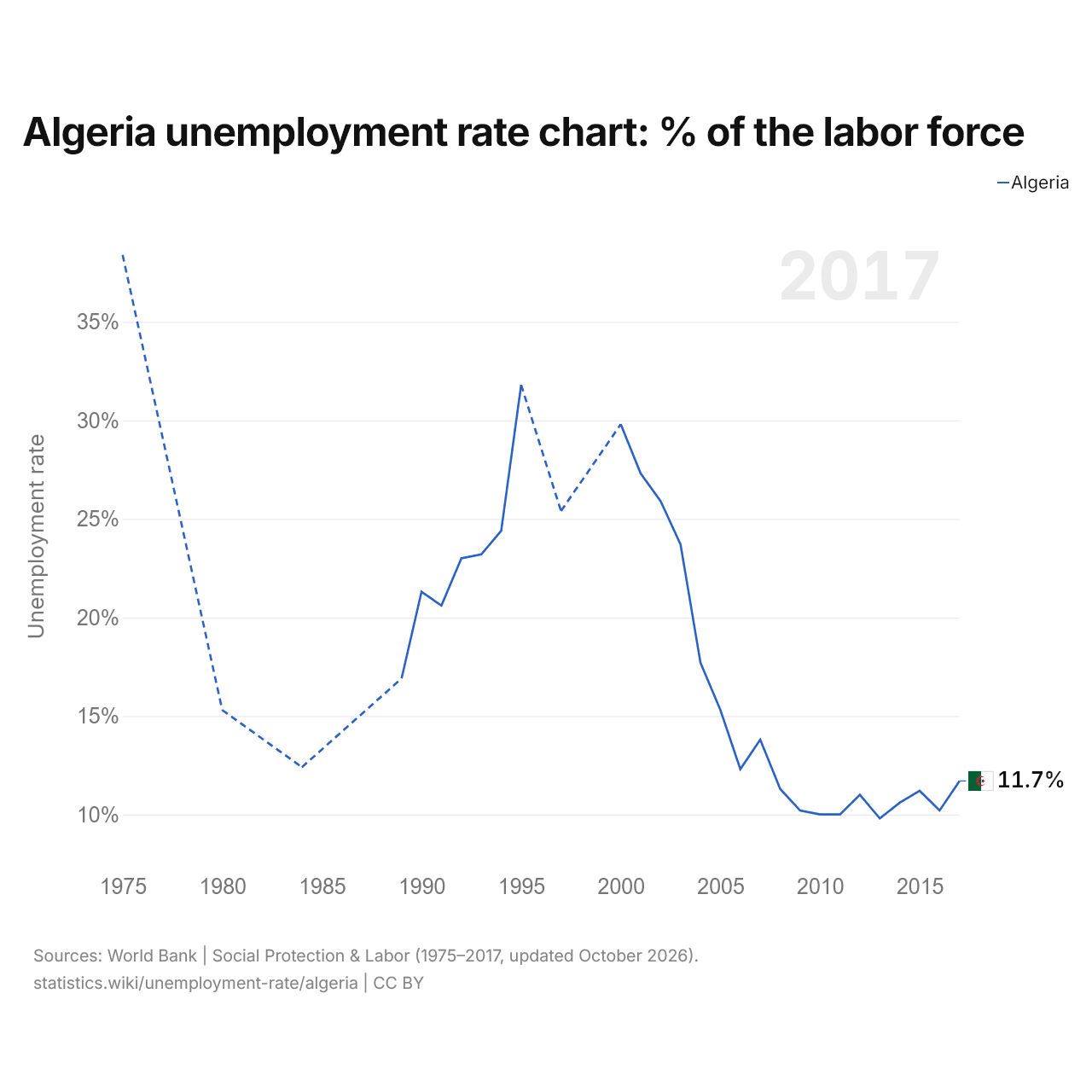
The unemployment rate in Algeria is 11.7% (2017), down from 38.4% in 1975. It was lowest in 2013, at 9.8%.
The largest ten-year fall in Algeria's unemployment rate was from 2000 to 2010, by 19.8 percentage points; the largest ten-year rise was from 1990 to 2000, by 8.5 points. Algeria's unemployment rate has been above 10% in 26 of the years since 1975, and every year since 2014.
Algeria's unemployment rate is the 13th highest of the 54 countries of Africa, where it ranges from Niger's 0.4% (2022) to Djibouti's 38.8%. Algeria's labor force numbered 13.6 million in 2025, the 45th largest in the world.
Algeria in the world unemployment rate ranking
| Rank | Country | Unemployment rate | Unemployed people | Change in 5 years, points | |
|---|---|---|---|---|---|
| 20 |
 Yemen |
13.5% (2014) | 872K | −1.2 | |
| 21 |
 South Sudan |
12.3% (2008) | 451K | n/a | |
| 22 |
 Morocco |
11.8% (2022) | 1.43M | n/a | vs Morocco |
| 23 |
Algeria |
11.7% | 1.45M | +0.7 | |
| 24 |
 Montenegro |
11.5% (2024) | 34.3K | −3.6 | |
| 25 |
 North Macedonia |
11.5% (2025) | 91K | −5.0 | |
| 26 |
 Lebanon |
11.3% (2019) | 231K | n/a |
Compare Algeria unemployment rate with other countries
Sources:
- World Bank | Social Protection & Labor (1975–2025, updated October 2026)
Creative Commons Attribution (CC BY): you may copy, share, adapt and reuse this content, also commercially, as long as you credit statistics.wiki and note any changes you made. The sources listed above may have their own license terms.