
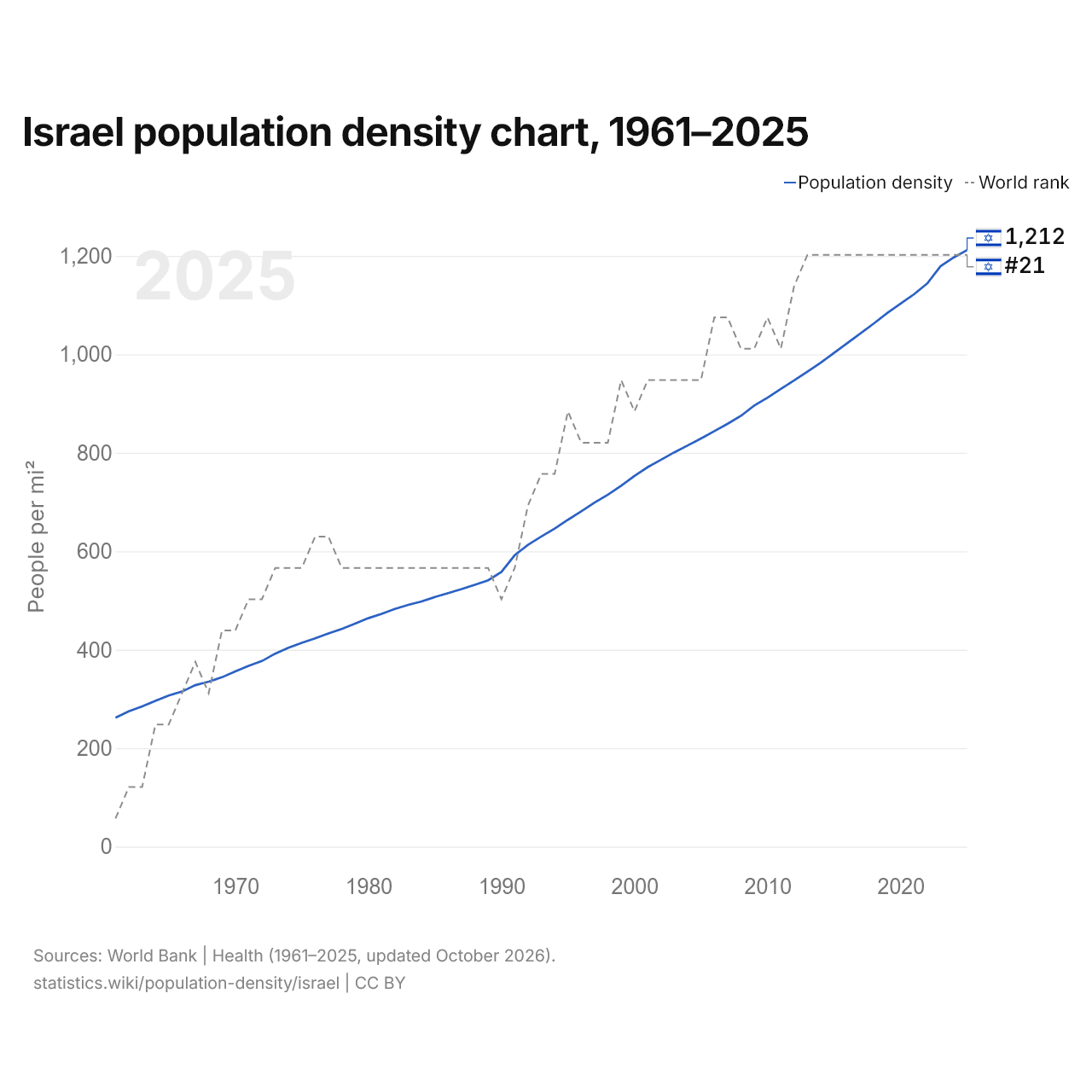
Israel population density chart, 1961–2025
| Year | People per mi² | World rank |
|---|---|---|
| 2025 | 1,212 | #21 |
| 2024 | 1,197 | #21 |
| 2023 | 1,179 | #21 |
| 2022 | 1,144 | #21 |
| 2021 | 1,122 | #21 |
| 2020 | 1,103 | #21 |
| 2019 | 1,084 | #21 |
| 2018 | 1,063 | #21 |
| 2017 | 1,043 | #21 |
| 2016 | 1,023 | #21 |
| 2015 | 1,003 | #21 |
| 2014 | 983 | #21 |
| 2013 | 965 | #21 |
| 2012 | 947 | #22 |
| 2011 | 930 | #24 |
| 2010 | 912 | #23 |
| 2009 | 896 | #24 |
| 2008 | 875 | #24 |
| 2007 | 859 | #23 |
| 2006 | 844 | #23 |
| 2005 | 829 | #25 |
| 2004 | 815 | #25 |
| 2003 | 801 | #25 |
| 2002 | 786 | #25 |
| 2001 | 771 | #25 |
| 2000 | 753 | #26 |
| 1999 | 733 | #25 |
| 1998 | 715 | #27 |
| 1997 | 699 | #27 |
| 1996 | 681 | #27 |
| 1995 | 664 | #26 |
| 1994 | 646 | #28 |
| 1993 | 630 | #28 |
| 1992 | 613 | #29 |
| 1991 | 592 | #31 |
| 1990 | 558 | #32 |
| 1989 | 541 | #31 |
| 1988 | 532 | #31 |
| 1987 | 523 | #31 |
| 1986 | 515 | #31 |
| 1985 | 507 | #31 |
| 1984 | 498 | #31 |
| 1983 | 491 | #31 |
| 1982 | 483 | #31 |
| 1981 | 473 | #31 |
| 1980 | 464 | #31 |
| 1979 | 453 | #31 |
| 1978 | 442 | #31 |
| 1977 | 433 | #30 |
| 1976 | 423 | #30 |
| 1975 | 414 | #31 |
| 1974 | 404 | #31 |
| 1973 | 392 | #31 |
| 1972 | 377 | #32 |
| 1971 | 367 | #32 |
| 1970 | 356 | #33 |
| 1969 | 344 | #33 |
| 1968 | 335 | #35 |
| 1967 | 328 | #34 |
| 1966 | 315 | #35 |
| 1965 | 307 | #36 |
| 1964 | 296 | #36 |
| 1963 | 285 | #38 |
| 1962 | 275 | #38 |
| 1961 | 262 | #39 |
In 2025, Israel's population density was 1,212 per mi² (468 per km²), up from 262 per mi² (101 per km²) in 1961. It was the 21st most densely populated country in the world, a rank it has held since 2013.
In 2025, Israel's population density was the 10th highest of the 48 countries of Asia, where it ranged from Mongolia's 5.96 per mi² (2.3 per km²) to Singapore's 21,837 per mi² (8,432 per km²). Israel's was 7.4 times the world's population density of 164 per mi² (63.4 per km²).
Israel in the world population density ranking, 2025
| Rank | Country | Population density | Population | Land area | |
|---|---|---|---|---|---|
| 18 |
 South Korea |
1,372 per mi² (530 per km²) | 51,684,564 | 37,684 mi² (97,600 km²) | vs S. Korea |
| 19 |
 India |
1,275 per mi² (492 per km²) | 1,463,865,525 | 1,147,955 mi² (2,973,190 km²) | vs India |
| 20 |
 Comoros |
1,223 per mi² (472 per km²) | 882,847 | 722 mi² (1,870 km²) | |
| 21 |
 Israel |
1,212 per mi² (468 per km²) | 10,122,800 | 8,355 mi² (21,640 km²) | |
| 22 |
 Haiti |
1,119 per mi² (432 per km²) | 11,906,095 | 10,641 mi² (27,560 km²) | vs Haiti |
| 23 |
 Philippines |
1,014 per mi² (392 per km²) | 116,786,962 | 115,124 mi² (298,170 km²) | vs Philippines |
| 24 |
 Belgium |
1,014 per mi² (392 per km²) | 11,941,781 | 11,774 mi² (30,494 km²) | vs Belgium |
Compare the population density of Israel with other countries
Sources:
- World Bank | Health (1961–2025, updated October 2026)
- U.S. Census Bureau (2025, updated October 2026)
Creative Commons Attribution (CC BY): you may copy, share, adapt and reuse this content, also commercially, as long as you credit statistics.wiki and note any changes you made. The sources listed above may have their own license terms.