
Algeria population density chart, 1961–2025
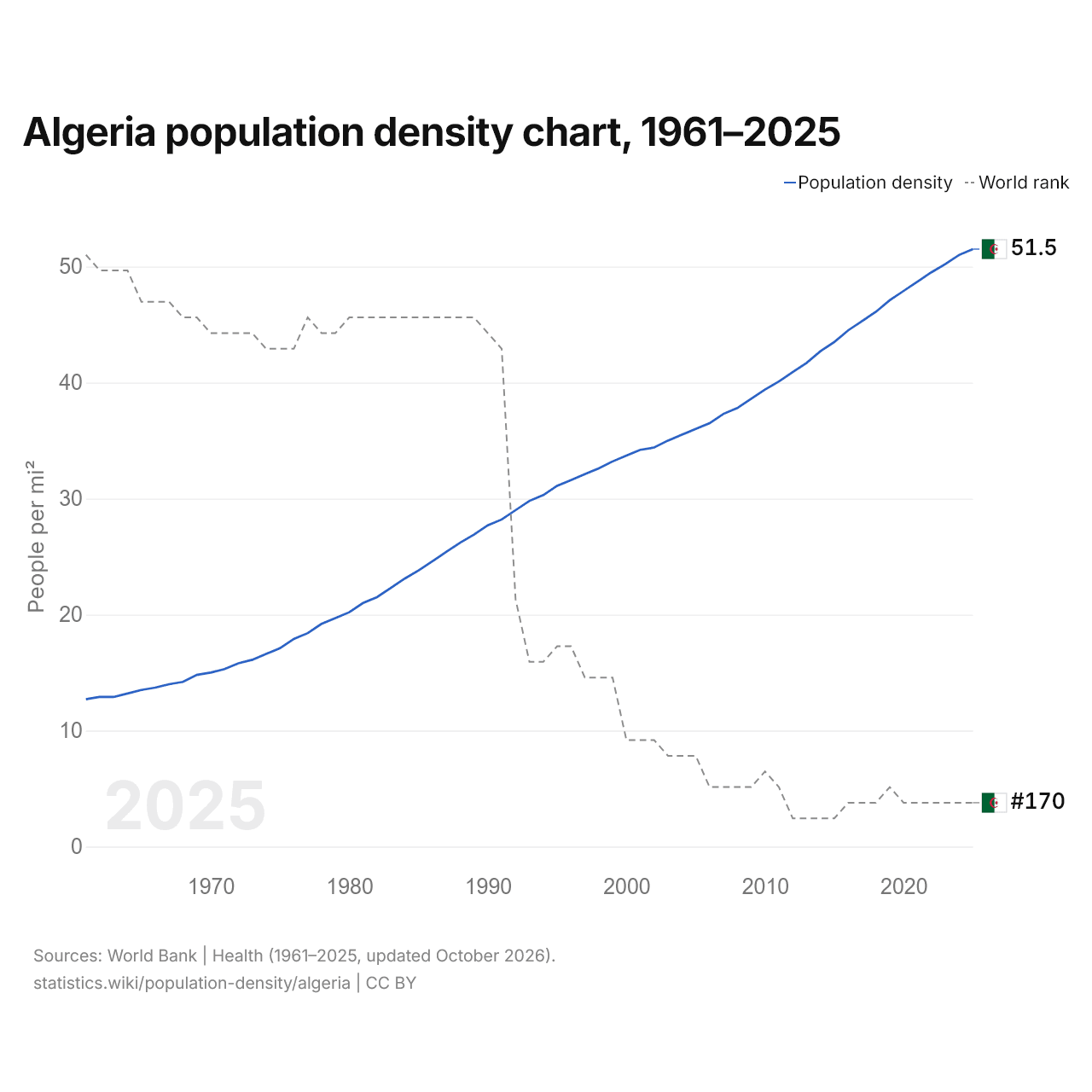
| Year | People per mi² | World rank |
|---|---|---|
| 2025 | 51.5 | #170 |
| 2024 | 51 | #170 |
| 2023 | 50.2 | #170 |
| 2022 | 49.5 | #170 |
| 2021 | 48.7 | #170 |
| 2020 | 47.9 | #170 |
| 2019 | 47.1 | #169 |
| 2018 | 46.1 | #170 |
| 2017 | 45.3 | #170 |
| 2016 | 44.5 | #170 |
| 2015 | 43.5 | #171 |
| 2014 | 42.7 | #171 |
| 2013 | 41.7 | #171 |
| 2012 | 40.9 | #171 |
| 2011 | 40.1 | #169 |
| 2010 | 39.4 | #168 |
| 2009 | 38.6 | #169 |
| 2008 | 37.8 | #169 |
| 2007 | 37.3 | #169 |
| 2006 | 36.5 | #169 |
| 2005 | 36 | #167 |
| 2004 | 35.5 | #167 |
| 2003 | 35 | #167 |
| 2002 | 34.4 | #166 |
| 2001 | 34.2 | #166 |
| 2000 | 33.7 | #166 |
| 1999 | 33.2 | #162 |
| 1998 | 32.6 | #162 |
| 1997 | 32.1 | #162 |
| 1996 | 31.6 | #160 |
| 1995 | 31.1 | #160 |
| 1994 | 30.3 | #161 |
| 1993 | 29.8 | #161 |
| 1992 | 29 | #157 |
| 1991 | 28.2 | #141 |
| 1990 | 27.7 | #140 |
| 1989 | 26.9 | #139 |
| 1988 | 26.2 | #139 |
| 1987 | 25.4 | #139 |
| 1986 | 24.6 | #139 |
| 1985 | 23.8 | #139 |
| 1984 | 23.1 | #139 |
| 1983 | 22.3 | #139 |
| 1982 | 21.5 | #139 |
| 1981 | 21 | #139 |
| 1980 | 20.2 | #139 |
| 1979 | 19.7 | #140 |
| 1978 | 19.2 | #140 |
| 1977 | 18.4 | #139 |
| 1976 | 17.9 | #141 |
| 1975 | 17.1 | #141 |
| 1974 | 16.6 | #141 |
| 1973 | 16.1 | #140 |
| 1972 | 15.8 | #140 |
| 1971 | 15.3 | #140 |
| 1970 | 15 | #140 |
| 1969 | 14.8 | #139 |
| 1968 | 14.2 | #139 |
| 1967 | 14 | #138 |
| 1966 | 13.7 | #138 |
| 1965 | 13.5 | #138 |
| 1964 | 13.2 | #136 |
| 1963 | 12.9 | #136 |
| 1962 | 12.9 | #136 |
| 1961 | 12.7 | #135 |
In 2025, Algeria's population density was 51.5 per mi² (19.9 per km²), up from 12.7 per mi² (4.9 per km²) in 1961. It was the 170th most densely populated country in the world, a rank it has held since 2020. Its highest rank was 135th, last held in 1961.
In 2025, Algeria's population density was the 45th highest of the 54 countries of Africa, where it ranged from Namibia's 9.84 per mi² (3.8 per km²) to Mauritius' 1,611 per mi² (622 per km²). Algeria's was 31% of the world's population density of 164 per mi² (63.4 per km²).
Algeria in the world population density ranking, 2025
| Rank | Country | Population density | Population | Land area | |
|---|---|---|---|---|---|
| 167 |
 Bhutan |
54.1 per mi² (20.9 per km²) | 796,682 | 14,726 mi² (38,140 km²) | |
| 168 |
 Mali |
53.5 per mi² (20.7 per km²) | 25,198,821 | 471,118 mi² (1,220,190 km²) | |
| 169 |
 New Zealand |
52.4 per mi² (20.2 per km²) | 5,324,700 | 101,665 mi² (263,310 km²) | |
| 170 |
 Algeria |
51.6 per mi² (19.9 per km²) | 47,435,312 | 919,595 mi² (2,381,740 km²) | |
| 171 |
 Uruguay |
50.1 per mi² (19.3 per km²) | 3,384,688 | 67,574 mi² (175,016 km²) | |
| 172 |
 South Sudan |
50 per mi² (19.3 per km²) | 12,188,788 | 243,990 mi² (631,930 km²) | |
| 173 |
 Congo |
49.2 per mi² (19 per km²) | 6,484,437 | 131,854 mi² (341,500 km²) |
Compare the population density of Algeria with other countries
Sources:
- World Bank | Health (1961–2025, updated October 2026)
- U.S. Census Bureau (2025, updated October 2026)
Creative Commons Attribution (CC BY): you may copy, share, adapt and reuse this content, also commercially, as long as you credit statistics.wiki and note any changes you made. The sources listed above may have their own license terms.