
Australia vs Angola: net migration per 1,000 people
1x
| Year | Net migration per 1,000 people | |
|---|---|---|
 Australia |
 Angola |
|
| 2023 | 5.3 | 0 |
| 2022 | 5.4 | 0 |
| 2021 | 4.5 | 0.8 |
| 2020 | 1.7 | 0.2 |
| 2019 | 8.2 | 1.8 |
| 2018 | 9.1 | 2 |
| 2017 | 10.4 | 2.6 |
| 2016 | 10.5 | 3.1 |
| 2015 | 8.9 | 2.6 |
| 2014 | 8.5 | 3.1 |
| 2013 | 9.3 | 4.8 |
| 2012 | 10.4 | 5.2 |
| 2011 | 8.8 | 5.3 |
| 2010 | 7.6 | 5.3 |
| 2009 | 10.9 | 4.7 |
| 2008 | 13 | 4.7 |
| 2007 | 12 | 4.8 |
| 2006 | 9.4 | 4.8 |
| 2005 | 6.5 | 4.5 |
| 2004 | 5.5 | 4.9 |
| 2003 | 5.3 | 4.5 |
| 2002 | 5.6 | 4.7 |
| 2001 | 6.1 | 4.6 |
| 2000 | 5.8 | 4.5 |
| 1999 | 4.9 | 4.5 |
| 1998 | 4.4 | 4.7 |
| 1997 | 3.7 | 4.6 |
| 1996 | 4.6 | 4.4 |
| 1995 | 4.5 | 4.1 |
| 1994 | 2.9 | 4.6 |
| 1993 | 1.4 | 4.1 |
| 1992 | 2.3 | 4.3 |
| 1991 | 4 | 3.8 |
| 1990 | 5.9 | 5.6 |
| 1989 | 8.6 | 5.7 |
| 1988 | 9.3 | 6 |
| 1987 | 8.4 | 6 |
| 1986 | 7.1 | 6.4 |
| 1985 | 6.2 | 7.6 |
| 1984 | 5.1 | 8.3 |
| 1983 | 4.8 | 9.1 |
| 1982 | 7.4 | 8.7 |
| 1981 | 8.2 | 8.4 |
| 1980 | 6.1 | 8.9 |
| 1979 | 3.6 | 8.2 |
| 1978 | 3.2 | 8.1 |
| 1977 | 3.2 | 8.4 |
| 1976 | 2.3 | 6.8 |
| 1975 | 1.8 | 7.7 |
| 1974 | 4.1 | 8 |
| 1973 | 4.7 | 8.6 |
| 1972 | 4.2 | 7.7 |
| 1971 | 17.3 | 0.7 |
| 1970 | 20.5 | −6.2 |
| 1969 | 8.9 | −15.7 |
| 1968 | 8.4 | −15.4 |
| 1967 | 6.9 | −15.1 |
| 1966 | 9.5 | −14.8 |
| 1965 | 10.4 | −14.7 |
| 1964 | 8.2 | −14.6 |
| 1963 | 6.7 | −14.6 |
| 1962 | 5.4 | −14.4 |
| 1961 | 6.2 | −14.1 |
| 1960 | 8.3 | −7.8 |
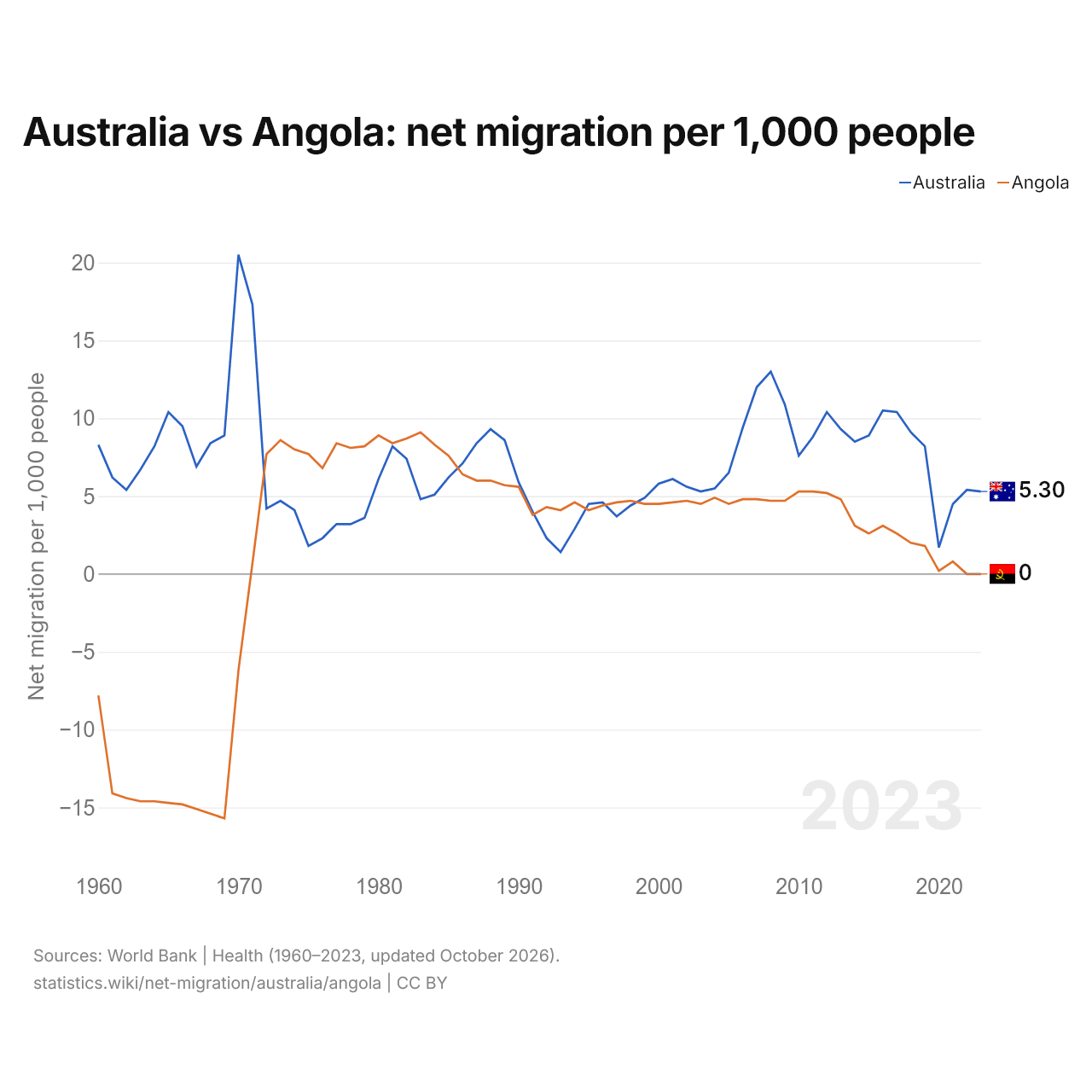
Net migration per 1,000 people is a gain of 5.3 in Australia and about zero in Angola, a gap of 5.3 per 1,000. In 1960, it was a gain of 8.3 in Australia and a loss of 7.8 in Angola, a gap of 16.1.
Australia vs Angola: net migration (people)
1x
| Year | People | |
|---|---|---|
|
Australia
|
Angola
|
|
| 2023 | 140,232 | −995 |
| 2022 | 140,972 | −995 |
| 2021 | 116,768 | 29,094 |
| 2020 | 44,447 | 7,556 |
| 2019 | 207,142 | 58,984 |
| 2018 | 226,412 | 61,632 |
| 2017 | 255,023 | 77,731 |
| 2016 | 254,648 | 91,614 |
| 2015 | 212,350 | 74,171 |
| 2014 | 200,177 | 84,535 |
| 2013 | 215,823 | 124,478 |
| 2012 | 235,776 | 130,643 |
| 2011 | 197,657 | 128,800 |
| 2010 | 166,752 | 122,418 |
| 2009 | 235,628 | 105,077 |
| 2008 | 275,773 | 100,370 |
| 2007 | 249,873 | 100,563 |
| 2006 | 191,985 | 95,431 |
| 2005 | 131,371 | 87,050 |
| 2004 | 110,072 | 90,553 |
| 2003 | 104,437 | 80,828 |
| 2002 | 108,852 | 82,292 |
| 2001 | 117,552 | 77,458 |
| 2000 | 111,186 | 72,793 |
| 1999 | 92,900 | 70,301 |
| 1998 | 81,310 | 70,527 |
| 1997 | 67,661 | 67,944 |
| 1996 | 82,965 | 61,681 |
| 1995 | 80,456 | 55,568 |
| 1994 | 51,941 | 61,569 |
| 1993 | 23,833 | 52,879 |
| 1992 | 40,767 | 53,310 |
| 1991 | 68,847 | 46,143 |
| 1990 | 100,093 | 64,821 |
| 1989 | 144,042 | 63,586 |
| 1988 | 153,330 | 65,028 |
| 1987 | 136,421 | 62,820 |
| 1986 | 113,061 | 64,974 |
| 1985 | 98,327 | 74,738 |
| 1984 | 79,617 | 78,529 |
| 1983 | 73,251 | 82,958 |
| 1982 | 111,722 | 75,921 |
| 1981 | 121,921 | 70,910 |
| 1980 | 89,189 | 72,192 |
| 1979 | 52,137 | 64,158 |
| 1978 | 45,832 | 61,200 |
| 1977 | 44,946 | 61,110 |
| 1976 | 32,792 | 47,927 |
| 1975 | 25,336 | 52,662 |
| 1974 | 56,167 | 53,232 |
| 1973 | 62,928 | 54,650 |
| 1972 | 54,895 | 47,611 |
| 1971 | 223,991 | 4,386 |
| 1970 | 256,295 | −36,456 |
| 1969 | 108,770 | −90,395 |
| 1968 | 100,963 | −87,730 |
| 1967 | 80,904 | −85,173 |
| 1966 | 110,864 | −82,767 |
| 1965 | 118,891 | −81,111 |
| 1964 | 91,588 | −79,977 |
| 1963 | 73,237 | −78,700 |
| 1962 | 58,315 | −77,265 |
| 1961 | 64,495 | −74,774 |
| 1960 | 85,707 | −40,935 |
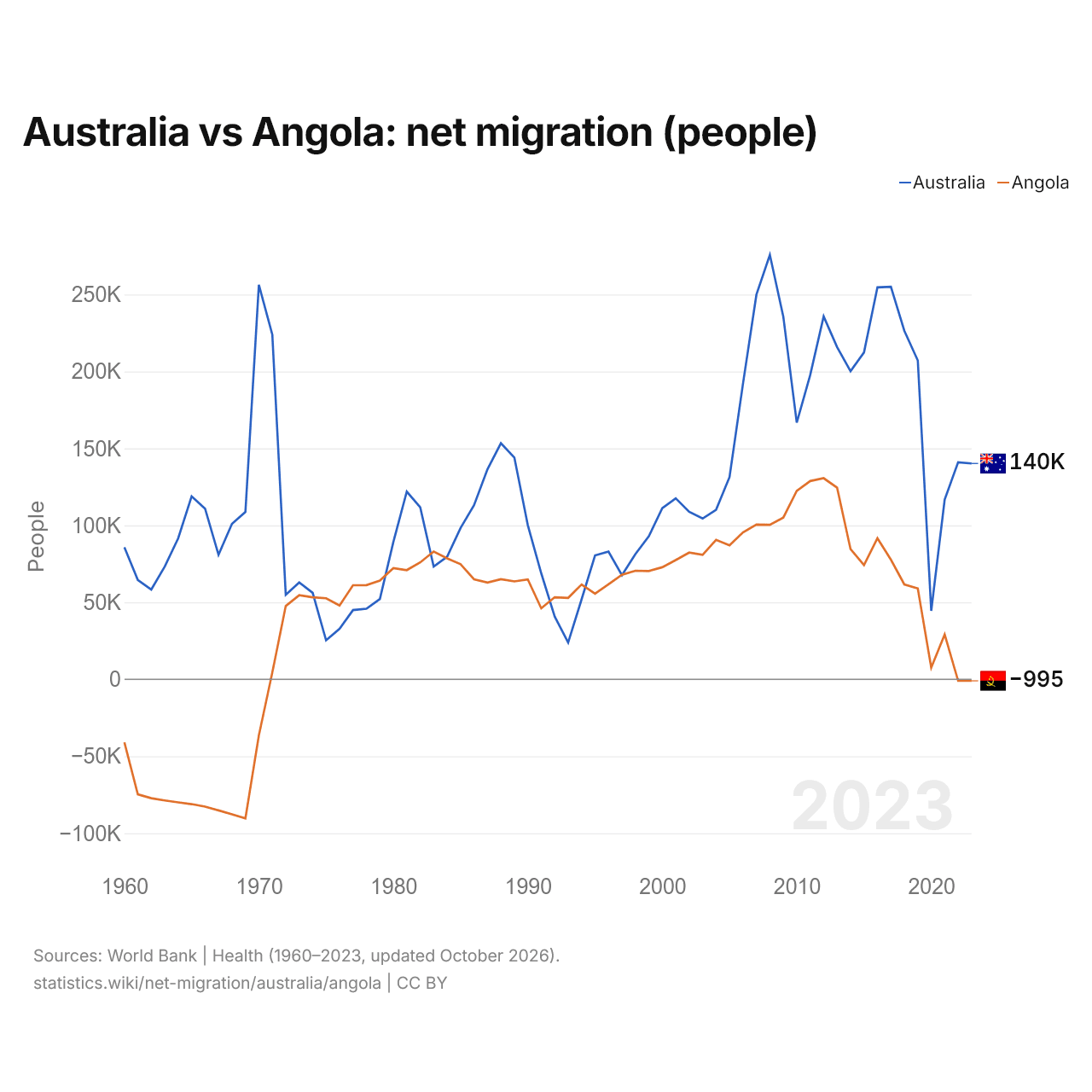
Net migration is a gain of 140,232 people a year in Australia and a loss of 995 in Angola.
Since 1960, net migration has added 7.81 million people to Australia and 2.83 million to Angola.
Australia vs Angola: net migration
Compare the net migration of any 2 countries
Sources:
- World Bank | Health (1960–2023, updated October 2026)
Creative Commons Attribution (CC BY): you may copy, share, adapt and reuse this content, also commercially, as long as you credit statistics.wiki and note any changes you made. The sources listed above may have their own license terms.