
Nigeria net migration (immigrants minus emigrants)
| Year | People | World rank |
|---|---|---|
| People | World rank | |
| 2023 | −57,936 | #179 |
| 2022 | −51,680 | #178 |
| 2021 | −86,115 | #184 |
| 2020 | −14,497 | #155 |
| 2019 | −99,722 | #183 |
| 2018 | −76,565 | #179 |
| 2017 | 78,685 | #26 |
| 2016 | 75,265 | #33 |
| 2015 | −116,162 | #181 |
| 2014 | −19,376 | #141 |
| 2013 | 40,201 | #34 |
| 2012 | 71,138 | #26 |
| 2011 | 67,808 | #26 |
| 2010 | 47,966 | #30 |
| 2009 | −18,422 | #139 |
| 2008 | −13,646 | #133 |
| 2007 | −9,162 | #119 |
| 2006 | −12,093 | #123 |
| 2005 | −17,146 | #135 |
| 2004 | 46,370 | #25 |
| 2003 | 33,857 | #30 |
| 2002 | 69,594 | #19 |
| 2001 | 64,163 | #17 |
| 2000 | 74,535 | #20 |
| 1999 | 97,195 | #14 |
| 1998 | 145,575 | #11 |
| 1997 | 96,885 | #14 |
| 1996 | 84,448 | #16 |
| 1995 | 73,243 | #20 |
| 1994 | 128,134 | #18 |
| 1993 | 90,200 | #21 |
| 1992 | 138,412 | #12 |
| 1991 | 42,760 | #28 |
| 1990 | 135,959 | #15 |
| 1989 | 99,588 | #11 |
| 1988 | 93,510 | #14 |
| 1987 | 64,418 | #18 |
| 1986 | 29,682 | #34 |
| 1985 | 61,514 | #23 |
| 1984 | 113,758 | #10 |
| 1983 | −507,539 | #196 |
| 1982 | 101,116 | #11 |
| 1981 | 106,723 | #10 |
| 1980 | 198,672 | #9 |
| 1979 | 137,721 | #7 |
| 1978 | 111,258 | #8 |
| 1977 | 129,075 | #4 |
| 1976 | 72,889 | #10 |
| 1975 | 75,603 | #8 |
| 1974 | 44,281 | #15 |
| 1973 | −618 | #91 |
| 1972 | −12,962 | #154 |
| 1971 | −35,639 | #179 |
| 1970 | 7,953 | #37 |
| 1969 | 6,912 | #41 |
| 1968 | 9,615 | #38 |
| 1967 | 18,683 | #28 |
| 1966 | 12,513 | #33 |
| 1965 | 32,988 | #16 |
| 1964 | 26,411 | #18 |
| 1963 | 27,115 | #18 |
| 1962 | 27,906 | #18 |
| 1961 | 25,515 | #20 |
| 1960 | 12,131 | #30 |
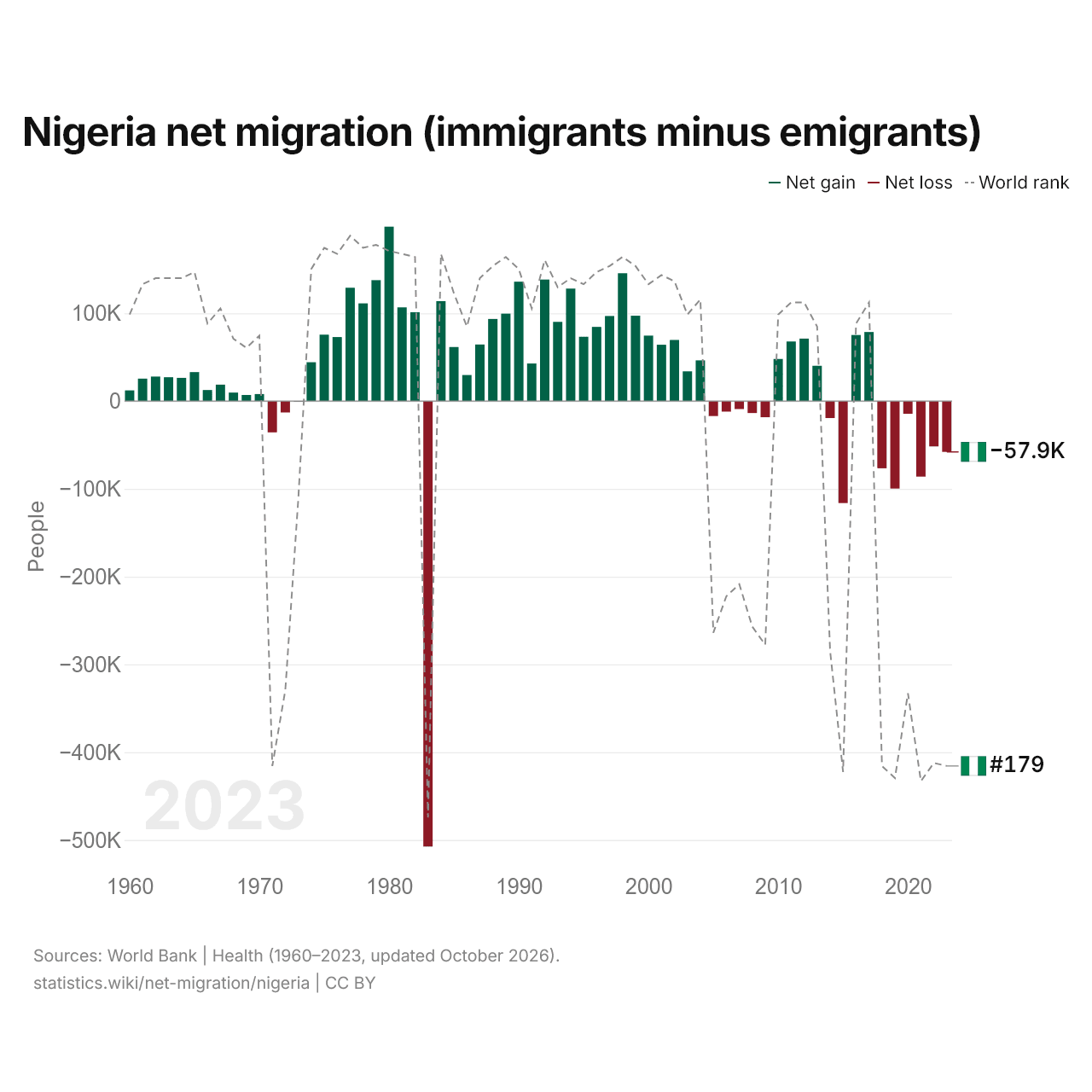
More people leave Nigeria than move in, 57,936 a year, compared with a net gain of 12,131 in 1960. Nigeria's net migration ranks 179th in the world, down from 178th the year before. Nigeria's highest rank was 4th, last held in 1977. More people have left Nigeria than moved in every year since 2018.
Since 1960, a total of 2.2 million more people have moved to Nigeria than left. By decade, Nigeria's net gain was largest from 1990 to 1999, at 1.03 million, and smallest from 2010 to 2019, at 69,238.
Nigeria net migration
| Net migration | −57,936 |
|---|---|
| Per 1,000 people | −0.3 |
| Total, 2014–2023 | −368,103 |
| World rank by number | 179/196 |
| World rank by rate | 109/196 |
Nigeria net migration per 1,000 people
| Year | Net migration per 1,000 people |
|---|---|
| Net migration per 1,000 people | |
| 2023 | −0.3 |
| 2022 | −0.2 |
| 2021 | −0.4 |
| 2020 | −0.1 |
| 2019 | −0.5 |
| 2018 | −0.4 |
| 2017 | 0.4 |
| 2016 | 0.4 |
| 2015 | −0.6 |
| 2014 | −0.1 |
| 2013 | 0.2 |
| 2012 | 0.4 |
| 2011 | 0.4 |
| 2010 | 0.3 |
| 2009 | −0.1 |
| 2008 | −0.1 |
| 2007 | −0.1 |
| 2006 | −0.1 |
| 2005 | −0.1 |
| 2004 | 0.3 |
| 2003 | 0.2 |
| 2002 | 0.5 |
| 2001 | 0.5 |
| 2000 | 0.6 |
| 1999 | 0.8 |
| 1998 | 1.2 |
| 1997 | 0.8 |
| 1996 | 0.7 |
| 1995 | 0.7 |
| 1994 | 1.2 |
| 1993 | 0.9 |
| 1992 | 1.4 |
| 1991 | 0.4 |
| 1990 | 1.4 |
| 1989 | 1.1 |
| 1988 | 1 |
| 1987 | 0.7 |
| 1986 | 0.3 |
| 1985 | 0.7 |
| 1984 | 1.4 |
| 1983 | −6.3 |
| 1982 | 1.3 |
| 1981 | 1.4 |
| 1980 | 2.7 |
| 1979 | 1.9 |
| 1978 | 1.6 |
| 1977 | 1.9 |
| 1976 | 1.1 |
| 1975 | 1.2 |
| 1974 | 0.7 |
| 1973 | 0 |
| 1972 | −0.2 |
| 1971 | −0.6 |
| 1970 | 0.1 |
| 1969 | 0.1 |
| 1968 | 0.2 |
| 1967 | 0.4 |
| 1966 | 0.2 |
| 1965 | 0.7 |
| 1964 | 0.5 |
| 1963 | 0.6 |
| 1962 | 0.6 |
| 1961 | 0.6 |
| 1960 | 0.3 |
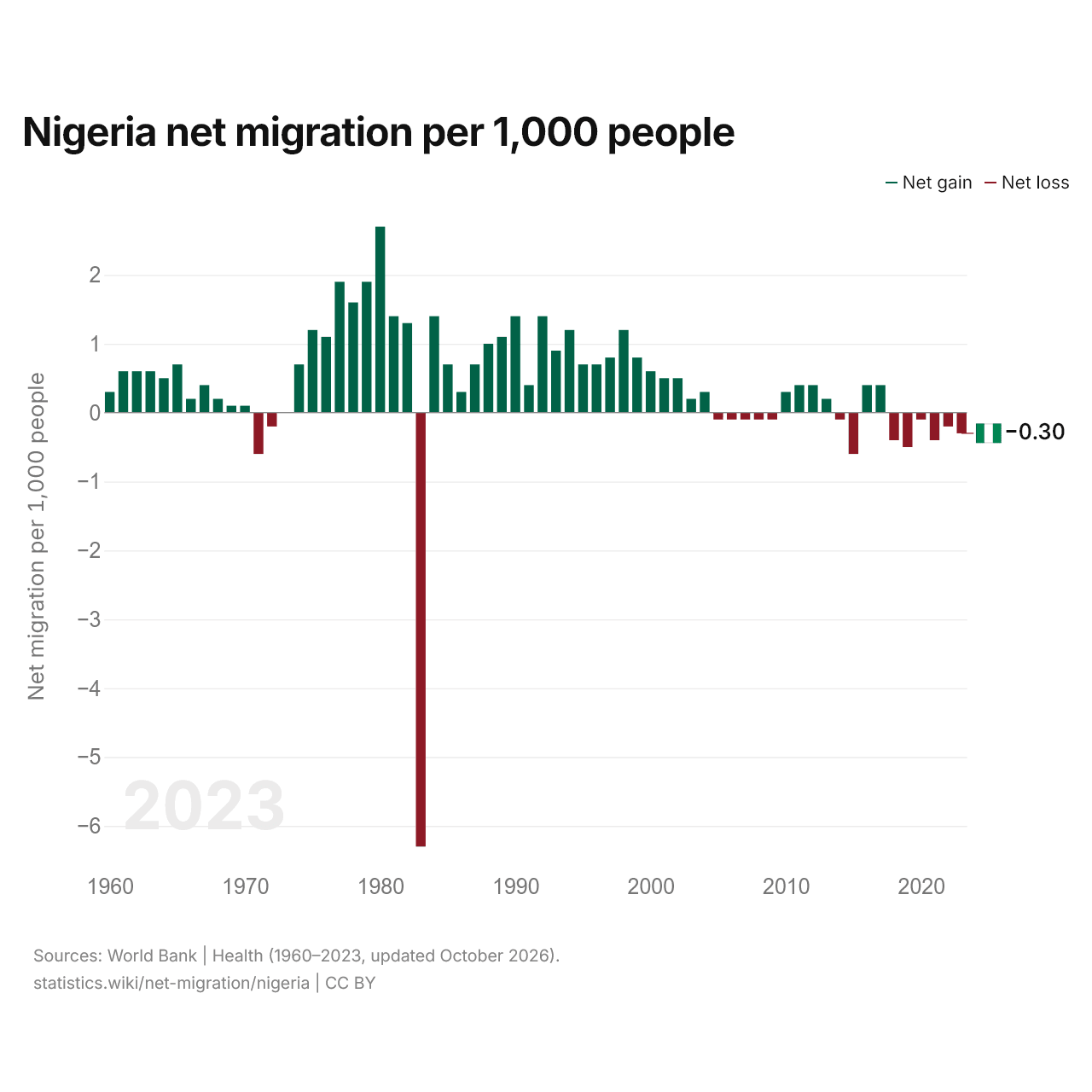
Per 1,000 people, Nigeria's net migration is a loss of 0.3. The highest rate was a gain of 2.7, in 1980, and the lowest a loss of 6.3, in 1983.
Nigeria in the world ranking by net migration
| Rank | Country | Net migration | Per 1,000 people | |
|---|---|---|---|---|
| 176 |
 Morocco |
−39,650 | −1.1 | vs Morocco |
| 177 |
 Mali |
−39,953 | −1.7 | vs Mali |
| 178 |
 Afghanistan |
−48,958 | −1.2 | |
| 179 |
 Nigeria |
−57,936 | −0.3 | |
| 180 |
 Vietnam |
−81,789 | −0.8 | |
| 181 |
 Azerbaijan |
−84,122 | −8.3 | |
| 182 |
 Zimbabwe |
−97,380 | −6.0 | vs Zimbabwe |
Compare Nigeria net migration with other countries
Sources:
- World Bank | Health (1960–2023, updated October 2026)
Creative Commons Attribution (CC BY): you may copy, share, adapt and reuse this content, also commercially, as long as you credit statistics.wiki and note any changes you made. The sources listed above may have their own license terms.