
United Kingdom vs Nicaragua: contraceptive prevalence, modern methods, % of married women aged 15–49
1x
| Year | % of married women 15–49 | |
|---|---|---|
| United Kingdom | Nicaragua | |
| 2012 | 71.1% | 77.4% |
| 2009 | 76% | - |
| 2007 | - | 69.8% |
| 2006 | 74% | - |
| 2005 | 76% | - |
| 2004 | 78% | - |
| 2003 | 79% | - |
| 2001 | 80% | 66.1% |
| 2000 | 75% | - |
| 1999 | 69% | - |
| 1998 | 77% | 57.4% |
| 1993 | 82% | 45.1% |
| 1986 | 78% | - |
| 1981 | - | 22.8% |
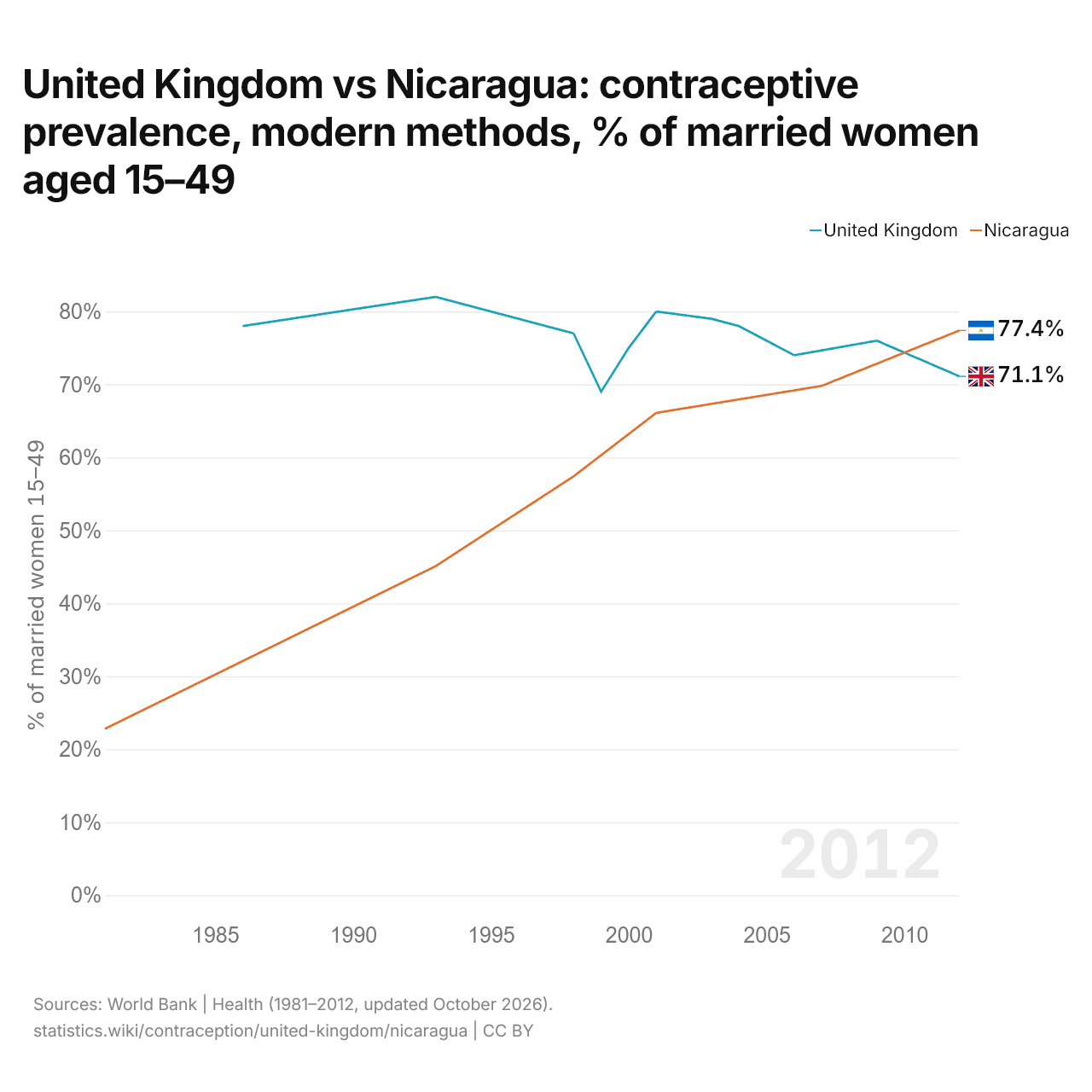
Among married women aged 15–49, 71.1% in the United Kingdom (2012) and 77.4% in Nicaragua (2012) use a modern method of contraception: 6.3 percentage points more in Nicaragua. In 1993, the shares were 82.0% in the United Kingdom and 45.1% in Nicaragua, 36.9 percentage points more in the United Kingdom.
United Kingdom vs Nicaragua: latest contraception surveys, % of married women aged 15–49
 United Kingdom |
 Nicaragua |
|
|---|---|---|
| Modern methods | 71.1% (2012) | 77.4% (2012) |
| Unmet need | 8.1% (2012) | 5.8% (2012) |
| Rank | Not ranked: latest survey before 2014 | Not ranked: latest survey before 2014 |
Compare contraceptive use in any 2 countries
Sources:
- World Bank | Health (1981–2012, updated October 2026)
Creative Commons Attribution (CC BY): you may copy, share, adapt and reuse this content, also commercially, as long as you credit statistics.wiki and note any changes you made. The sources listed above may have their own license terms.