
Modern contraceptive use and unmet need by country, % of married women 15–49
| Rank | Country | Modern methods | Survey year | Unmet need |
|---|---|---|---|---|
| 1 |  Finland |
81.6% | 2015 | n/a |
| 2 |  China |
80.5% | 2017 | 2.3% (2001) |
| 3 |  Colombia |
75.9% | 2015 | 7.0% |
| 4 |  Ecuador |
72.4% | 2018 | 7.1% |
| 5 |  Thailand |
70.7% | 2022 | 8.9% |
| 6 |  Costa Rica |
70.0% | 2018 | 13.7% |
| 7 |  Chile |
69.8% | 2016 | n/a |
| 8 |  Mexico |
69.1% | 2023 | 10.8% (2018) |
| 9 |  North Korea |
68.8% | 2017 | 6.6% |
| 10 |  South Korea |
67.6% | 2021 | 8.6% |
| 11 |  Switzerland |
67.3% | 2017 | n/a |
| 12 |  Argentina |
67.2% | 2020 | 12.5% |
| 13 |  Honduras |
66.5% | 2019 | 12.9% |
| 14 |  Paraguay |
66.4% | 2016 | 12.1% |
| 15 |  United States |
66.1% | 2019 | 7.2% |
| 16 |  Zimbabwe |
65.8% | 2015 | 10.4% |
| 17 |  Belgium |
65.4% | 2018 | 3.4% (1992) |
| 18 |  Lesotho |
65.3% | 2024 | 12.6% |
| 19 |  Malawi |
64.7% | 2020 | 15.4% |
| 20 |  Australia |
64.7% | 2016 | n/a |
| 21 |  Dominican Republic |
62.0% | 2019 | 15.3% |
| 22 |  Estonia |
60.9% | 2014 | 9.3% |
| 23 |  Cuba |
60.1% | 2022 | 8.8% (2019) |
| 24 |  Spain |
59.9% | 2018 | 11.8% (1995) |
| 25 |  Vietnam |
59.8% | 2021 | 10.1% |
| 26 |  Morocco |
59.1% | 2018 | 11.3% |
| 27 |  Rwanda |
58.4% | 2020 | 13.6% |
| 28 |  Peru |
57.9% | 2023 | 8.9% |
| 29 |  Eswatini |
57.0% | 2022 | 20.4% |
| 30 |  Egypt |
56.9% | 2014 | 12.6% |
| 30 |  Kenya |
56.9% | 2022 | 13.9% |
| 32 |  India |
56.4% | 2021 | 9.4% |
| 32 |  Uzbekistan |
56.4% | 2022 | 11.0% |
| 34 |  Bangladesh |
54.7% | 2022 | 10.0% |
| 35 |  Cape Verde |
54.6% | 2018 | 16.7% (2005) |
| 36 |  South Africa |
54.0% | 2016 | 14.9% |
| 37 |  Sri Lanka |
53.6% | 2016 | 7.5% |
| 38 |  Jamaica |
53.2% | 2022 | 7.0% |
| 39 |  Japan |
52.8% | 2021 | n/a |
| 40 |  El Salvador |
52.1% | 2021 | 17.7% |
| 41 |  Indonesia |
51.6% | 2023 | 10.6% (2017) |
| 42 |  Myanmar |
51.3% | 2016 | 16.2% |
| 43 |  Laos |
51.0% | 2017 | 13.3% |
| 44 |  Poland |
50.7% | 2014 | n/a |
| 45 |  Kazakhstan |
50.1% | 2018 | 15.5% |
| 46 |  Guatemala |
48.9% | 2015 | 13.9% |
| 46 |  Turkey |
48.9% | 2018 | 11.6% |
| 48 |  Belize |
48.5% | 2016 | 22.2% |
| 49 |  Tunisia |
48.4% | 2023 | 16.5% |
| 50 |  Zambia |
47.5% | 2018 | 19.7% |
| 51 |  Turkmenistan |
47.3% | 2019 | 9.7% |
| 52 |  Panama |
46.9% | 2015 | 24.2% |
| 53 |  Sao Tome |
46.0% | 2019 | 27.1% |
| 54 |  Belarus |
45.9% | 2019 | 17.5% |
| 55 |  Mongolia |
45.2% | 2018 | 22.6% |
| 56 |  Bolivia |
45.1% | 2016 | 23.2% |
| 57 |  Algeria |
44.9% | 2019 | 14.1% |
| 58 |  Cambodia |
44.7% | 2022 | 11.5% |
| 59 |  Moldova |
43.9% | 2020 | 21.2% |
| 60 |  Palestine |
42.8% | 2020 | 12.9% |
| 61 |  Madagascar |
42.7% | 2021 | 14.6% |
| 61 |  Nepal |
42.7% | 2022 | 20.8% |
| 63 |  Philippines |
41.8% | 2022 | 12.4% |
| 64 |  Suriname |
38.7% | 2018 | 28.4% |
| 65 |  Jordan |
38.4% | 2023 | 10.8% |
| 66 |  Uganda |
38.0% | 2022 | 21.8% |
| 67 |  Kyrgyzstan |
37.8% | 2018 | 19.7% |
| 68 |  Iraq |
36.1% | 2018 | 14.3% |
| 69 |  Ethiopia |
34.6% | 2021 | 21.2% |
| 70 |  Malaysia |
34.5% | 2022 | 26.7% |
| 71 |  Saudi Arabia |
32.9% | 2023 | 21.4% |
| 72 |  Haiti |
31.8% | 2017 | 38.0% |
| 73 |  Burkina Faso |
31.3% | 2022 | 21.0% |
| 74 |  Georgia |
31.2% | 2018 | 23.7% |
| 75 |  Fiji |
31.2% | 2021 | 25.3% |
| 76 |  Mauritius |
31.1% | 2014 | 12.5% |
| 76 |  Tanzania |
31.1% | 2022 | 21.0% |
| 78 |  Papua New Guinea |
30.5% | 2018 | 25.9% |
| 78 |  Trinidad |
30.5% | 2022 | 23.4% |
| 80 |  Guyana |
28.6% | 2020 | 30.5% |
| 81 |  Armenia |
28.0% | 2016 | 12.5% |
| 82 |  Ghana |
27.8% | 2022 | 23.4% |
| 83 |  Kiribati |
27.3% | 2019 | 17.3% |
| 84 |  Tajikistan |
27.1% | 2017 | 22.7% |
| 85 |  Senegal |
25.6% | 2023 | 19.1% |
| 86 |  Mozambique |
25.4% | 2023 | 26.6% |
| 87 |  Tonga |
25.2% | 2019 | 21.8% |
| 88 |  Ivory Coast |
25.2% | 2022 | 22.4% |
| 89 |  Pakistan |
25.0% | 2018 | 17.3% |
| 90 |  Solomon Islands |
24.3% | 2015 | 34.7% |
| 91 |  East Timor |
24.1% | 2016 | 25.3% |
| 92 |  Liberia |
23.9% | 2020 | 33.4% |
| 93 |  Burundi |
22.9% | 2017 | 29.7% |
| 94 |  Tuvalu |
22.4% | 2020 | 26.2% |
| 95 |  Togo |
21.4% | 2017 | 34.0% |
| 96 |  Serbia |
21.3% | 2019 | 8.8% |
| 97 |  Sierra Leone |
20.9% | 2019 | 24.8% |
| 98 |  Guinea-Bissau |
20.2% | 2019 | 21.1% |
| 99 |  Afghanistan |
19.8% | 2015 | 24.5% |
| 100 |  Oman |
18.8% | 2014 | 17.8% |
| 101 |  Congo |
18.3% | 2015 | 17.9% |
| 102 |  Nigeria |
18.2% | 2021 | 23.9% |
| 103 |  DR Congo |
17.6% | 2018 | 28.7% |
| 104 |  Gabon |
17.3% | 2021 | 33.4% |
| 105 |  Gambia |
17.1% | 2020 | 24.2% |
| 106 |  Benin |
16.9% | 2022 | 29.9% |
| 107 |  Mali |
16.4% | 2018 | 23.9% |
| 108 |  Libya |
16.3% | 2014 | 40.2% |
| 109 |  Samoa |
15.8% | 2020 | 38.9% |
| 110 |  Cameroon |
15.4% | 2018 | 23.0% |
| 111 |  Maldives |
14.9% | 2017 | 31.4% |
| 112 |  CAR |
14.4% | 2019 | 37.6% |
| 113 |  North Macedonia |
14.0% | 2019 | 10.3% |
| 114 |  Niger |
13.9% | 2023 | 21.1% |
| 115 |  Mauritania |
12.8% | 2021 | 31.1% |
| 116 |  Angola |
12.5% | 2016 | 38.0% |
| 117 |  Sudan |
12.0% | 2014 | 26.6% |
| 118 |  Montenegro |
11.6% | 2018 | 21.0% |
| 119 |  Guinea |
10.6% | 2018 | 22.1% |
| 120 |  Comoros |
8.6% | 2022 | 36.9% |
| 121 |  Chad |
6.7% | 2019 | 30.2% |
| 122 |  Albania |
3.7% | 2018 | 15.2% |
| 123 |  Somalia |
0.9% | 2019 | 36.6% |
| Not ranked: latest survey before 2014 | ||||
 Germany |
80.2% | 2011 | n/a | |
 Brazil |
77.7% | 2013 | 6.0% (2007) | |
 Czech Republic |
77.6% | 2008 | 4.3% | |
 Nicaragua |
77.4% | 2012 | 5.8% | |
 Netherlands |
75.6% | 1993 | n/a | |
 Uruguay |
74.8% | 2004 | n/a | |
 Canada |
73.3% | 1995 | n/a | |
 France |
72.7% | 2010 | 1.7% (2005) | |
 New Zealand |
71.6% | 1995 | n/a | |
 United Kingdom |
71.1% | 2012 | 8.1% | |
 Ireland |
70.9% | 2010 | n/a | |
 Norway |
69.2% | 1989 | n/a | |
 Bhutan |
65.4% | 2010 | 11.7% | |
 Slovenia |
63.2% | 1995 | 9.2% | |
 Austria |
63.0% | 2013 | n/a | |
 Venezuela |
61.7% | 1998 | 18.9% | |
 Bahamas |
60.1% | 1988 | n/a | |
 Denmark |
59.9% | 1975 | n/a | |
 Iran |
57.0% | 2010 | 5.7% | |
 Latvia |
55.6% | 1995 | 16.8% | |
 Barbados |
55.4% | 2012 | 19.9% | |
 Namibia |
55.3% | 2013 | 17.5% | |
 Russia |
55.0% | 2011 | 8.0% | |
 Singapore |
55.0% | 1997 | n/a | |
 Hungary |
54.1% | 2009 | 7.0% (1993) | |
 Saint Lucia |
52.4% | 2012 | 17.0% | |
 Israel |
51.9% | 1988 | n/a | |
 Italy |
51.8% | 2013 | 11.8% (1996) | |
 Saint Vincent |
51.6% | 1981 | n/a | |
 Lithuania |
51.4% | 2009 | 18.0% (1995) | |
 Romania |
50.5% | 2005 | 11.9% (2004) | |
 Dominica |
47.9% | 1987 | n/a | |
 Ukraine |
47.6% | 2012 | 4.9% | |
 Lebanon |
46.8% | 2009 | n/a | |
 Malta |
46.0% | 1993 | n/a | |
 Antigua |
44.6% | 1981 | n/a | |
 Marshall Islands |
42.4% | 2007 | 8.1% | |
 Botswana |
42.1% | 2000 | 9.6% (2007) | |
 Bulgaria |
39.6% | 2007 | 29.7% (1998) | |
 Kuwait |
39.3% | 1999 | n/a | |
 Portugal |
37.7% | 1980 | n/a | |
 Syria |
37.5% | 2009 | 16.4% | |
 Vanuatu |
37.1% | 2013 | 24.2% | |
 Qatar |
34.3% | 2012 | 12.4% | |
 Greece |
33.6% | 1999 | n/a | |
 Bahrain |
30.6% | 1995 | n/a | |
 Yemen |
29.2% | 2013 | 28.7% | |
 Grenada |
27.4% | 1985 | n/a | |
 Nauru |
25.1% | 2007 | 23.5% | |
 UAE |
23.6% | 1995 | n/a | |
 Djibouti |
18.0% | 2012 | n/a | |
 Azerbaijan |
13.9% | 2011 | 15.4% (2006) | |
 Bosnia |
12.1% | 2012 | 9.0% | |
 Equatorial Guinea |
9.6% | 2011 | 33.8% | |
 Eritrea |
7.1% | 2010 | 27.4% | |
 South Sudan |
1.6% | 2010 | 26.3% | |
Of the 123 countries in the table, the latest share of married women aged 15–49 who use a modern method of contraception is highest in Finland, 81.6% (2015), and lowest in Somalia, 0.9%. In half of them it is below 42.7%.
Contraceptive prevalence is the share of married women aged 15–49 who use a modern method of contraception (birth control), such as the pill, an intrauterine device, condoms or sterilization. The unmet need is the share of married women aged 15–49 who want to stop or delay having children but use no method. The figures come from national surveys, compiled by the World Bank.
Modern contraceptive use by country map, % of married women 15–49
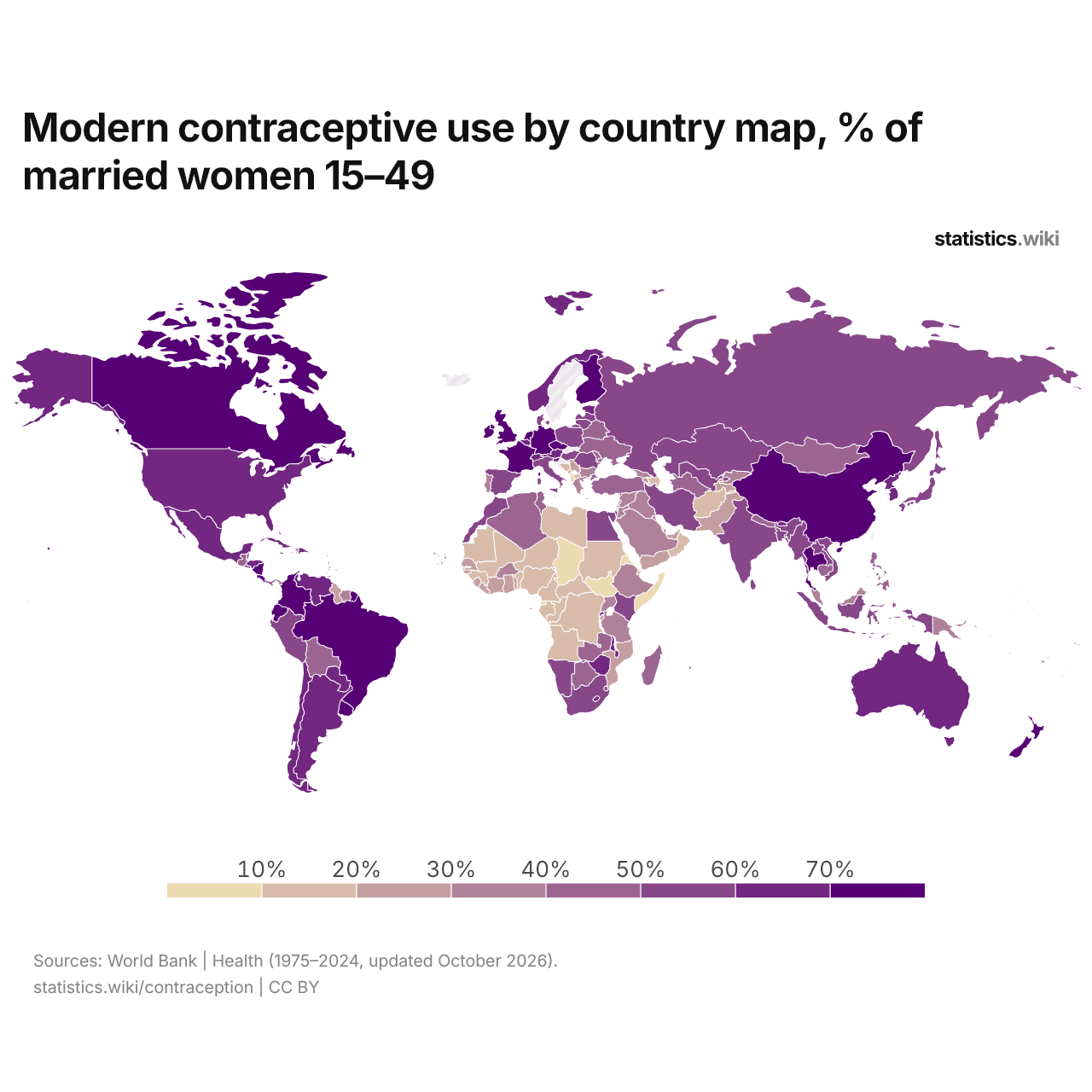
In the latest surveys of 179 countries, more than 60% of married women aged 15–49 used a modern method of contraception in 40, and fewer than 20% in 31.
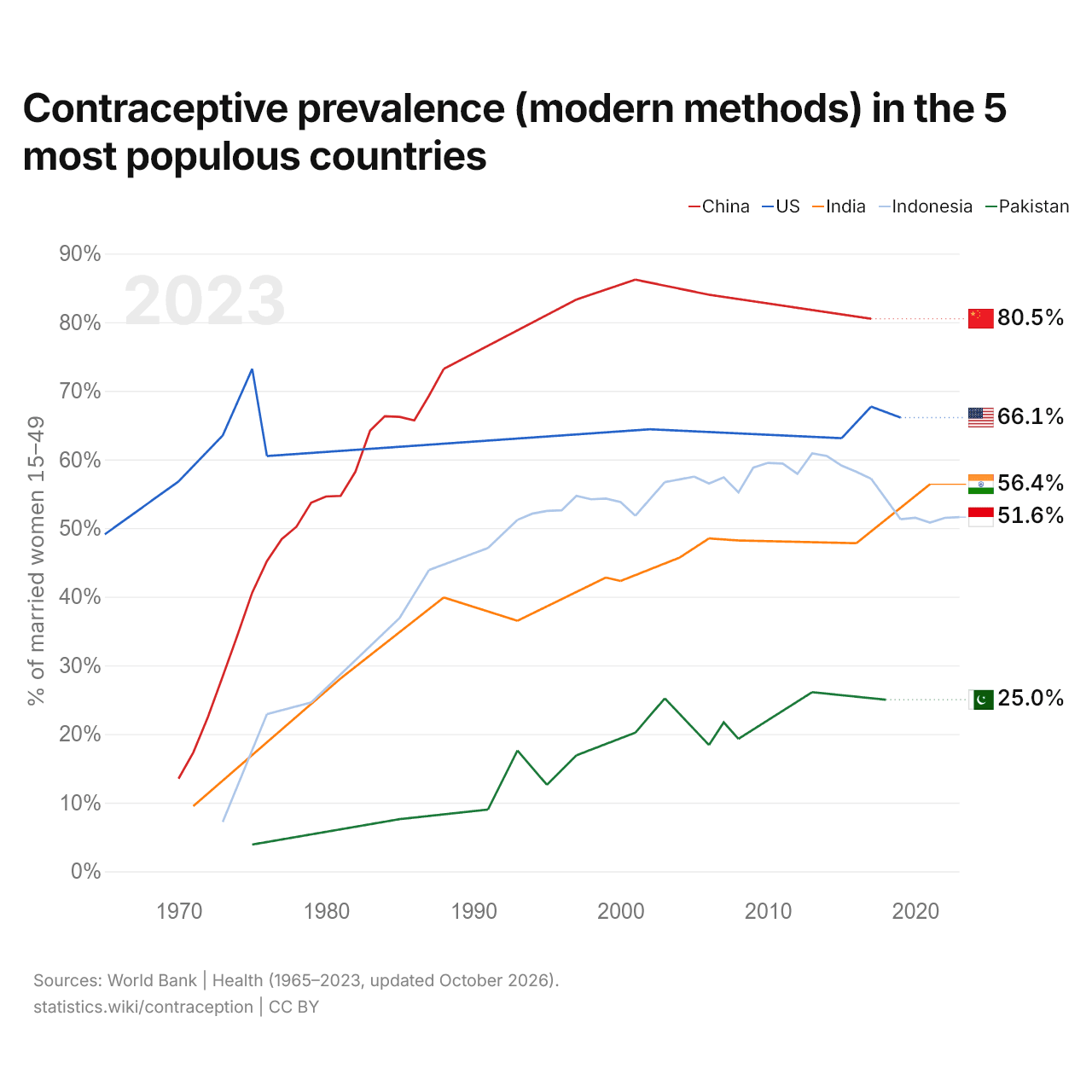
Contraceptive prevalence (modern methods) in the 5 most populous countries
| Year | % of married women 15–49 | ||||
|---|---|---|---|---|---|
| China | United States | India | Indonesia | Pakistan | |
| 2023 | - | - | - | 51.6% | - |
| 2022 | - | - | - | 51.5% | - |
| 2021 | - | - | 56.4% | 50.8% | - |
| 2020 | - | - | - | 51.5% | - |
| 2019 | - | 66.1% | - | 51.3% | - |
| 2018 | - | - | - | - | 25% |
| 2017 | 80.5% | 67.7% | - | 57.2% | - |
| 2016 | - | - | 47.8% | 58.2% | - |
| 2015 | - | 63.1% | - | 59.1% | - |
| 2014 | - | - | - | 60.5% | - |
| 2013 | - | - | - | 60.9% | 26.1% |
| 2012 | - | - | - | 57.9% | - |
| 2011 | - | - | - | 59.4% | - |
| 2010 | - | - | - | 59.5% | - |
| 2009 | - | - | - | 58.8% | - |
| 2008 | - | - | 48.2% | 55.2% | 19.3% |
| 2007 | - | - | - | 57.4% | 21.7% |
| 2006 | 84% | - | 48.5% | 56.5% | 18.4% |
| 2005 | - | - | - | 57.5% | - |
| 2004 | - | - | 45.7% | - | - |
| 2003 | - | - | - | 56.7% | 25.2% |
| 2002 | - | 64.4% | - | - | - |
| 2001 | 86.2% | - | - | 51.8% | 20.2% |
| 2000 | - | - | 42.3% | 53.8% | - |
| 1999 | - | - | 42.8% | 54.3% | - |
| 1998 | - | - | - | 54.2% | - |
| 1997 | 83.3% | - | - | 54.7% | 16.9% |
| 1996 | - | - | - | 52.6% | - |
| 1995 | - | - | - | 52.5% | 12.6% |
| 1994 | - | - | - | 52.1% | - |
| 1993 | - | - | 36.5% | 51.2% | 17.6% |
| 1991 | - | - | - | 47.1% | 9% |
| 1988 | 73.2% | - | 39.9% | - | - |
| 1987 | 69.3% | - | - | 43.9% | - |
| 1986 | 65.7% | - | - | - | - |
| 1985 | 66.2% | - | - | 36.9% | 7.6% |
| 1984 | 66.3% | - | - | - | - |
| 1983 | 64.2% | - | - | - | - |
| 1982 | 58.2% | - | - | - | - |
| 1981 | 54.7% | - | 28.1% | - | - |
| 1980 | 54.6% | - | - | - | - |
| 1979 | 53.7% | - | - | 24.6% | - |
| 1978 | 50.2% | - | - | - | - |
| 1977 | 48.4% | - | - | - | - |
| 1976 | 45.2% | 60.5% | - | 22.9% | - |
| 1975 | 40.6% | 73.2% | - | - | 3.9% |
| 1974 | 34.4% | - | - | - | - |
| 1973 | 28.4% | 63.5% | - | 7.2% | - |
| 1972 | 22.5% | - | - | - | - |
| 1971 | 17.3% | - | 9.5% | - | - |
| 1970 | 13.5% | 56.8% | - | - | - |
| 1965 | - | 49.1% | - | - | - |
Among the five countries, the latest share of married women aged 15–49 who use a modern method is highest in China, 80.5% (2017), and lowest in Pakistan, 25.0%. The largest change is in China, where it has risen from 13.5% in 1970 to 80.5%.
Compare contraceptive use in any 2 countries
Sources:
- World Bank | Health (1965–2024, updated October 2026)
Creative Commons Attribution (CC BY): you may copy, share, adapt and reuse this content, also commercially, as long as you credit statistics.wiki and note any changes you made. The sources listed above may have their own license terms.