
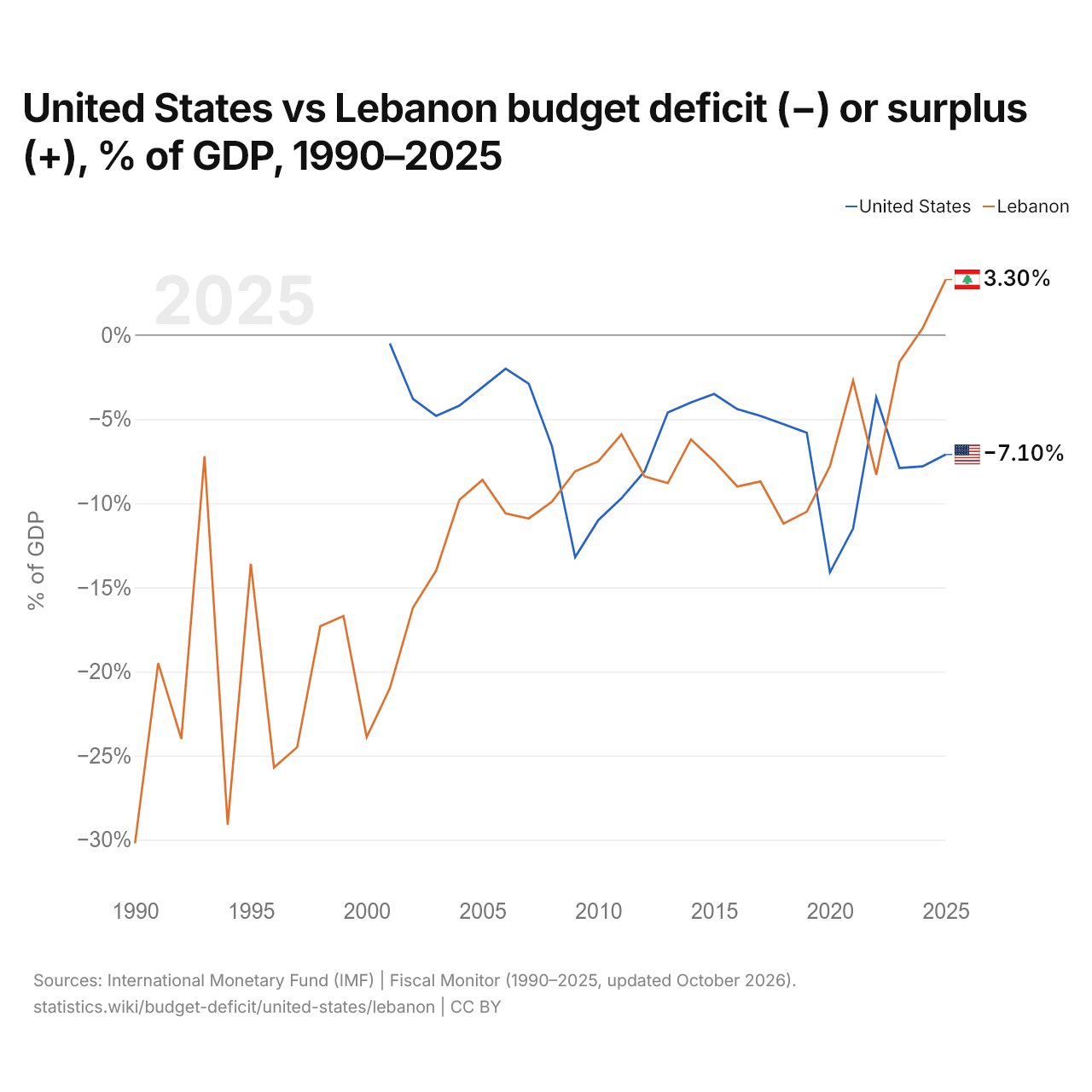
United States vs Lebanon budget deficit (−) or surplus (+), % of GDP, 1990–2025
1x
| Year | % of GDP | |
|---|---|---|
 United States |
 Lebanon |
|
| 2025 | −7.1% | 3.3% |
| 2024 | −7.8% | 0.4% |
| 2023 | −7.9% | −1.6% |
| 2022 | −3.7% | −8.3% |
| 2021 | −11.5% | −2.7% |
| 2020 | −14.1% | −7.8% |
| 2019 | −5.8% | −10.5% |
| 2018 | −5.3% | −11.2% |
| 2017 | −4.8% | −8.7% |
| 2016 | −4.4% | −9% |
| 2015 | −3.5% | −7.5% |
| 2014 | −4% | −6.2% |
| 2013 | −4.6% | −8.8% |
| 2012 | −8.1% | −8.4% |
| 2011 | −9.7% | −5.9% |
| 2010 | −11% | −7.5% |
| 2009 | −13.2% | −8.1% |
| 2008 | −6.6% | −9.9% |
| 2007 | −2.9% | −10.9% |
| 2006 | −2% | −10.6% |
| 2005 | −3.1% | −8.6% |
| 2004 | −4.2% | −9.8% |
| 2003 | −4.8% | −14% |
| 2002 | −3.8% | −16.2% |
| 2001 | −0.5% | −21% |
| 2000 | - | −23.9% |
| 1999 | - | −16.7% |
| 1998 | - | −17.3% |
| 1997 | - | −24.5% |
| 1996 | - | −25.7% |
| 1995 | - | −13.6% |
| 1994 | - | −29.1% |
| 1993 | - | −7.2% |
| 1992 | - | −24% |
| 1991 | - | −19.5% |
| 1990 | - | −30.2% |
In 2025, the United States had a budget deficit of 7.1% of GDP and Lebanon a surplus of 3.3%. From 2016 to 2025, the United States' budget balance averaged a deficit of 7.2% of GDP a year and Lebanon's a deficit of 5.6%.
The United States' budget balance was higher than Lebanon's in 17 of the 25 years from 2001 to 2025, and lower in eight. The United States and Lebanon both had a budget deficit in 23 of those years, most recently in 2023.
United States vs Lebanon: budget deficit or surplus figures
|
United States
|
Lebanon
|
|
|---|---|---|
| % of GDP, 2025 | −7.1% | +3.3% |
| US$, 2025 | −$2.17T | n/a |
| Average per year, 2016–2025 | −7.2% | −5.6% |
| Years in deficit | 25 of 25 (2001–2025) | 24 of 26 (2000–2025) |
| Largest deficit | 2020: −14.1% | 1990: −30.2% |
| Largest surplus | None | 2025: +3.3% |
Compare the budget deficit of any 2 countries
Sources:
- International Monetary Fund (IMF) | Fiscal Monitor (1990–2025, updated October 2026)
- World Bank | Economy & Growth (2025, updated October 2026)
Creative Commons Attribution (CC BY): you may copy, share, adapt and reuse this content, also commercially, as long as you credit statistics.wiki and note any changes you made. The sources listed above may have their own license terms.