
Austria budget deficit (−) or surplus (+), % of GDP, 1990–2025
| Year | % of GDP |
|---|---|
 Austria |
|
| 2025 | −4.2% |
| 2024 | −4.6% |
| 2023 | −2.6% |
| 2022 | −3.4% |
| 2021 | −5.7% |
| 2020 | −8.2% |
| 2019 | 0.5% |
| 2018 | 0.2% |
| 2017 | −0.8% |
| 2016 | −1.5% |
| 2015 | −0.5% |
| 2014 | −1.9% |
| 2013 | −2% |
| 2012 | −2.2% |
| 2011 | −2.5% |
| 2010 | −4.5% |
| 2009 | −5.4% |
| 2008 | −1.6% |
| 2007 | −1.6% |
| 2006 | −2.6% |
| 2005 | −2.6% |
| 2004 | −4.9% |
| 2003 | −1.8% |
| 2002 | −1.4% |
| 2001 | −0.7% |
| 2000 | −2.1% |
| 1999 | −2.6% |
| 1998 | −2.7% |
| 1997 | −2.4% |
| 1996 | −4.4% |
| 1995 | −6.2% |
| 1994 | −5% |
| 1993 | −4.6% |
| 1992 | −2.1% |
| 1991 | −3% |
| 1990 | −2.6% |
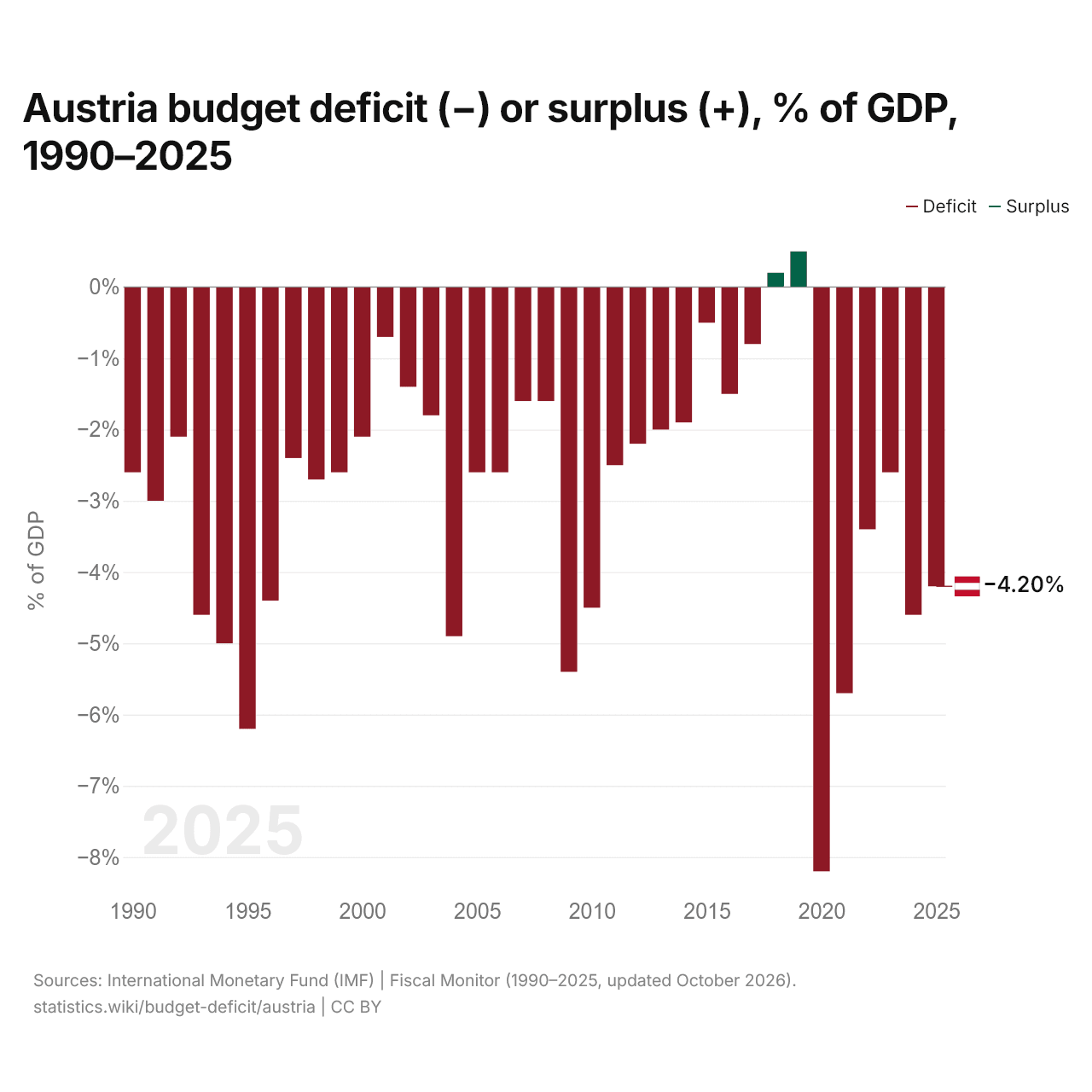
In 2025, Austria's government had a budget deficit of 4.2% of GDP, compared with a deficit of 2.6% in 1990. The largest deficit was 8.2%, in 2020, and the largest surplus 0.5%, in 2019. Austria's government has had a deficit every year since 2020.
In 2025, Austria's budget balance was the 32nd highest of 41 countries in Europe, where budget balances ranged from Ukraine's deficit of 17.6% to Norway's surplus of 10.6%. Austria's government revenue was 50.9% of GDP in 2025 and its government spending 55.1%.
Austria budget deficit or surplus: key figures
| % of GDP, 2025 | −4.2% |
|---|---|
| US$, 2025 | −$24.2B |
| Average per year, 2016–2025 | −3.0% |
| Years in deficit, 2000–2025 | 24 of 26 |
| Largest deficit | 2020: −8.2% |
| Largest surplus | 2019: +0.5% |
Austria budget deficit (−) or surplus (+), US$, 1990–2025
| Year | Current US$ |
|---|---|
|
Austria
|
|
| 2025 | $−24,212,731,897 |
| 2024 | $−24,841,716,954 |
| 2023 | $−13,245,538,635 |
| 2022 | $−16,139,022,925 |
| 2021 | $−27,354,417,487 |
| 2020 | $−35,639,943,220 |
| 2019 | $2,375,524,730 |
| 2018 | $883,354,243 |
| 2017 | $−3,218,461,698 |
| 2016 | $−5,713,832,262 |
| 2015 | $−1,808,506,223 |
| 2014 | $−8,434,653,600 |
| 2013 | $−8,499,955,689 |
| 2012 | $−8,853,479,018 |
| 2011 | $−10,645,671,874 |
| 2010 | $−17,405,334,472 |
| 2009 | $−21,483,835,595 |
| 2008 | $−6,746,355,405 |
| 2007 | $−6,034,338,727 |
| 2006 | $−8,710,090,709 |
| 2005 | $−8,125,151,412 |
| 2004 | $−14,783,780,692 |
| 2003 | $−4,794,990,400 |
| 2002 | $−3,034,346,368 |
| 2001 | $−1,399,868,964 |
| 2000 | $−4,070,499,333 |
| 1999 | $−5,687,908,111 |
| 1998 | $−5,824,839,901 |
| 1997 | $−5,047,018,670 |
| 1996 | $−10,337,276,710 |
| 1995 | $−14,824,198,118 |
| 1994 | $−10,220,002,455 |
| 1993 | $−8,660,468,082 |
| 1992 | $−4,174,730,070 |
| 1991 | $−5,127,283,819 |
| 1990 | $−4,284,844,312 |
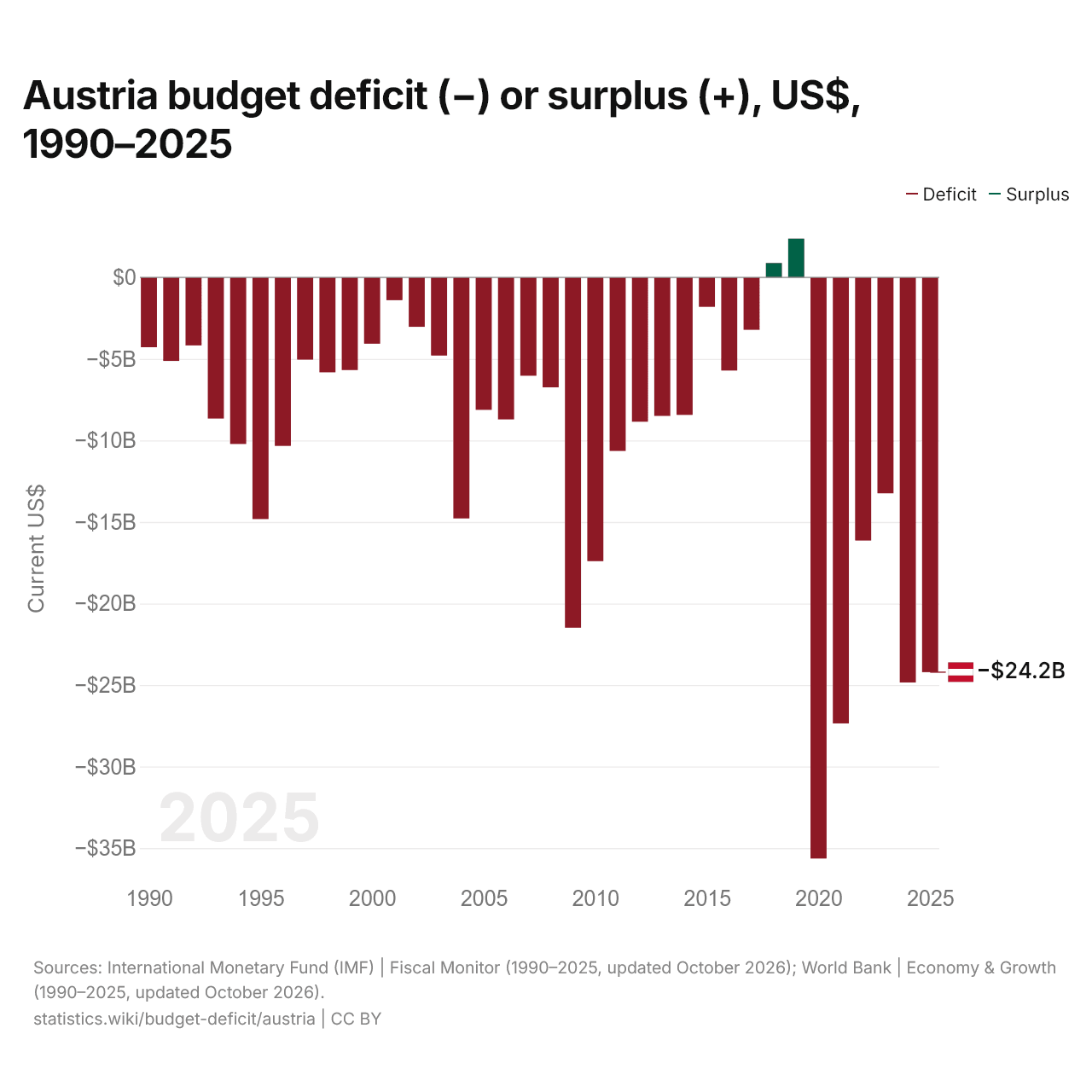
In 2025, Austria's budget deficit was $24.2 billion, compared with a deficit of $4.28 billion in 1990. The largest deficit was $35.6 billion, in 2020, and the largest surplus $2.38 billion, in 2019.
From 2016 to 2025, Austria's budget balances added up to a deficit of $147 billion, compared with a deficit of $98.6 billion from 2006 to 2015.
Compare Austria budget deficit with other countries
Sources:
- International Monetary Fund (IMF) | Fiscal Monitor (1990–2025, updated October 2026)
- World Bank | Economy & Growth (1990–2025, updated October 2026)
Creative Commons Attribution (CC BY): you may copy, share, adapt and reuse this content, also commercially, as long as you credit statistics.wiki and note any changes you made. The sources listed above may have their own license terms.