
Japan vs Bangladesh vaccination coverage (% of children aged 12–23 months)
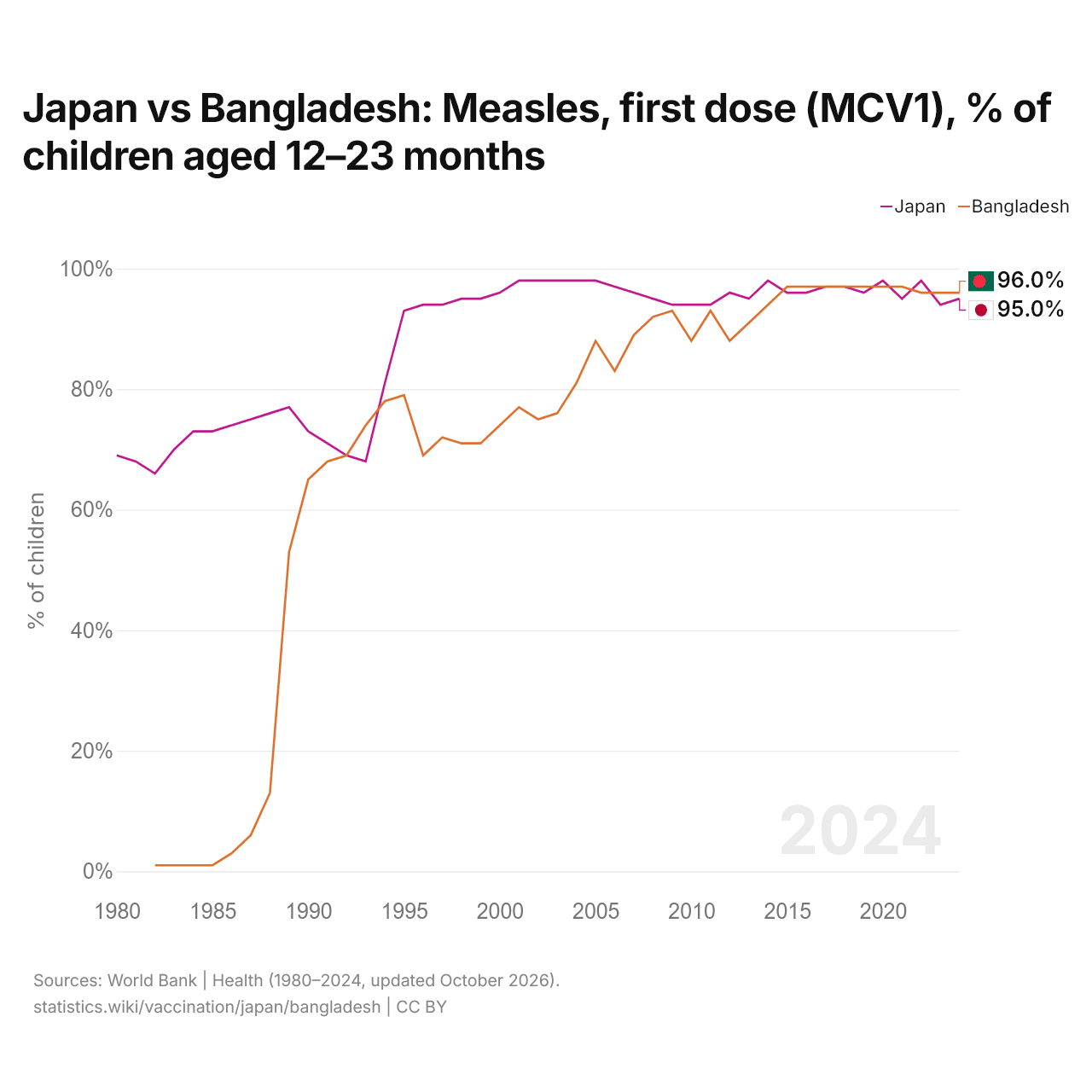
Measles, first dose (MCV1)
| Year | % of children | |
|---|---|---|
 Japan |
 Bangladesh |
|
| 2024 | 95% | 96% |
| 2023 | 94% | 96% |
| 2022 | 98% | 96% |
| 2021 | 95% | 97% |
| 2020 | 98% | 97% |
| 2019 | 96% | 97% |
| 2018 | 97% | 97% |
| 2017 | 97% | 97% |
| 2016 | 96% | 97% |
| 2015 | 96% | 97% |
| 2014 | 98% | 94% |
| 2013 | 95% | 91% |
| 2012 | 96% | 88% |
| 2011 | 94% | 93% |
| 2010 | 94% | 88% |
| 2009 | 94% | 93% |
| 2008 | 95% | 92% |
| 2007 | 96% | 89% |
| 2006 | 97% | 83% |
| 2005 | 98% | 88% |
| 2004 | 98% | 81% |
| 2003 | 98% | 76% |
| 2002 | 98% | 75% |
| 2001 | 98% | 77% |
| 2000 | 96% | 74% |
| 1999 | 95% | 71% |
| 1998 | 95% | 71% |
| 1997 | 94% | 72% |
| 1996 | 94% | 69% |
| 1995 | 93% | 79% |
| 1994 | 81% | 78% |
| 1993 | 68% | 74% |
| 1992 | 69% | 69% |
| 1991 | 71% | 68% |
| 1990 | 73% | 65% |
| 1989 | 77% | 53% |
| 1988 | 76% | 13% |
| 1987 | 75% | 6% |
| 1986 | 74% | 3% |
| 1985 | 73% | 1% |
| 1984 | 73% | 1% |
| 1983 | 70% | 1% |
| 1982 | 66% | 1% |
| 1981 | 68% | - |
| 1980 | 69% | - |
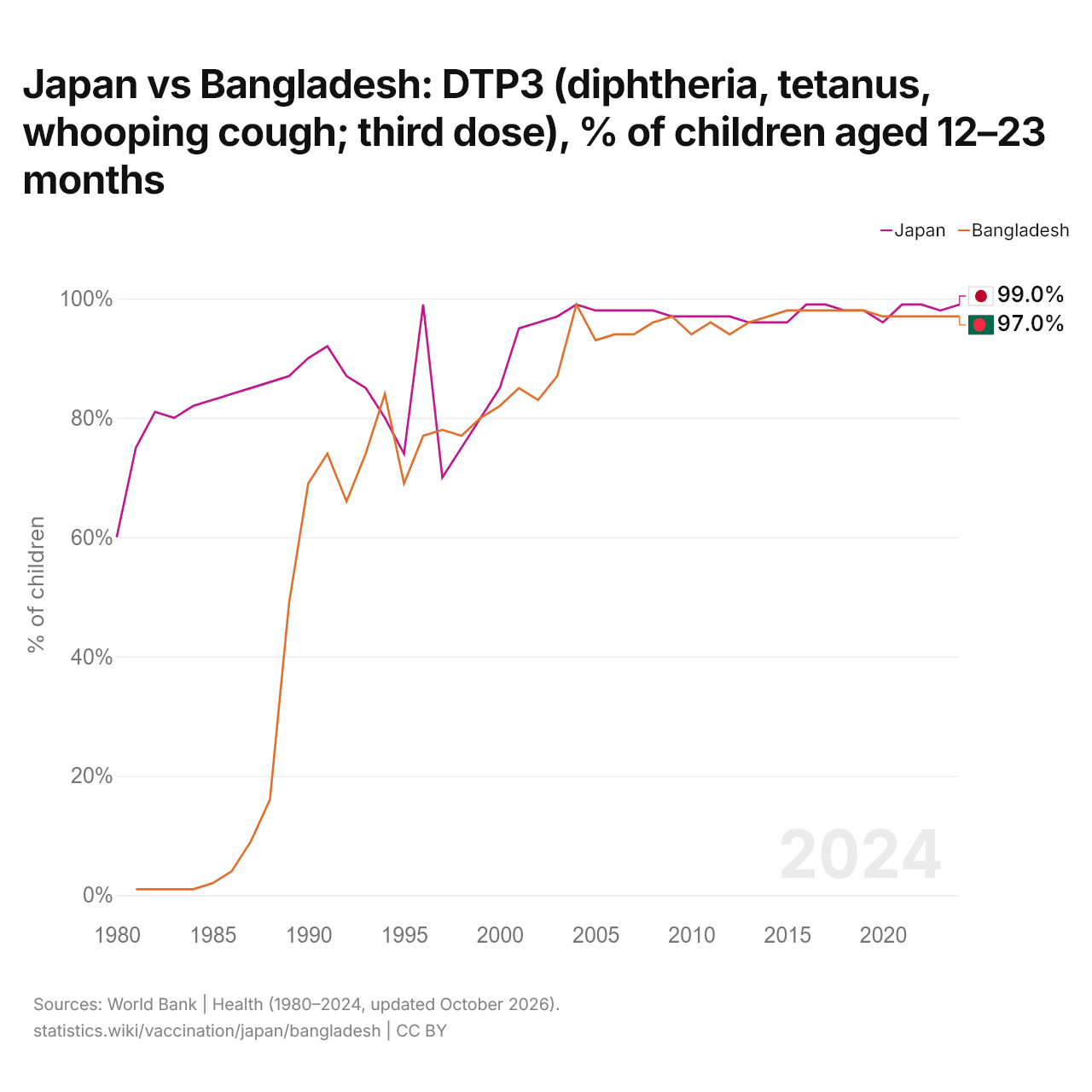
DTP3 (diphtheria, tetanus, whooping cough; third dose)
| Year | % of children | |
|---|---|---|
|
Japan
|
Bangladesh
|
|
| 2024 | 99% | 97% |
| 2023 | 98% | 97% |
| 2022 | 99% | 97% |
| 2021 | 99% | 97% |
| 2020 | 96% | 97% |
| 2019 | 98% | 98% |
| 2018 | 98% | 98% |
| 2017 | 99% | 98% |
| 2016 | 99% | 98% |
| 2015 | 96% | 98% |
| 2014 | 96% | 97% |
| 2013 | 96% | 96% |
| 2012 | 97% | 94% |
| 2011 | 97% | 96% |
| 2010 | 97% | 94% |
| 2009 | 97% | 97% |
| 2008 | 98% | 96% |
| 2007 | 98% | 94% |
| 2006 | 98% | 94% |
| 2005 | 98% | 93% |
| 2004 | 99% | 99% |
| 2003 | 97% | 87% |
| 2002 | 96% | 83% |
| 2001 | 95% | 85% |
| 2000 | 85% | 82% |
| 1999 | 80% | 80% |
| 1998 | 75% | 77% |
| 1997 | 70% | 78% |
| 1996 | 99% | 77% |
| 1995 | 74% | 69% |
| 1994 | 80% | 84% |
| 1993 | 85% | 74% |
| 1992 | 87% | 66% |
| 1991 | 92% | 74% |
| 1990 | 90% | 69% |
| 1989 | 87% | 49% |
| 1988 | 86% | 16% |
| 1987 | 85% | 9% |
| 1986 | 84% | 4% |
| 1985 | 83% | 2% |
| 1984 | 82% | 1% |
| 1983 | 80% | 1% |
| 1982 | 81% | 1% |
| 1981 | 75% | 1% |
| 1980 | 60% | - |
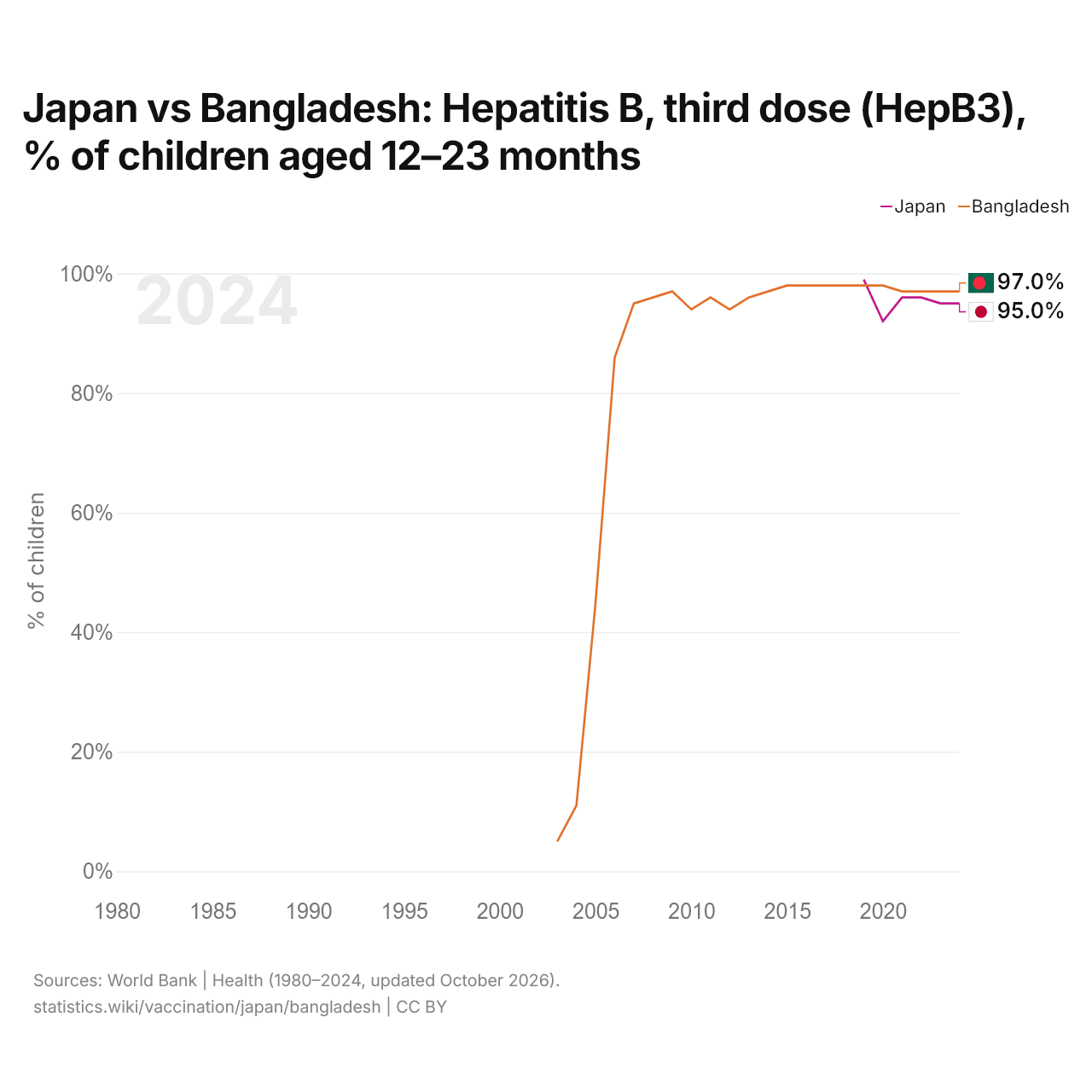
Hepatitis B, third dose (HepB3)
| Year | % of children | |
|---|---|---|
|
Japan
|
Bangladesh
|
|
| 2024 | 95% | 97% |
| 2023 | 95% | 97% |
| 2022 | 96% | 97% |
| 2021 | 96% | 97% |
| 2020 | 92% | 98% |
| 2019 | 99% | 98% |
| 2018 | - | 98% |
| 2017 | - | 98% |
| 2016 | - | 98% |
| 2015 | - | 98% |
| 2014 | - | 97% |
| 2013 | - | 96% |
| 2012 | - | 94% |
| 2011 | - | 96% |
| 2010 | - | 94% |
| 2009 | - | 97% |
| 2008 | - | 96% |
| 2007 | - | 95% |
| 2006 | - | 86% |
| 2005 | - | 45% |
| 2004 | - | 11% |
| 2003 | - | 5% |
| 2002 | - | - |
| 2001 | - | - |
| 2000 | - | - |
| 1999 | - | - |
| 1998 | - | - |
| 1997 | - | - |
| 1996 | - | - |
| 1995 | - | - |
| 1994 | - | - |
| 1993 | - | - |
| 1992 | - | - |
| 1991 | - | - |
| 1990 | - | - |
| 1989 | - | - |
| 1988 | - | - |
| 1987 | - | - |
| 1986 | - | - |
| 1985 | - | - |
| 1984 | - | - |
| 1983 | - | - |
| 1982 | - | - |
| 1981 | - | - |
| 1980 | - | - |
The first measles dose reaches 95% of children aged 12–23 months in Japan and 96% in Bangladesh: 1 percentage point more in Bangladesh. The third DTP dose reaches 99% in Japan and 97% in Bangladesh, 2 points more in Japan. The third hepatitis B dose reaches 95% in Japan and 97% in Bangladesh, 2 points more in Bangladesh. In 1982, the first measles dose reached 66% in Japan and 1% in Bangladesh, 65 percentage points more in Japan.
Japan vs Bangladesh: latest vaccination coverage (% of children aged 12–23 months)
|
Japan
|
Bangladesh
|
|
|---|---|---|
| Measles (MCV1) | 95% (2024) | 96% (2024) |
| DTP3 | 99% (2024) | 97% (2024) |
| HepB3 | 95% (2024) | 97% (2024) |
Japan and nearby countries: measles vaccination (MCV1), % of children aged 12–23 months


Bangladesh and nearby countries: measles vaccination (MCV1), % of children aged 12–23 months
Of Japan and the five nearby countries, the latest coverage of the first measles dose is highest in North Korea, at 99%, and lowest in the Philippines, at 80%; of Bangladesh and the five nearby countries, the latest coverage of the first measles dose is highest in India, at 97%, and lowest in Laos, at 69%.
Compare the vaccination rates of any 2 countries
Sources:
- World Bank | Health (1980–2024, updated October 2026)
Creative Commons Attribution (CC BY): you may copy, share, adapt and reuse this content, also commercially, as long as you credit statistics.wiki and note any changes you made. The sources listed above may have their own license terms.