
Montenegro renewable share of final energy use and of electricity, 2005–2025
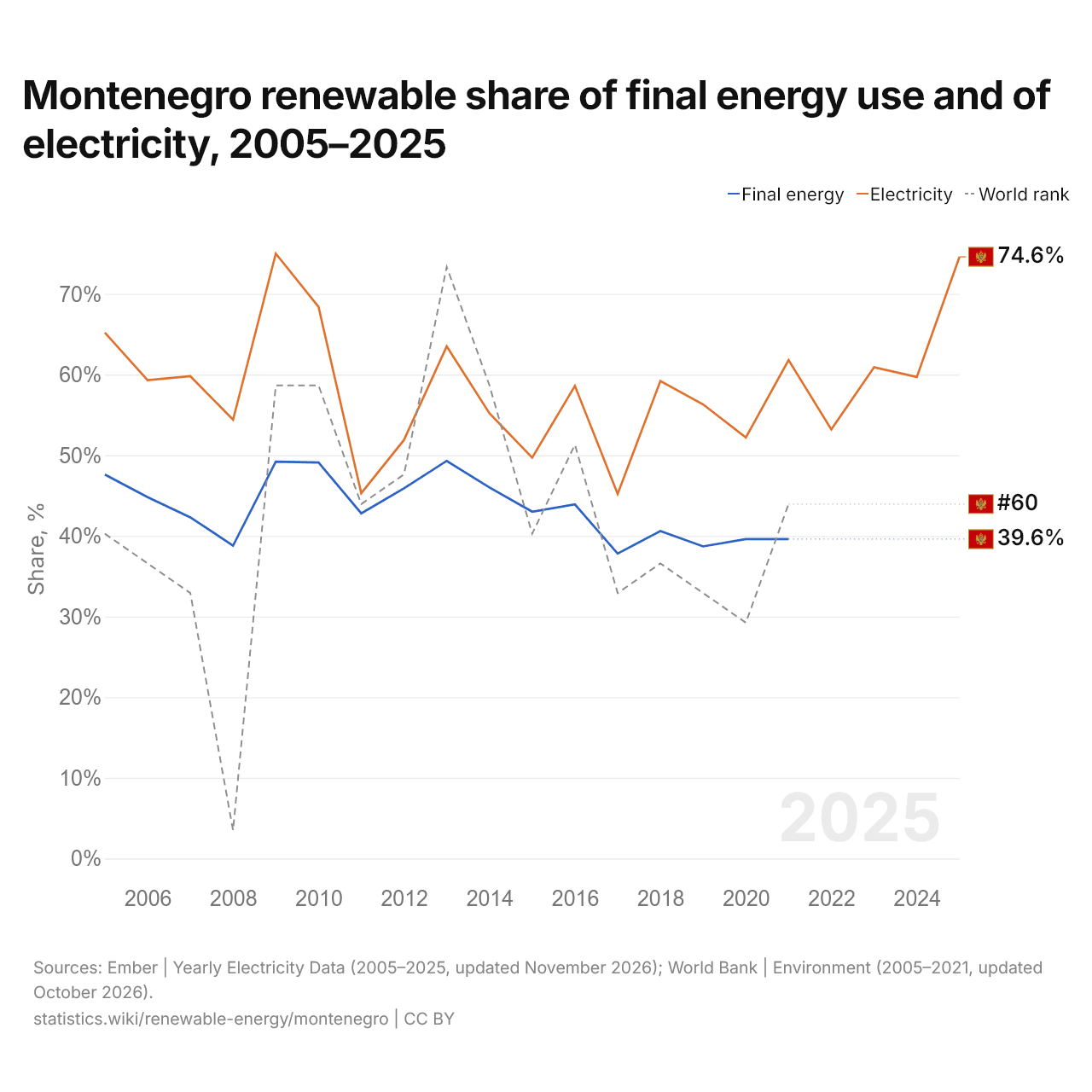
Renewables make up 39.6% of Montenegro's final energy consumption, down from 47.6% in 2005. The share was highest in 2013, at 49.3%. It is the 60th highest in the world, up from 64th the year before. Its highest rank was 52nd, last held in 2013. Renewables produced 74.6% of Montenegro's electricity in 2025, up from 65.2% in 2005.
Montenegro's renewable share of final energy consumption is the 8th highest of 42 countries in Europe, where it ranges from Russia's 3.5% to Iceland's 82.4%.
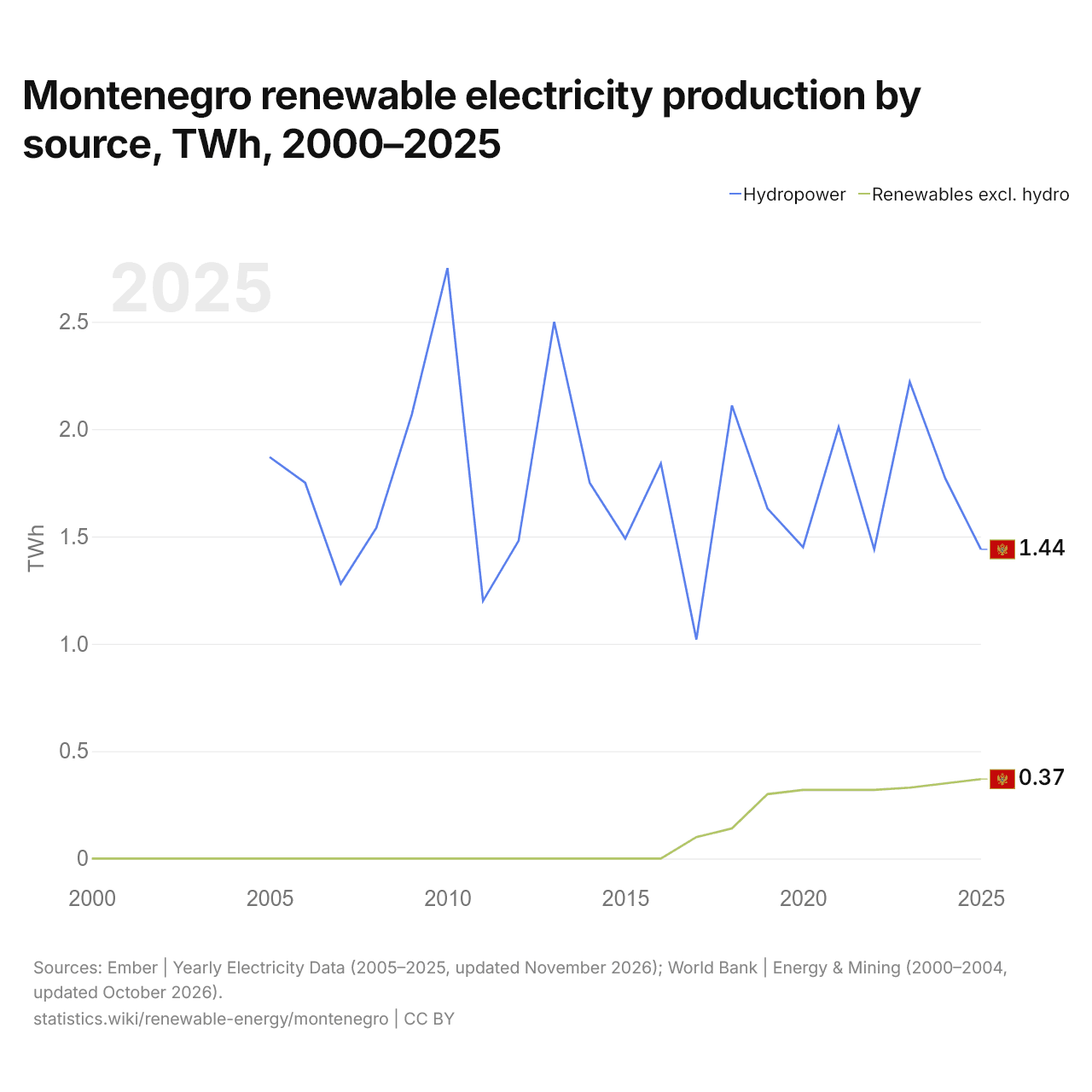
Montenegro renewable electricity production by source, TWh, 2000–2025
| Year | TWh | |
|---|---|---|
| Hydropower | Renewables excl. hydro | |
| 2025 | 1.44 | 0.37 |
| 2024 | 1.77 | 0.35 |
| 2023 | 2.22 | 0.33 |
| 2022 | 1.44 | 0.32 |
| 2021 | 2.01 | 0.32 |
| 2020 | 1.45 | 0.32 |
| 2019 | 1.63 | 0.3 |
| 2018 | 2.11 | 0.14 |
| 2017 | 1.02 | 0.1 |
| 2016 | 1.84 | 0 |
| 2015 | 1.49 | 0 |
| 2014 | 1.75 | 0 |
| 2013 | 2.5 | 0 |
| 2012 | 1.48 | 0 |
| 2011 | 1.2 | 0 |
| 2010 | 2.75 | 0 |
| 2009 | 2.07 | 0 |
| 2008 | 1.54 | 0 |
| 2007 | 1.28 | 0 |
| 2006 | 1.75 | 0 |
| 2005 | 1.87 | 0 |
| 2004 | - | 0 |
| 2003 | - | 0 |
| 2002 | - | 0 |
| 2001 | - | 0 |
| 2000 | - | 0 |
In 2025, Montenegro produced 1.44 TWh of electricity from hydropower and 0.374 TWh from the other renewables. In 2005, the figures were 1.87 TWh and 0 TWh.
Montenegro in the world renewable energy ranking
| Rank | Country | Share of final energy | Share of electricity (2025) | Renewable electricity, TWh (2025) | |
|---|---|---|---|---|---|
| 57 |
 Albania |
41.9% | 100.0% | 9.06 | vs Albania |
| 57 |
 Kiribati |
41.9% (2022) | 28.6% (2024) | 0.01 (2024) | |
| 59 |
 Pakistan |
41.6% | 46.9% | 80 | |
| 60 |
 Montenegro |
39.6% | 74.6% | 1.81 | |
| 61 |
 Denmark |
39.5% | 91.2% | 32.5 | |
| 62 |
 Comoros |
39.3% (2022) | 6.7% (2023) | 0.01 (2023) | |
| 63 |
 Ghana |
39.0% | 37.4% (2024) | 9.24 (2024) |
Compare the renewable energy of Montenegro with other countries
Sources:
- Ember | Yearly Electricity Data (2005–2025, updated November 2026)
- World Bank | Environment (2005–2022, updated October 2026)
Creative Commons Attribution (CC BY): you may copy, share, adapt and reuse this content, also commercially, as long as you credit statistics.wiki and note any changes you made. The sources listed above may have their own license terms.