
Austria population, 1960–2026
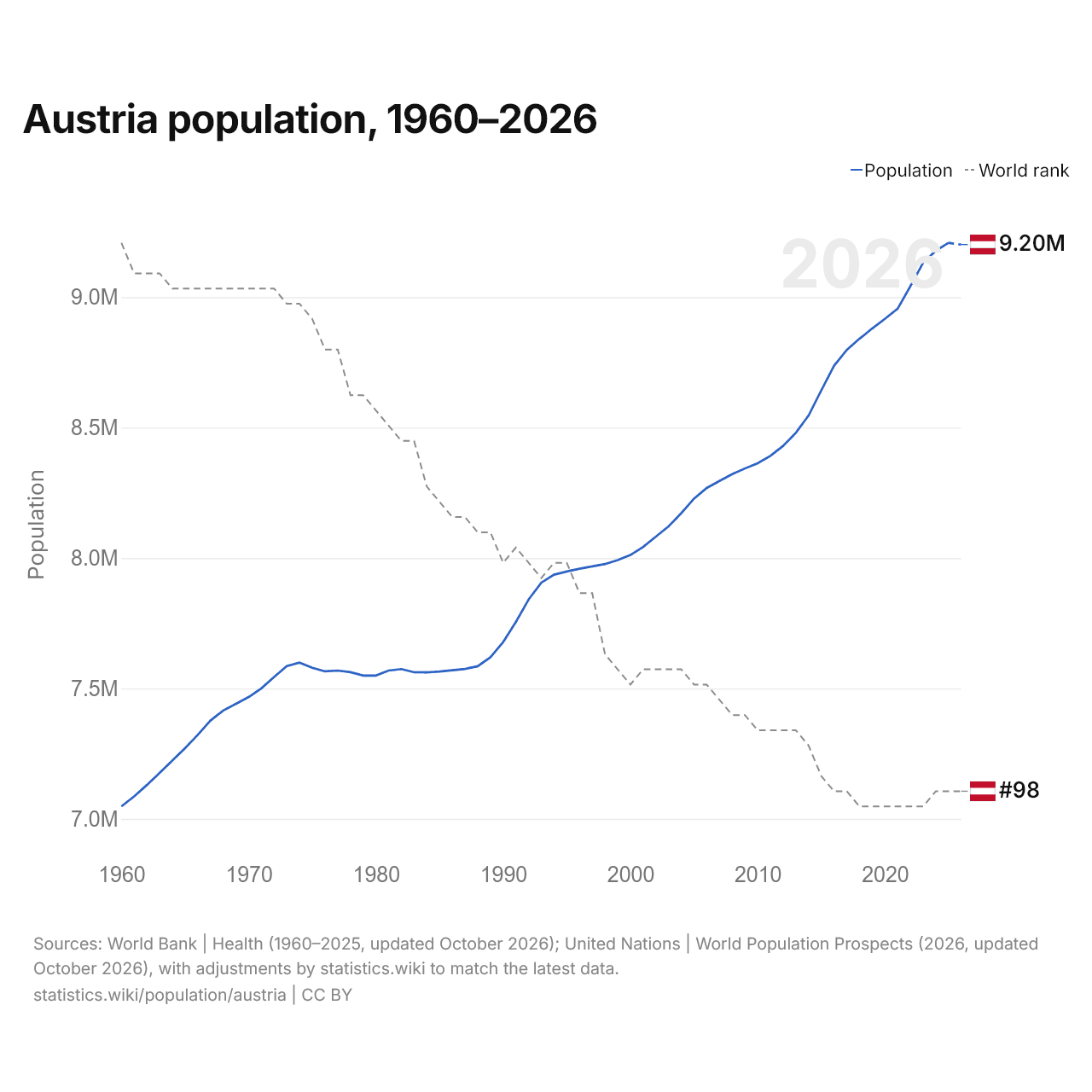
| Year | Population | World rank |
|---|---|---|
| Austria | ||
| 2026 projected | 9,201,502 | #98 |
| 2025 | 9,208,163 | #98 |
| 2024 | 9,177,982 | #98 |
| 2023 | 9,131,761 | #99 |
| 2022 | 9,041,851 | #99 |
| 2021 | 8,955,797 | #99 |
| 2020 | 8,916,864 | #99 |
| 2019 | 8,879,920 | #99 |
| 2018 | 8,840,521 | #99 |
| 2017 | 8,797,566 | #98 |
| 2016 | 8,736,668 | #98 |
| 2015 | 8,642,699 | #97 |
| 2014 | 8,546,356 | #95 |
| 2013 | 8,479,823 | #94 |
| 2012 | 8,429,991 | #94 |
| 2011 | 8,391,643 | #94 |
| 2010 | 8,363,404 | #94 |
| 2009 | 8,343,323 | #93 |
| 2008 | 8,321,496 | #93 |
| 2007 | 8,295,487 | #92 |
| 2006 | 8,268,641 | #91 |
| 2005 | 8,227,829 | #91 |
| 2004 | 8,171,966 | #90 |
| 2003 | 8,121,423 | #90 |
| 2002 | 8,081,957 | #90 |
| 2001 | 8,042,293 | #90 |
| 2000 | 8,011,566 | #91 |
| 1999 | 7,992,324 | #90 |
| 1998 | 7,976,789 | #89 |
| 1997 | 7,968,041 | #85 |
| 1996 | 7,959,017 | #85 |
| 1995 | 7,948,278 | #83 |
| 1994 | 7,936,118 | #83 |
| 1993 | 7,905,633 | #84 |
| 1992 | 7,840,709 | #83 |
| 1991 | 7,754,891 | #82 |
| 1990 | 7,677,850 | #83 |
| 1989 | 7,619,567 | #81 |
| 1988 | 7,585,317 | #81 |
| 1987 | 7,574,586 | #80 |
| 1986 | 7,569,794 | #80 |
| 1985 | 7,564,985 | #79 |
| 1984 | 7,561,434 | #78 |
| 1983 | 7,561,910 | #75 |
| 1982 | 7,574,140 | #75 |
| 1981 | 7,568,710 | #74 |
| 1980 | 7,549,433 | #73 |
| 1979 | 7,549,425 | #72 |
| 1978 | 7,562,305 | #72 |
| 1977 | 7,568,430 | #69 |
| 1976 | 7,565,525 | #69 |
| 1975 | 7,578,903 | #67 |
| 1974 | 7,599,038 | #66 |
| 1973 | 7,586,115 | #66 |
| 1972 | 7,544,201 | #65 |
| 1971 | 7,500,482 | #65 |
| 1970 | 7,467,086 | #65 |
| 1969 | 7,441,055 | #65 |
| 1968 | 7,415,403 | #65 |
| 1967 | 7,376,998 | #65 |
| 1966 | 7,322,066 | #65 |
| 1965 | 7,270,889 | #65 |
| 1964 | 7,223,801 | #65 |
| 1963 | 7,175,811 | #64 |
| 1962 | 7,129,864 | #64 |
| 1961 | 7,086,299 | #64 |
| 1960 | 7,047,539 | #62 |
Austria's population is 9.2 million in 2026, up from 7.05 million in 1960. It is the 98th most populous country in the world, a rank it has held since 2024. Its highest rank was 62nd, last held in 1960. From 2016 to 2026, Austria's population grew by 5.3%. It peaked at 9.21 million in 2025.
In 2026, Austria's population is 31% larger than in 1960, an average growth of 0.4% a year. Of the decades since 1960, Austria's population grew fastest from 2010 to 2020, at 0.6% a year, and slowest from 1970 to 1980, at 0.1% a year. Austria's population passed 9 million in 2022.
Austria is the 17th most populous of the 45 countries of Europe, with 1.2% of the region's population. Austria's population density was 289 per mi² (112 per km²) in 2025, the 83rd highest in the world. In 2025, 69.7% of the people of Austria lived in urban areas, the 78th highest share in the world.
Austria in the world population ranking, 2026
| Rank | Country | Population | Share of world | |
|---|---|---|---|---|
| 95 |
 Azerbaijan |
10,305,002 | 0.12% | |
| 96 |
 Israel |
10,261,927 | 0.12% | vs Israel |
| 97 |
 Hungary |
9,454,659 | 0.11% | vs Hungary |
| 98 |
 Austria |
9,201,502 | 0.11% | |
| 99 |
 Switzerland |
9,136,169 | 0.11% | vs Switzerland |
| 100 |
 Belarus |
9,025,821 | 0.11% | |
| 101 |
 Sierra Leone |
8,998,902 | 0.11% |
Compare Austria population with other countries
Sources:
- World Bank | Health (1960–2025, updated October 2026)
- United Nations | World Population Prospects (2026, updated October 2026), with adjustments by statistics.wiki to match the latest data
Creative Commons Attribution (CC BY): you may copy, share, adapt and reuse this content, also commercially, as long as you credit statistics.wiki and note any changes you made. The sources listed above may have their own license terms.