
Andorra population, 1960–2026
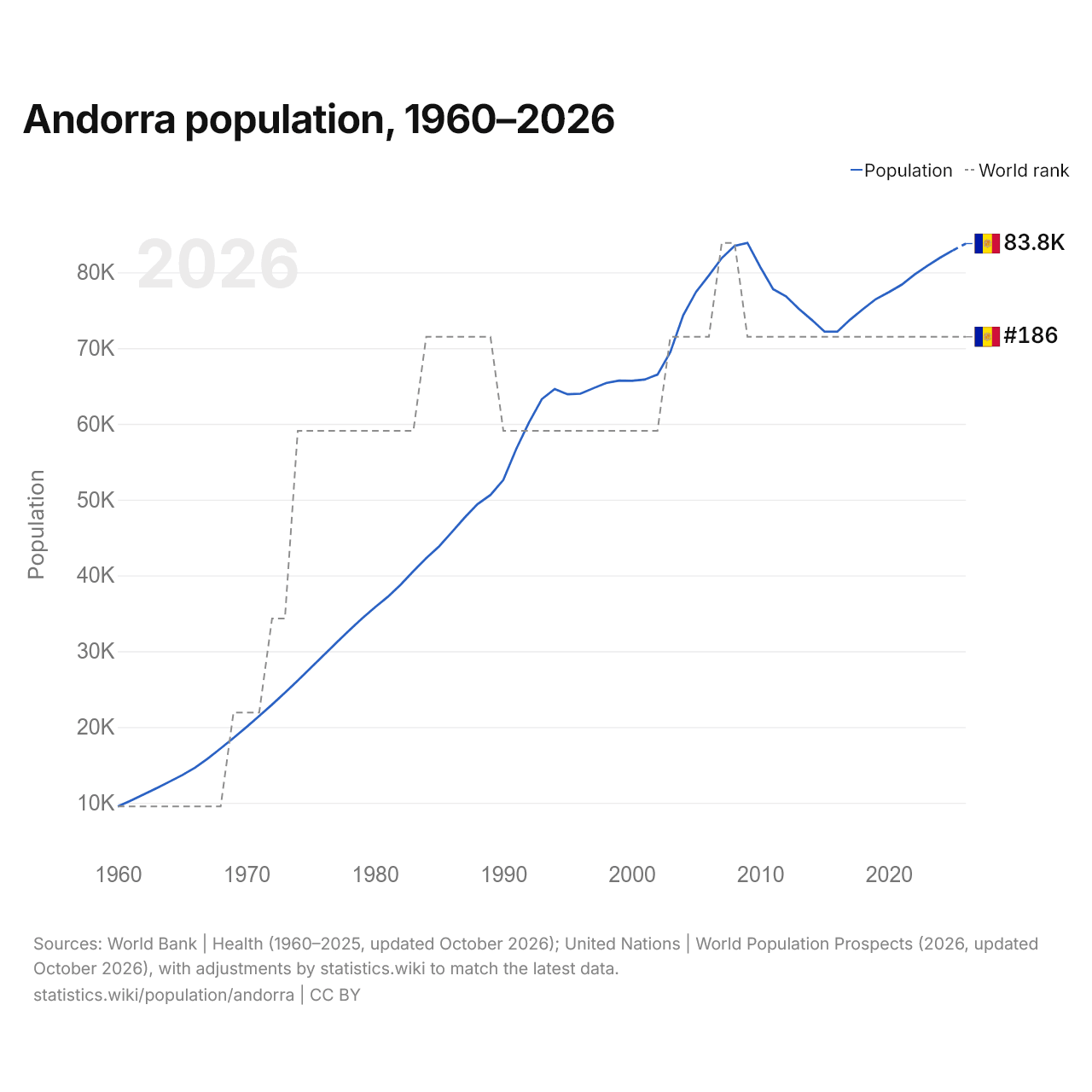
| Year | Population | World rank |
|---|---|---|
| Andorra | ||
| 2026 projected | 83,803 | #186 |
| 2025 | 82,904 | #186 |
| 2024 | 81,938 | #186 |
| 2023 | 80,856 | #186 |
| 2022 | 79,705 | #186 |
| 2021 | 78,364 | #186 |
| 2020 | 77,380 | #186 |
| 2019 | 76,474 | #186 |
| 2018 | 75,162 | #186 |
| 2017 | 73,763 | #186 |
| 2016 | 72,181 | #186 |
| 2015 | 72,174 | #186 |
| 2014 | 73,737 | #186 |
| 2013 | 75,194 | #186 |
| 2012 | 76,834 | #186 |
| 2011 | 77,783 | #186 |
| 2010 | 80,706 | #186 |
| 2009 | 83,888 | #186 |
| 2008 | 83,495 | #185 |
| 2007 | 81,877 | #185 |
| 2006 | 79,585 | #186 |
| 2005 | 77,421 | #186 |
| 2004 | 74,325 | #186 |
| 2003 | 69,486 | #186 |
| 2002 | 66,506 | #187 |
| 2001 | 65,852 | #187 |
| 2000 | 65,685 | #187 |
| 1999 | 65,710 | #187 |
| 1998 | 65,382 | #187 |
| 1997 | 64,700 | #187 |
| 1996 | 63,984 | #187 |
| 1995 | 63,912 | #187 |
| 1994 | 64,612 | #187 |
| 1993 | 63,272 | #187 |
| 1992 | 60,200 | #187 |
| 1991 | 56,667 | #187 |
| 1990 | 52,597 | #187 |
| 1989 | 50,620 | #186 |
| 1988 | 49,416 | #186 |
| 1987 | 47,653 | #186 |
| 1986 | 45,734 | #186 |
| 1985 | 43,825 | #186 |
| 1984 | 42,273 | #186 |
| 1983 | 40,565 | #187 |
| 1982 | 38,764 | #187 |
| 1981 | 37,169 | #187 |
| 1980 | 35,782 | #187 |
| 1979 | 34,306 | #187 |
| 1978 | 32,735 | #187 |
| 1977 | 31,097 | #187 |
| 1976 | 29,436 | #187 |
| 1975 | 27,773 | #187 |
| 1974 | 26,130 | #187 |
| 1973 | 24,523 | #189 |
| 1972 | 22,957 | #189 |
| 1971 | 21,442 | #190 |
| 1970 | 19,977 | #190 |
| 1969 | 18,555 | #190 |
| 1968 | 17,176 | #191 |
| 1967 | 15,837 | #191 |
| 1966 | 14,626 | #191 |
| 1965 | 13,634 | #191 |
| 1964 | 12,764 | #191 |
| 1963 | 11,915 | #191 |
| 1962 | 11,086 | #191 |
| 1961 | 10,283 | #191 |
| 1960 | 9,510 | #191 |
Andorra's population is 83,803 in 2026, up from 9,510 in 1960. It is the 186th most populous country in the world, a rank it has held since 2009. Its highest rank was 185th, last held in 2008. From 2016 to 2026, Andorra's population grew by 16.1%. It peaked at 83,888 in 2009.
In 2026, Andorra's population is 8.8 times its 1960 size, an average growth of 3.4% a year. Of the decades since 1960, Andorra's population grew fastest from 1960 to 1970, at 7.7% a year, and fell most from 2010 to 2020, by 0.4% a year.
Andorra is the 41st most populous of the 45 countries of Europe, with 0.011% of the region's population. Andorra's population density was 459 per mi² (177 per km²) in 2025, the 58th highest in the world. In 2025, 88.9% of the people of Andorra lived in urban areas, the 25th highest share in the world.
Andorra in the world population ranking, 2026
| Rank | Country | Population | Share of world | |
|---|---|---|---|---|
| 183 |
 Tonga |
103,283 | 0.001% | |
| 184 |
 Saint Vincent |
99,243 | 0.001% | |
| 185 |
 Antigua |
94,638 | 0.001% | |
| 186 |
 Andorra |
83,803 | 0.001% | |
| 187 |
 Cayman Islands |
77,225 | <0.001% | |
| 188 |
 Dominica |
65,501 | <0.001% | |
| 189 |
 Saint Kitts |
46,999 | <0.001% |
Compare Andorra population with other countries
Sources:
- World Bank | Health (1960–2025, updated October 2026)
- United Nations | World Population Prospects (2026, updated October 2026), with adjustments by statistics.wiki to match the latest data
Creative Commons Attribution (CC BY): you may copy, share, adapt and reuse this content, also commercially, as long as you credit statistics.wiki and note any changes you made. The sources listed above may have their own license terms.