
Bahrain population by age and sex, 1950–2100
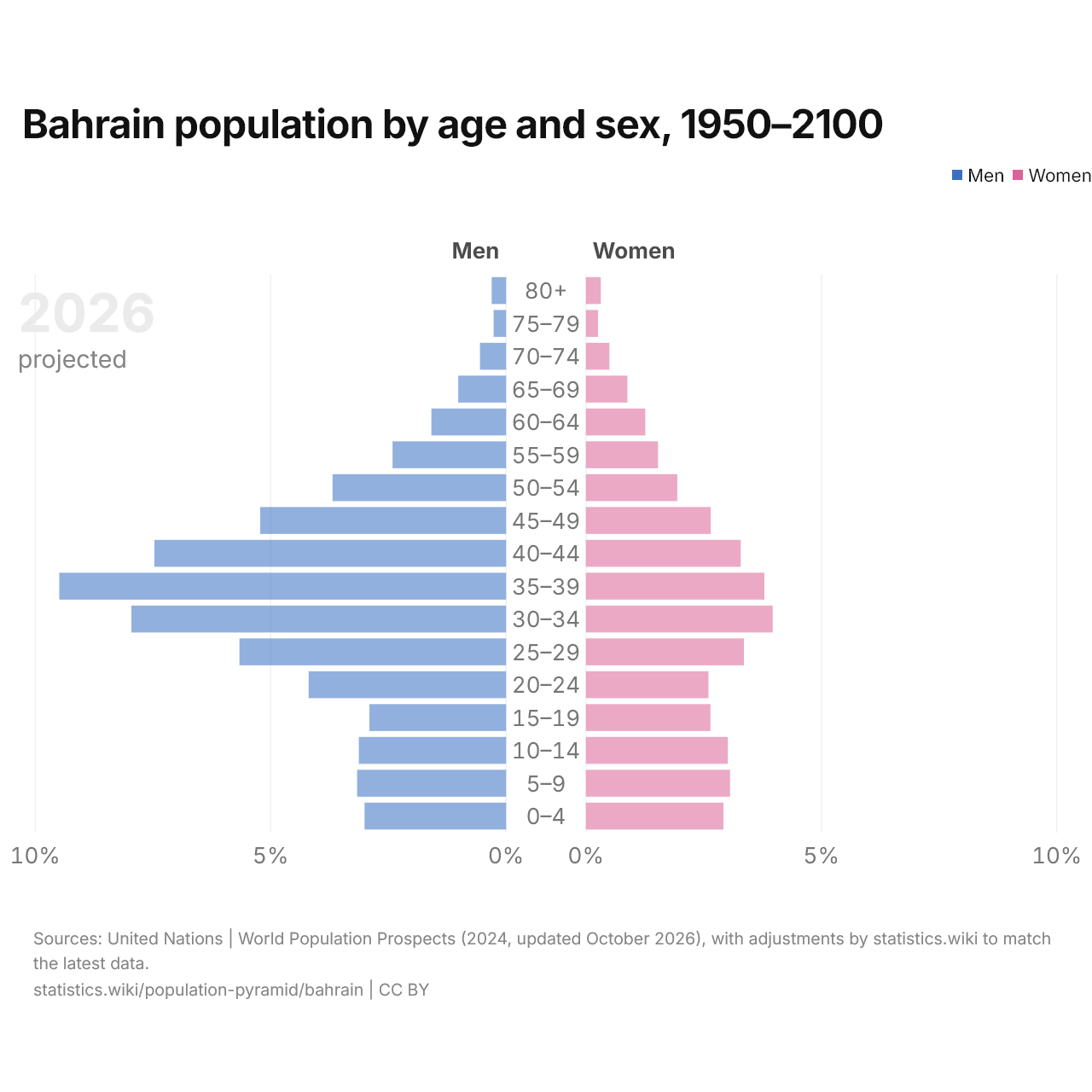
| Age (2026 projected) | Men | Women | Men, % of population | Women, % of population |
|---|---|---|---|---|
| 80+ | 5.01K | 5.15K | 0.3% | 0.3% |
| 75–79 | 4.35K | 4.21K | 0.3% | 0.3% |
| 70–74 | 9.09K | 8.17K | 0.6% | 0.5% |
| 65–69 | 16.6K | 14.4K | 1.0% | 0.9% |
| 60–64 | 25.9K | 20.6K | 1.6% | 1.3% |
| 55–59 | 39.4K | 25K | 2.4% | 1.5% |
| 50–54 | 60.2K | 31.7K | 3.7% | 1.9% |
| 45–49 | 85.3K | 43.3K | 5.2% | 2.7% |
| 40–44 | 122K | 53.7K | 7.5% | 3.3% |
| 35–39 | 155K | 61.9K | 9.5% | 3.8% |
| 30–34 | 130K | 64.8K | 8.0% | 4.0% |
| 25–29 | 92.5K | 54.8K | 5.7% | 3.4% |
| 20–24 | 68.5K | 42.5K | 4.2% | 2.6% |
| 15–19 | 47.4K | 43.2K | 2.9% | 2.6% |
| 10–14 | 51.1K | 49.2K | 3.1% | 3.0% |
| 5–9 | 51.7K | 50K | 3.2% | 3.1% |
| 0–4 | 49.1K | 47.7K | 3.0% | 2.9% |
| All ages | 1.01M | 620K | 62.0% | 38.0% |
In 2026, the largest age group in Bahrain is 35–39, with 13.3% of the population. Children aged 0–14 make up 18.3% of the population and people aged 65 and over 4.1%. Among people aged 65 and over in Bahrain, there are 109.8 men per 100 women. In 1950, the largest group was 0–4 (17.5%); children made up 42.3% of the population and people aged 65 and over 2.9%.
The youngest age group, 0–4, makes up 5.9% of Bahrain's population in 2026. The largest age group of men in Bahrain is 35–39 (155,000), and of women 30–34 (64,800).
Bahrain population pyramids by year, 1950–2100
- Men Women
1950
2000
2026 (projected)
2050 (projected)
2100 (projected)
Children aged 0–14 made up 42.3% of the population in 1950 and 30.0% in 2000; people aged 65 and over, 2.9% and 2.3%. By the UN's projections, children will make up 17.2% in 2050 and 16.6% in 2100, people aged 65 and over 8.4% and 15.3%, and the largest age group in 2100 will be 35–39.
Bahrain age structure, 1950–2100
| Measure | 1950 | 2000 | 2026 projected | 2050 projected | 2100 projected |
|---|---|---|---|---|---|
| Aged 0–14 | 42.3% | 30.0% | 18.3% | 17.2% | 16.6% |
| Aged 15–64 | 54.9% | 67.8% | 77.6% | 74.5% | 68.1% |
| Aged 65+ | 2.9% | 2.3% | 4.1% | 8.4% | 15.3% |
| Median age | 18.9 | 26.4 | 34.4 | 35.9 | 37.6 |
| Men per 100 women | 117.7 | 144.4 | 163.4 | 149.0 | 130.5 |
Compare the Bahrain population pyramid with other countries
Sources:
- United Nations | World Population Prospects (1950–2100, updated October 2026), with adjustments by statistics.wiki to match the latest data
Creative Commons Attribution (CC BY): you may copy, share, adapt and reuse this content, also commercially, as long as you credit statistics.wiki and note any changes you made. The sources listed above may have their own license terms.