
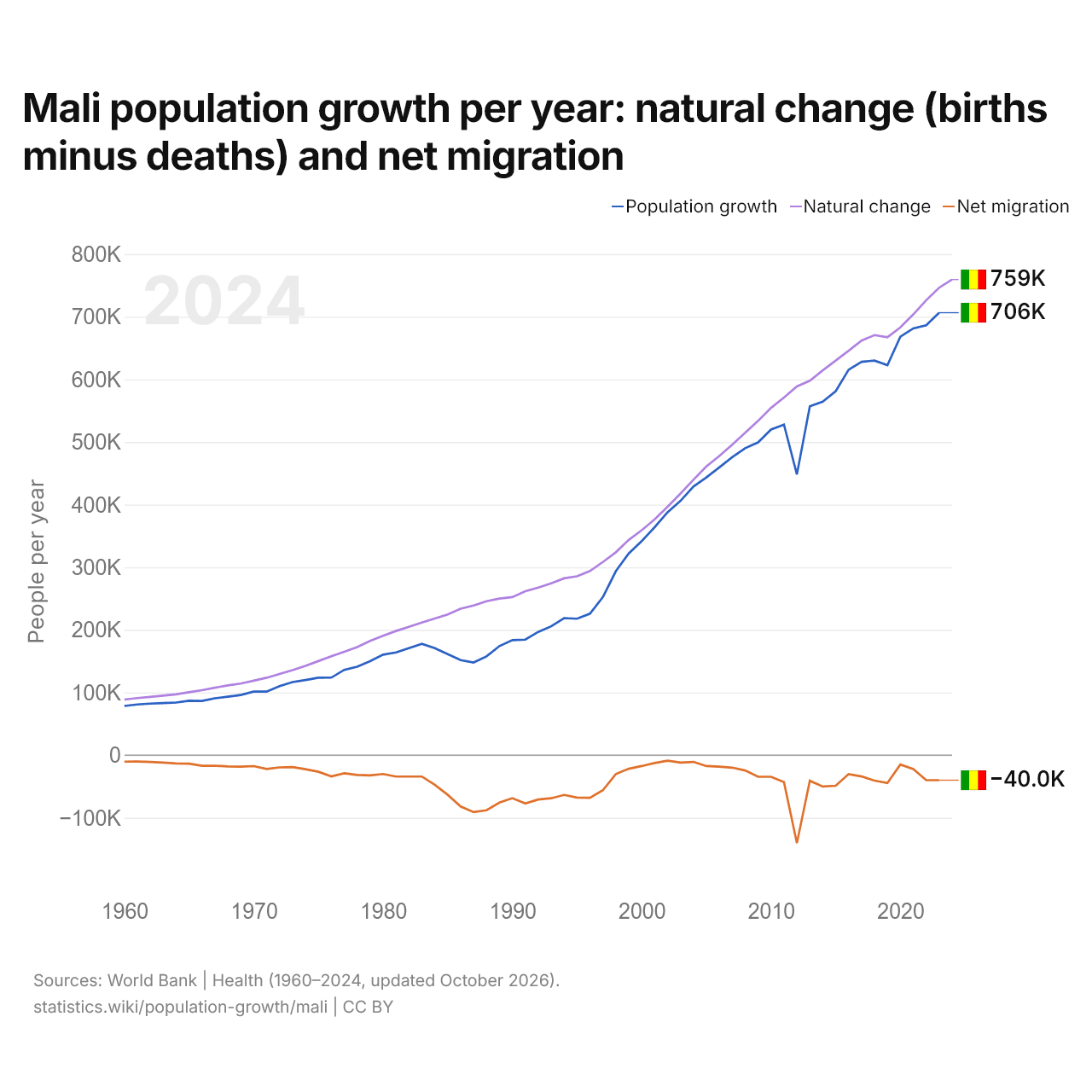
Mali population growth per year: natural change (births minus deaths) and net migration
| Year | People per year | ||
|---|---|---|---|
| Population growth | Natural change | Net migration | |
| 2024 | - | 759,375 | - |
| 2023 | 706,445 | 746,398 | −39,953 |
| 2022 | 686,514 | 726,465 | −39,951 |
| 2021 | 681,464 | 703,674 | −22,210 |
| 2020 | 668,091 | 683,053 | −14,962 |
| 2019 | 622,737 | 667,110 | −44,373 |
| 2018 | 630,013 | 670,723 | −40,710 |
| 2017 | 628,031 | 661,973 | −33,942 |
| 2016 | 615,401 | 645,652 | −30,251 |
| 2015 | 581,134 | 630,006 | −48,872 |
| 2014 | 564,351 | 614,419 | −50,068 |
| 2013 | 556,936 | 597,887 | −40,951 |
| 2012 | 448,241 | 588,748 | −140,507 |
| 2011 | 527,739 | 570,899 | −43,160 |
| 2010 | 519,964 | 554,447 | −34,483 |
| 2009 | 499,347 | 533,730 | −34,383 |
| 2008 | 490,156 | 514,665 | −24,509 |
| 2007 | 475,855 | 495,800 | −19,945 |
| 2006 | 459,418 | 477,665 | −18,247 |
| 2005 | 443,551 | 460,964 | −17,413 |
| 2004 | 428,921 | 439,717 | −10,796 |
| 2003 | 405,998 | 417,766 | −11,768 |
| 2002 | 387,818 | 396,732 | −8,914 |
| 2001 | 363,965 | 376,472 | −12,507 |
| 2000 | 341,764 | 359,159 | −17,395 |
| 1999 | 322,003 | 343,705 | −21,702 |
| 1998 | 293,685 | 323,940 | −30,255 |
| 1997 | 252,451 | 308,429 | −55,978 |
| 1996 | 225,979 | 293,953 | −67,974 |
| 1995 | 217,835 | 285,598 | −67,763 |
| 1994 | 218,823 | 282,356 | −63,533 |
| 1993 | 205,664 | 274,480 | −68,816 |
| 1992 | 196,816 | 267,605 | −70,789 |
| 1991 | 184,484 | 261,656 | −77,172 |
| 1990 | 183,640 | 252,308 | −68,668 |
| 1989 | 174,158 | 249,929 | −75,771 |
| 1988 | 157,730 | 245,682 | −87,952 |
| 1987 | 147,931 | 238,871 | −90,940 |
| 1986 | 151,829 | 233,799 | −81,970 |
| 1985 | 161,387 | 224,734 | −63,347 |
| 1984 | 170,747 | 218,078 | −47,331 |
| 1983 | 177,663 | 211,795 | −34,132 |
| 1982 | 170,752 | 204,892 | −34,140 |
| 1981 | 164,097 | 198,227 | −34,130 |
| 1980 | 160,404 | 190,560 | −30,156 |
| 1979 | 150,096 | 182,449 | −32,353 |
| 1978 | 141,132 | 172,652 | −31,520 |
| 1977 | 136,218 | 165,071 | −28,853 |
| 1976 | 123,779 | 157,778 | −33,999 |
| 1975 | 123,650 | 150,222 | −26,572 |
| 1974 | 119,999 | 142,448 | −22,449 |
| 1973 | 116,664 | 135,801 | −19,137 |
| 1972 | 110,093 | 129,687 | −19,594 |
| 1971 | 101,464 | 123,591 | −22,127 |
| 1970 | 101,473 | 118,952 | −17,479 |
| 1969 | 96,059 | 114,361 | −18,302 |
| 1968 | 93,388 | 111,403 | −18,015 |
| 1967 | 90,750 | 107,650 | −16,900 |
| 1966 | 86,652 | 103,684 | −17,032 |
| 1965 | 86,789 | 100,451 | −13,662 |
| 1964 | 83,940 | 97,166 | −13,226 |
| 1963 | 83,104 | 95,055 | −11,951 |
| 1962 | 82,280 | 93,101 | −10,821 |
| 1961 | 80,976 | 91,115 | −10,139 |
| 1960 | 78,488 | 88,802 | −10,314 |
Mali's population grows by 706,445 people a year (2023): births outnumber deaths by 746,398, and 39,953 more people leave than move in. In Mali, births have outnumbered deaths every year since 1960, and more people have left than moved in every year since 1960.
Since 1960, births in Mali have outnumbered deaths by 21.1 million in total, and 2.37 million more people have left than moved in. In the ten years from 2014, births outnumbered deaths in Mali by 6.75 million, and 365,292 more people left than moved in.
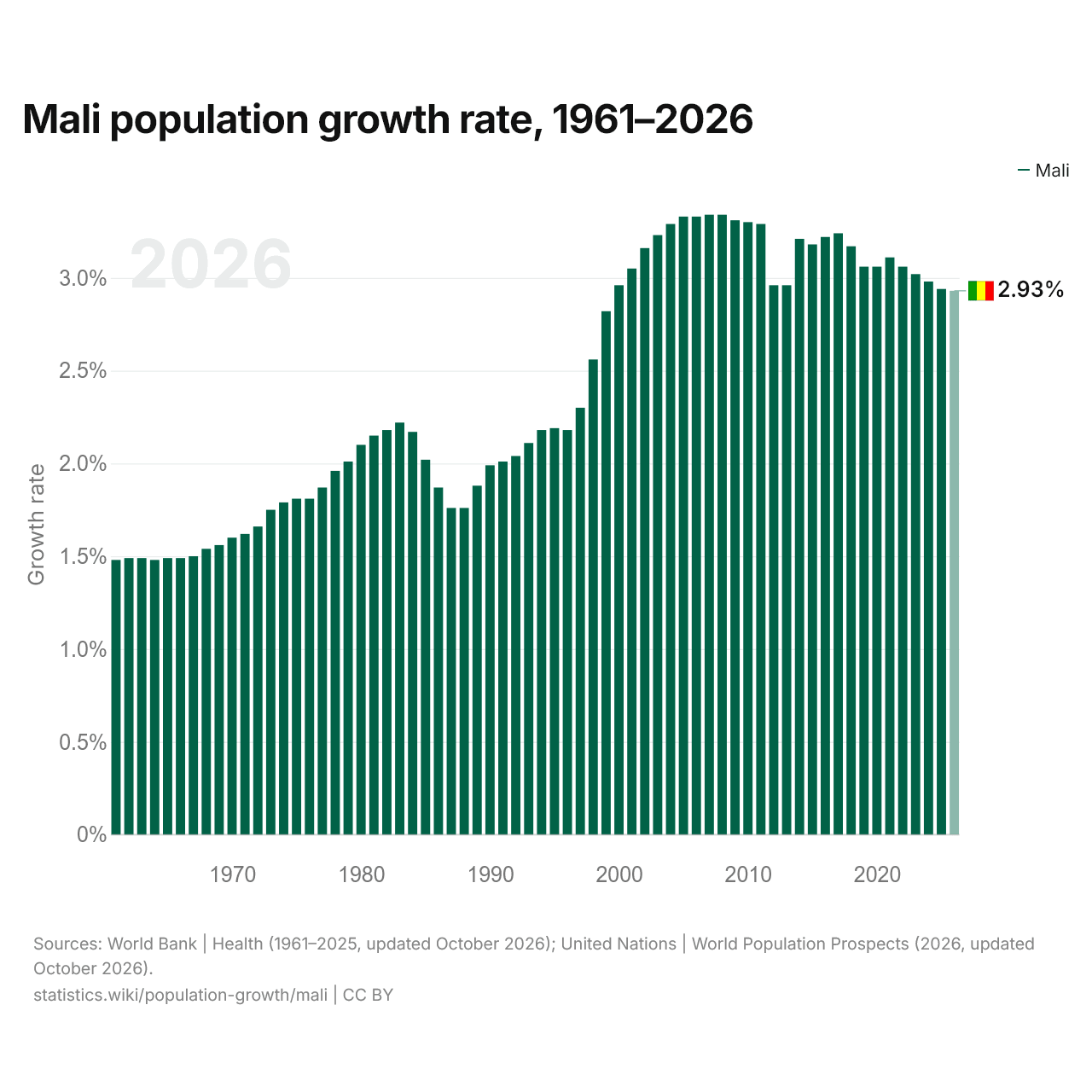
Mali population growth rate, 1961–2026
| Year | Growth rate |
|---|---|
| Mali | |
| 2026 projected | 2.93% |
| 2025 | 2.94% |
| 2024 | 2.98% |
| 2023 | 3.02% |
| 2022 | 3.06% |
| 2021 | 3.11% |
| 2020 | 3.06% |
| 2019 | 3.06% |
| 2018 | 3.17% |
| 2017 | 3.24% |
| 2016 | 3.22% |
| 2015 | 3.18% |
| 2014 | 3.21% |
| 2013 | 2.96% |
| 2012 | 2.96% |
| 2011 | 3.29% |
| 2010 | 3.3% |
| 2009 | 3.31% |
| 2008 | 3.34% |
| 2007 | 3.34% |
| 2006 | 3.33% |
| 2005 | 3.33% |
| 2004 | 3.29% |
| 2003 | 3.23% |
| 2002 | 3.16% |
| 2001 | 3.05% |
| 2000 | 2.96% |
| 1999 | 2.82% |
| 1998 | 2.56% |
| 1997 | 2.3% |
| 1996 | 2.18% |
| 1995 | 2.19% |
| 1994 | 2.18% |
| 1993 | 2.11% |
| 1992 | 2.04% |
| 1991 | 2.01% |
| 1990 | 1.99% |
| 1989 | 1.88% |
| 1988 | 1.76% |
| 1987 | 1.76% |
| 1986 | 1.87% |
| 1985 | 2.02% |
| 1984 | 2.17% |
| 1983 | 2.22% |
| 1982 | 2.18% |
| 1981 | 2.15% |
| 1980 | 2.1% |
| 1979 | 2.01% |
| 1978 | 1.96% |
| 1977 | 1.87% |
| 1976 | 1.81% |
| 1975 | 1.81% |
| 1974 | 1.79% |
| 1973 | 1.75% |
| 1972 | 1.66% |
| 1971 | 1.62% |
| 1970 | 1.6% |
| 1969 | 1.56% |
| 1968 | 1.54% |
| 1967 | 1.5% |
| 1966 | 1.49% |
| 1965 | 1.49% |
| 1964 | 1.48% |
| 1963 | 1.49% |
| 1962 | 1.49% |
| 1961 | 1.48% |
Mali's population grows by 2.9% in 2026. It has grown every year since 1961. Growth in Mali was highest in 2007, at 3.3%; the lowest growth was 1.5%, in 1961.
Mali's population growth in 2026 is the 7th highest of the 54 countries of Africa, where it ranges from Mauritius' fall of 0.2% to the Central African Republic's growth of 3.4%.
Mali population growth, 2026
| Growth rate | +2.93% |
|---|---|
| Population change | +738,621 |
| Average yearly growth, 2021–2026 | +2.99% |
| Average yearly growth, 2016–2026 | +3.06% |
| World rank | 10/197 |
| Doubling time at the 2016–2026 rate | 23 years |
Compare Mali population growth with other countries
Sources:
- World Bank | Health (1960–2025, updated October 2026)
- United Nations | World Population Prospects (2026, updated October 2026)
Creative Commons Attribution (CC BY): you may copy, share, adapt and reuse this content, also commercially, as long as you credit statistics.wiki and note any changes you made. The sources listed above may have their own license terms.