
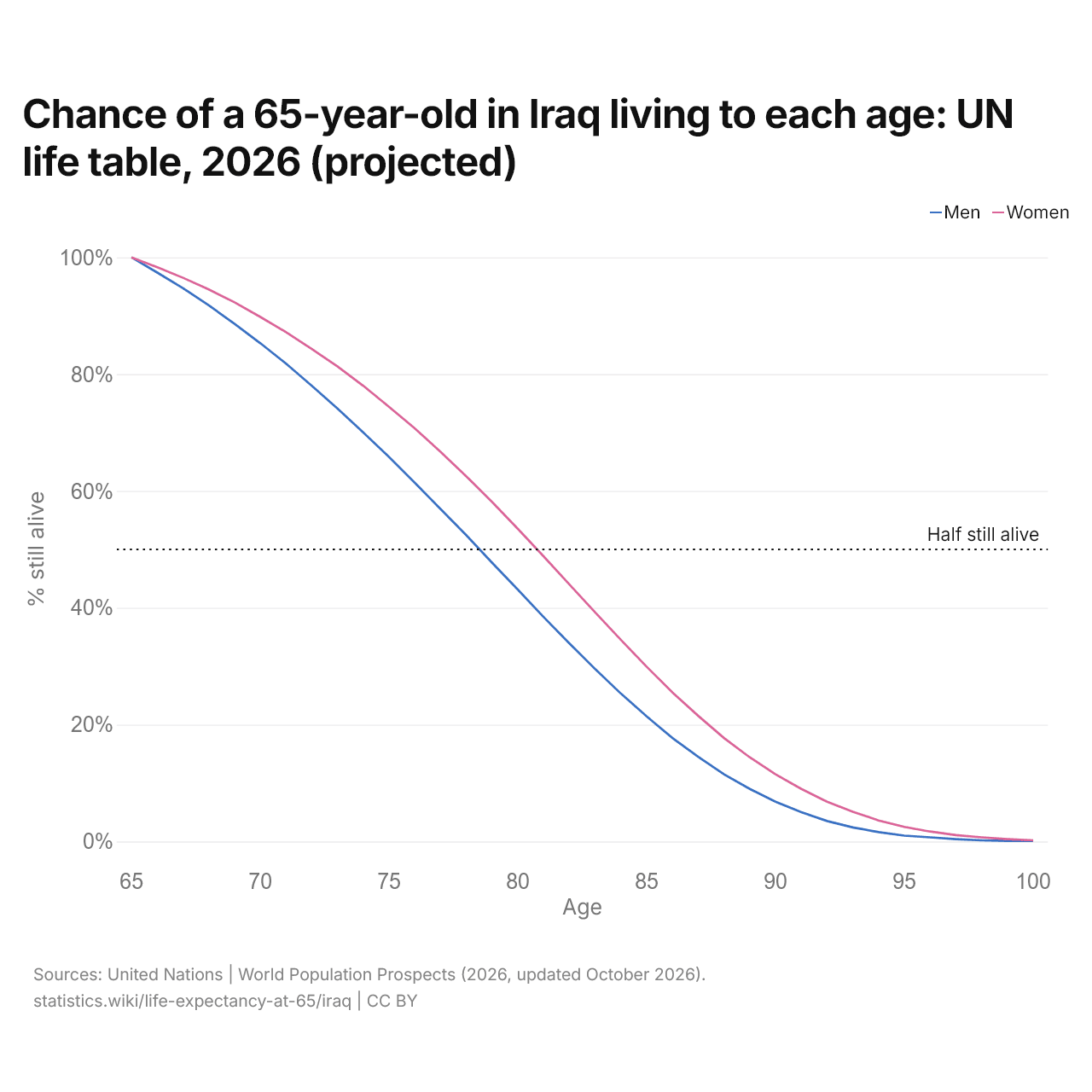
Chance of a 65-year-old in Iraq living to each age: UN life table, 2026 (projected)
| Age | % still alive | |
|---|---|---|
| Men | Women | |
| 65 | 100% | 100% |
| 66 | 97.4% | 98.3% |
| 67 | 94.7% | 96.5% |
| 68 | 91.8% | 94.5% |
| 69 | 88.6% | 92.3% |
| 70 | 85.3% | 89.8% |
| 71 | 81.8% | 87.2% |
| 72 | 78% | 84.3% |
| 73 | 74.1% | 81.3% |
| 74 | 70% | 78% |
| 75 | 65.8% | 74.4% |
| 76 | 61.4% | 70.7% |
| 77 | 56.9% | 66.7% |
| 78 | 52.4% | 62.5% |
| 79 | 47.7% | 58.1% |
| 80 | 43.1% | 53.5% |
| 81 | 38.4% | 48.8% |
| 82 | 33.9% | 44% |
| 83 | 29.5% | 39.2% |
| 84 | 25.3% | 34.5% |
| 85 | 21.4% | 29.9% |
| 86 | 17.7% | 25.5% |
| 87 | 14.5% | 21.5% |
| 88 | 11.5% | 17.7% |
| 89 | 9% | 14.4% |
| 90 | 6.8% | 11.5% |
| 91 | 5% | 9% |
| 92 | 3.5% | 6.8% |
| 93 | 2.4% | 5.1% |
| 94 | 1.6% | 3.6% |
| 95 | 1% | 2.5% |
| 96 | 0.7% | 1.7% |
| 97 | 0.4% | 1.1% |
| 98 | 0.2% | 0.7% |
| 99 | 0.1% | 0.4% |
| 100 | 0.1% | 0.2% |
In 2026, half of the men in Iraq who reach 65 live to 78 or older, and half of the women to 80 or older. A 65-year-old man has a 6.8% chance of living to 90 and a woman 11.5%; the chances of living to 100 are 0.1% and 0.2%.
Life expectancy at 60–80 in Iraq: UN life table, 2026 (projected)
| Age | Men | Women | Both sexes |
|---|---|---|---|
| 60 | 17.1 | 19.5 | 18.4 |
| 65 | 13.6 | 15.6 | 14.7 |
| 70 | 10.5 | 12.0 | 11.4 |
| 75 | 7.9 | 9.0 | 8.5 |
| 80 | 5.7 | 6.5 | 6.2 |
| Age | Men | Women | Both sexes |
|---|---|---|---|
| 60 | 77.1 | 79.5 | 78.4 |
| 65 | 78.6 | 80.6 | 79.7 |
| 70 | 80.5 | 82.0 | 81.4 |
| 75 | 82.9 | 84.0 | 83.5 |
| 80 | 85.7 | 86.5 | 86.2 |
At 60, men in Iraq live another 17.1 years on average and women another 19.5; at 80, men another 5.7 and women another 6.5.
Iraq and its neighbors: life expectancy at 65, UN life tables, 2026 (projected)


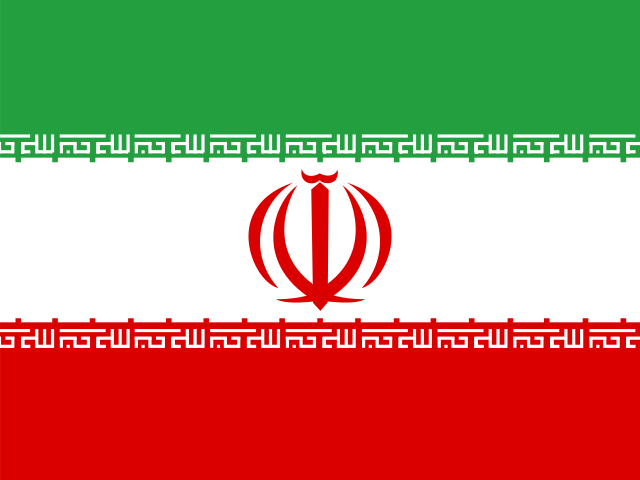
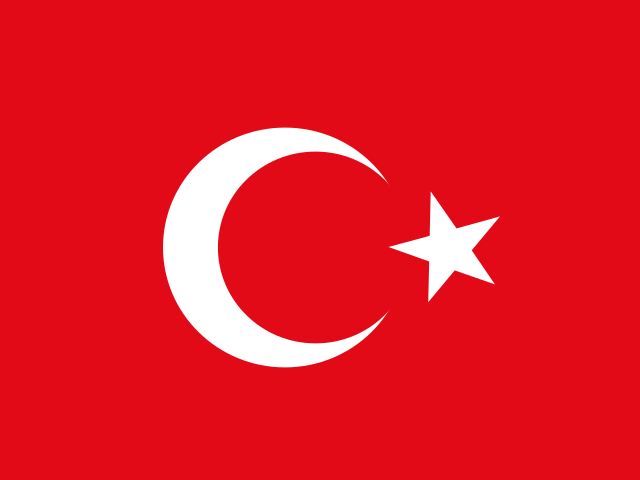
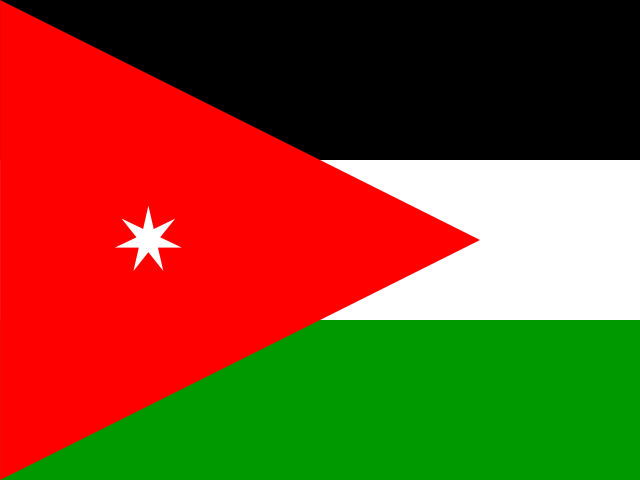
Of Iraq and its six neighbors, life expectancy at 65 is highest in Kuwait, at 18.7 years, and lowest in Iraq, at 14.7.
Iraq in the world ranking of life expectancy at 65: UN life tables, 2026 (projected)




Compare life expectancy at 65 in Iraq with other countries
Sources:
- United Nations | World Population Prospects (2026, updated October 2026)
Creative Commons Attribution (CC BY): you may copy, share, adapt and reuse this content, also commercially, as long as you credit statistics.wiki and note any changes you made. The sources listed above may have their own license terms.