
Paraguay energy consumption by year
| Year | Energy consumption, TWh | World rank |
|---|---|---|
| Paraguay | ||
| 2024 | 85.1 | #103 |
| 2023 | 77.9 | #104 |
| 2022 | 74.9 | #104 |
| 2021 | 78.6 | #102 |
| 2020 | 81.1 | #102 |
| 2019 | 83.8 | #102 |
| 2018 | 84.5 | #102 |
| 2017 | 82.3 | #100 |
| 2016 | 78 | #102 |
| 2015 | 66.3 | #105 |
| 2014 | 60.7 | #109 |
| 2013 | 58.1 | #111 |
| 2012 | 57.5 | #108 |
| 2011 | 57.2 | #108 |
| 2010 | 56.4 | #108 |
| 2009 | 53 | #106 |
| 2008 | 51.9 | #108 |
| 2007 | 48.4 | #110 |
| 2006 | 47.5 | #110 |
| 2005 | 46.1 | #107 |
| 2004 | 46.7 | #106 |
| 2003 | 46.3 | #105 |
| 2002 | 45.3 | #105 |
| 2001 | 45.6 | #104 |
| 2000 | 44.9 | #103 |
| 1999 | 48 | #103 |
| 1998 | 50.1 | #103 |
| 1997 | 50.7 | #103 |
| 1996 | 46.6 | #104 |
| 1995 | 45.6 | #103 |
| 1994 | 41.7 | #104 |
| 1993 | 38.2 | #107 |
| 1992 | 36.7 | #110 |
| 1991 | 36.9 | #108 |
| 1990 | 35.7 | #109 |
| 1989 | 36.8 | #85 |
| 1988 | 33.8 | #87 |
| 1987 | 31.6 | #87 |
| 1986 | 27.4 | #89 |
| 1985 | 26.3 | #90 |
| 1984 | 25.7 | #90 |
| 1983 | 25.3 | #89 |
| 1982 | 24.7 | #91 |
| 1981 | 24.2 | #91 |
| 1980 | 24.2 | #91 |
| 1979 | 22.4 | #92 |
| 1978 | 22.1 | #90 |
| 1977 | 19.8 | #93 |
| 1976 | 18.2 | #94 |
| 1975 | 17.1 | #94 |
| 1974 | 17.5 | #91 |
| 1973 | 17.7 | #90 |
| 1972 | 16.3 | #91 |
| 1971 | 15.9 | #91 |
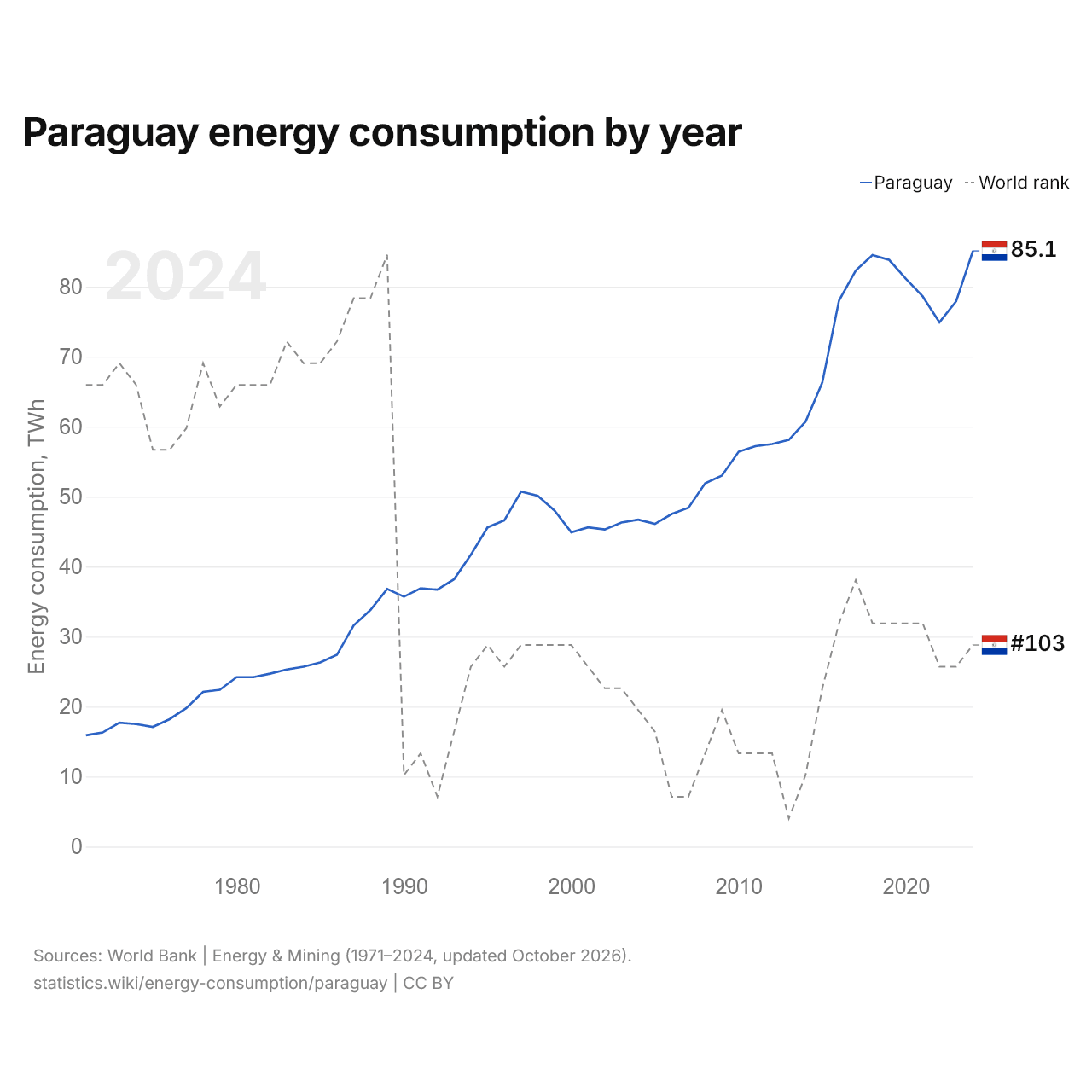
Energy consumption in Paraguay is 85.1 TWh, up from 15.9 TWh in 1971. It is the 103rd largest energy consumer in the world, up from 104th the year before. Its highest rank was 85th, last held in 1989.
Paraguay's energy consumption is the 14th largest of 24 countries in Latin America. Paraguay's electricity consumption is 2,849 kWh per person, the 70th highest in the world. The renewable share of final energy consumption in Paraguay is 58.8%, the 38th highest in the world.
Paraguay energy consumption per capita by year
| Year | Energy consumption, kWh per person | World rank |
|---|---|---|
| Paraguay | ||
| 2024 | 12,285 | #87 |
| 2023 | 11,377 | #90 |
| 2022 | 11,080 | #92 |
| 2021 | 11,761 | #86 |
| 2020 | 12,287 | #85 |
| 2019 | 12,858 | #87 |
| 2018 | 13,148 | #85 |
| 2017 | 12,983 | #90 |
| 2016 | 12,474 | #90 |
| 2015 | 10,760 | #97 |
| 2014 | 10,000 | #101 |
| 2013 | 9,709 | #101 |
| 2012 | 9,754 | #101 |
| 2011 | 9,843 | #102 |
| 2010 | 9,837 | #98 |
| 2009 | 9,349 | #101 |
| 2008 | 9,247 | #100 |
| 2007 | 8,709 | #103 |
| 2006 | 8,631 | #103 |
| 2005 | 8,463 | #104 |
| 2004 | 8,666 | #100 |
| 2003 | 8,690 | #92 |
| 2002 | 8,609 | #91 |
| 2001 | 8,798 | #90 |
| 2000 | 8,801 | #93 |
| 1999 | 9,586 | #89 |
| 1998 | 10,232 | #86 |
| 1997 | 10,579 | #83 |
| 1996 | 9,949 | #87 |
| 1995 | 9,960 | #87 |
| 1994 | 9,329 | #90 |
| 1993 | 8,745 | #93 |
| 1992 | 8,639 | #94 |
| 1991 | 8,903 | #93 |
| 1990 | 8,856 | #94 |
| 1989 | 9,367 | #64 |
| 1988 | 8,839 | #66 |
| 1987 | 8,504 | #68 |
| 1986 | 7,578 | #72 |
| 1985 | 7,483 | #72 |
| 1984 | 7,539 | #70 |
| 1983 | 7,613 | #69 |
| 1982 | 7,654 | #69 |
| 1981 | 7,714 | #68 |
| 1980 | 7,941 | #64 |
| 1979 | 7,545 | #65 |
| 1978 | 7,628 | #64 |
| 1977 | 7,008 | #70 |
| 1976 | 6,607 | #71 |
| 1975 | 6,369 | #69 |
| 1974 | 6,675 | #68 |
| 1973 | 6,899 | #67 |
| 1972 | 6,531 | #67 |
| 1971 | 6,516 | #65 |
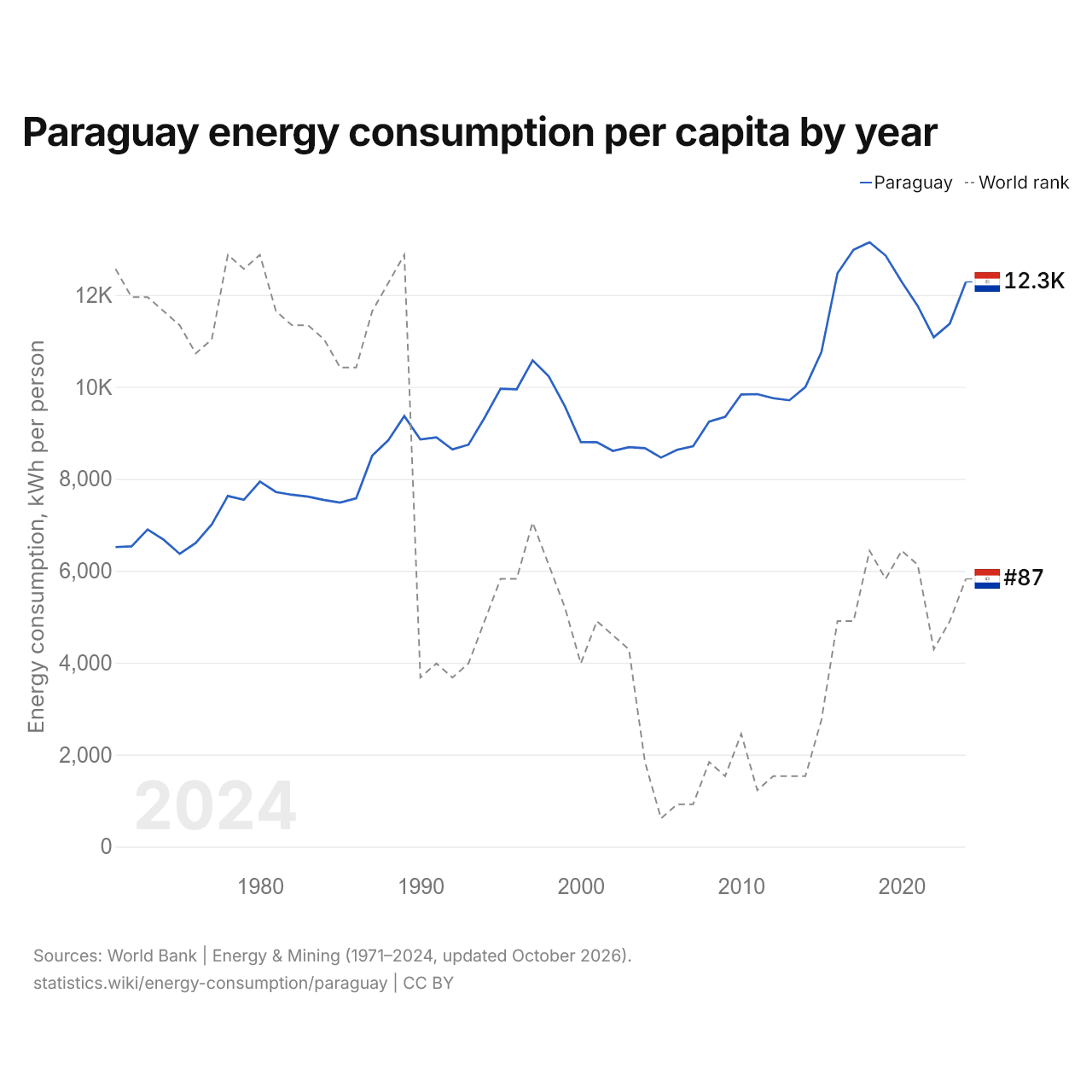
Energy consumption in Paraguay is 12,285 kWh per person, up from 6,516 kWh in 1971. Its consumption per person was highest in 2018, at 13,148 kWh. It is the 87th highest in the world, up from 90th the year before. Its highest rank was 64th, last held in 1989.
Paraguay energy use by source: fossil fuels vs alternative and nuclear, %
| Year | Share of energy use, % | |
|---|---|---|
| Fossil fuels | Alternative and nuclear | |
| 2024 | - | 49.9% |
| 2023 | - | 67.8% |
| 2022 | 34.8% | 58.6% |
| 2021 | 37.3% | 51.6% |
| 2020 | 34.9% | 57.2% |
| 2019 | 36.4% | 59% |
| 2018 | 37.3% | 70.1% |
| 2017 | 36.5% | 72.5% |
| 2016 | 34.3% | 81.8% |
| 2015 | 35.5% | 84.1% |
| 2014 | 34.3% | 91.1% |
| 2013 | 34.2% | 100% |
| 2012 | 33.1% | 100% |
| 2011 | 34.3% | 100% |
| 2010 | 33.1% | 95.8% |
| 2009 | 31.5% | 100% |
| 2008 | 30.5% | 100% |
| 2007 | 28.2% | 100% |
| 2006 | 30.4% | 100% |
| 2005 | 29.1% | 100% |
| 2004 | 31.3% | 100% |
| 2003 | 31.2% | 100% |
| 2002 | 30.7% | 100% |
| 2001 | 28.9% | 99.3% |
| 2000 | 28.4% | 100% |
| 1999 | 32.6% | 100% |
| 1998 | 31% | 100% |
| 1997 | 29% | 100% |
| 1996 | 28.4% | 96% |
| 1995 | 29.5% | 92.3% |
| 1994 | 28.5% | 87.3% |
| 1993 | 26.6% | 82.3% |
| 1992 | 23.9% | 73.8% |
| 1991 | 20.1% | 79.5% |
| 1990 | 21.3% | 76% |
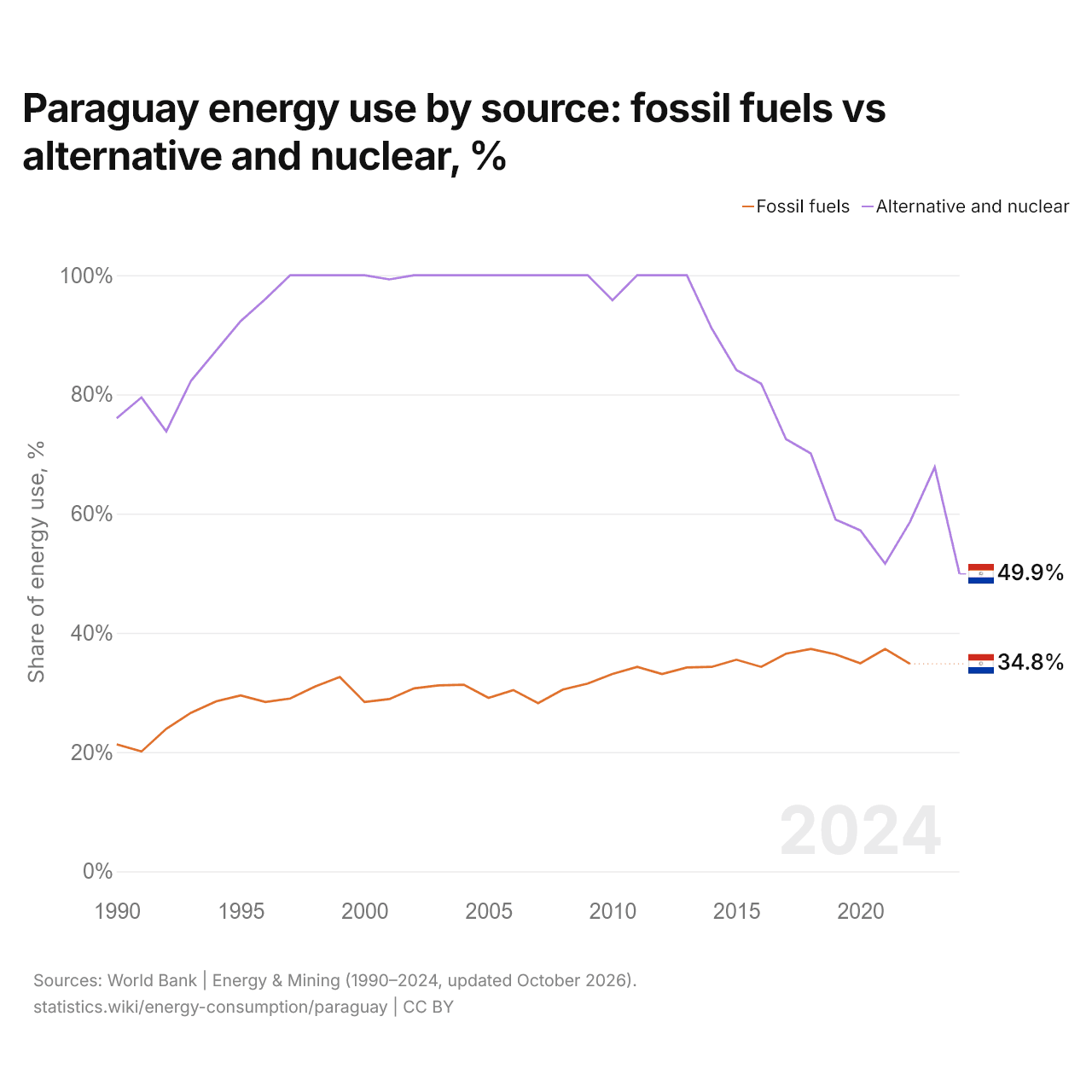
Fossil fuels made up 34.8% of Paraguay's energy use and alternative and nuclear energy 58.6%. In 1990, Paraguay's shares were 21.3% and 76.0%.
Paraguay net energy imports (imports minus exports), % of energy use
| Year | % of energy use |
|---|---|
| Paraguay | |
| 2024 | 16.7% |
| 2023 | −5.7% |
| 2022 | 6.2% |
| 2021 | 10.6% |
| 2020 | 0.8% |
| 2019 | −1.5% |
| 2018 | −12.5% |
| 2017 | −18.4% |
| 2016 | −27% |
| 2015 | −27.1% |
| 2014 | −34.5% |
| 2013 | −50.8% |
| 2012 | −50.6% |
| 2011 | −51.2% |
| 2010 | −48.3% |
| 2009 | −56.1% |
| 2008 | −64.9% |
| 2007 | −71% |
| 2006 | −70.3% |
| 2005 | −66.3% |
| 2004 | −64.9% |
| 2003 | −67.5% |
| 2002 | −60.8% |
| 2001 | −56.2% |
| 2000 | −75.7% |
| 1999 | −64.5% |
| 1998 | −58.3% |
| 1997 | −61.2% |
| 1996 | −61% |
| 1995 | −55.4% |
| 1994 | −48.7% |
| 1993 | −49.2% |
| 1992 | −43.5% |
| 1991 | −53.7% |
| 1990 | −48.1% |
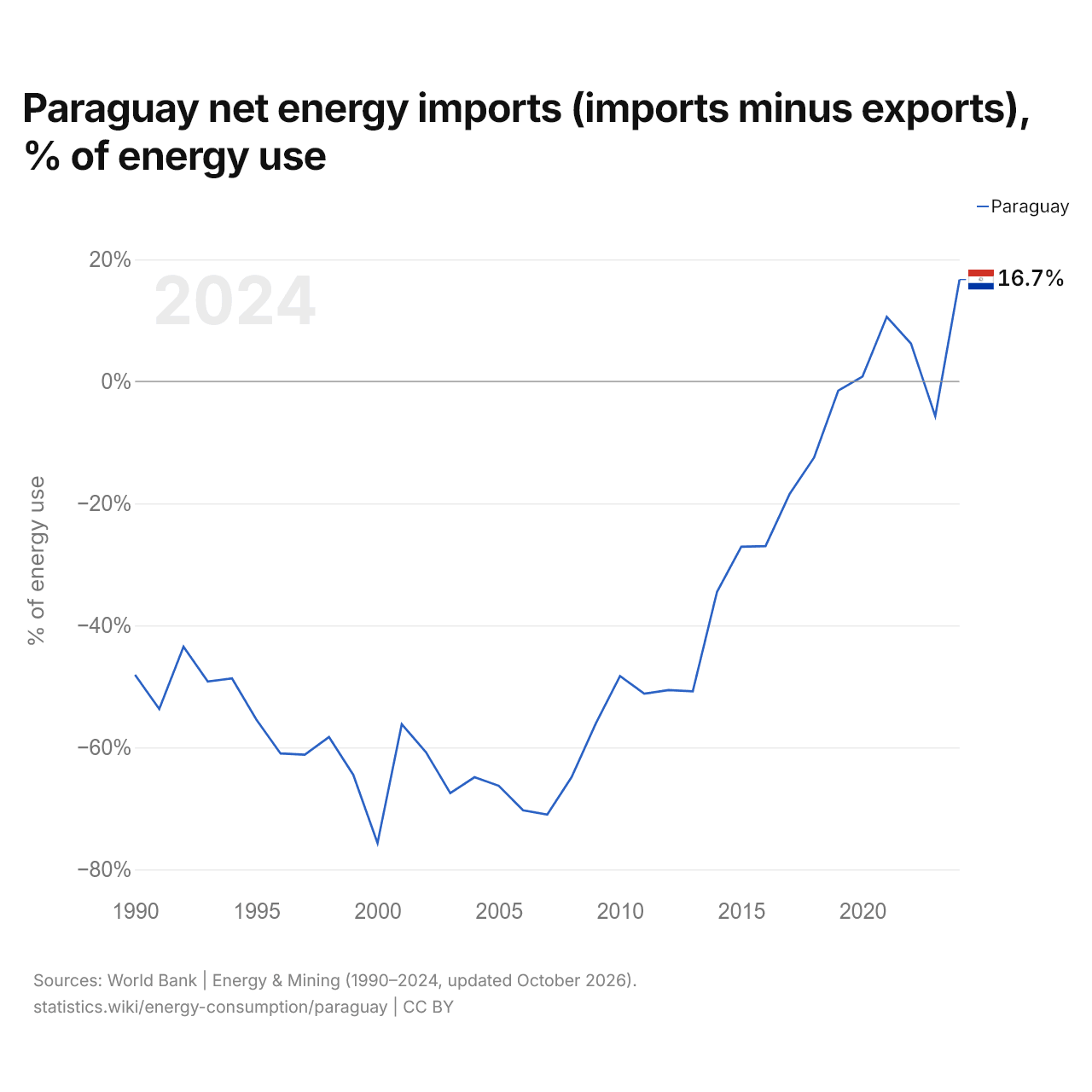
Paraguay's net energy imports equal 16.7% of its energy use; in 1990, its net exports equaled 48.1%.
Paraguay in the world energy consumption ranking
| Rank | Country | TWh | kWh per person | |
|---|---|---|---|---|
| 100 |
 Zimbabwe |
94.8 | 5,701 | |
| 101 |
 Burkina Faso |
91.1 | 3,869 | |
| 102 |
 Lithuania |
85.7 | 29,679 | |
| 103 |
 Paraguay |
85.1 | 12,285 | |
| 104 |
 Bosnia |
80.1 | 25,328 | |
| 105 |
 Uruguay |
77.2 | 22,786 | vs Uruguay |
| 106 |
 Laos |
76.1 | 9,793 |
Compare the energy consumption of Paraguay with other countries
Sources:
- World Bank | Energy & Mining (1971–2024, updated October 2026)
Creative Commons Attribution (CC BY): you may copy, share, adapt and reuse this content, also commercially, as long as you credit statistics.wiki and note any changes you made. The sources listed above may have their own license terms.