
Sweden vs Germany: chance of a newborn living to 100, 90, 80 and 65, UN life tables, 2026 (projected)

In 2026, 2.2% of newborns would live to 100 in Sweden and 1.6% in Germany.
For boys, the chance of living to 100 is 1.2% in Sweden and 0.87% in Germany; for girls, it is 3.2% and 2.2%.
Sweden vs Germany: chance of a newborn reaching each age, UN life tables, 2026 (projected)
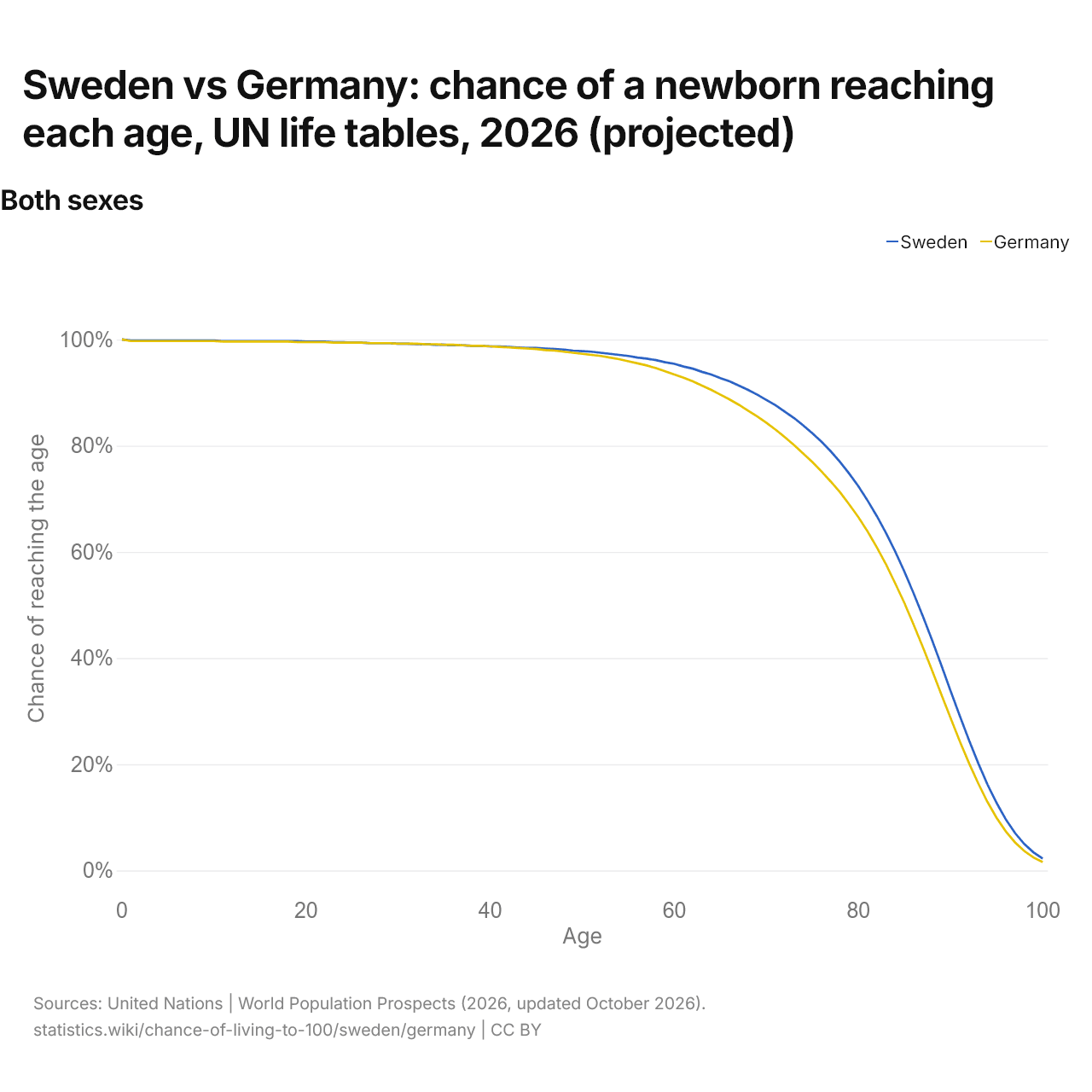
| Age | Chance of reaching the age | |
|---|---|---|
| Sweden | Germany | |
| 0 | 100% | 100% |
| 1 | 99.8% | 99.7% |
| 2 | 99.8% | 99.7% |
| 3 | 99.8% | 99.7% |
| 4 | 99.8% | 99.7% |
| 5 | 99.8% | 99.7% |
| 6 | 99.8% | 99.7% |
| 7 | 99.8% | 99.7% |
| 8 | 99.8% | 99.7% |
| 9 | 99.8% | 99.7% |
| 10 | 99.8% | 99.7% |
| 11 | 99.7% | 99.6% |
| 12 | 99.7% | 99.6% |
| 13 | 99.7% | 99.6% |
| 14 | 99.7% | 99.6% |
| 15 | 99.7% | 99.6% |
| 16 | 99.7% | 99.6% |
| 17 | 99.7% | 99.6% |
| 18 | 99.7% | 99.6% |
| 19 | 99.7% | 99.5% |
| 20 | 99.6% | 99.5% |
| 21 | 99.6% | 99.5% |
| 22 | 99.6% | 99.5% |
| 23 | 99.5% | 99.4% |
| 24 | 99.5% | 99.4% |
| 25 | 99.4% | 99.4% |
| 26 | 99.4% | 99.4% |
| 27 | 99.3% | 99.3% |
| 28 | 99.3% | 99.3% |
| 29 | 99.3% | 99.3% |
| 30 | 99.2% | 99.2% |
| 31 | 99.2% | 99.2% |
| 32 | 99.1% | 99.2% |
| 33 | 99.1% | 99.1% |
| 34 | 99% | 99.1% |
| 35 | 99% | 99% |
| 36 | 98.9% | 99% |
| 37 | 98.9% | 98.9% |
| 38 | 98.8% | 98.8% |
| 39 | 98.8% | 98.8% |
| 40 | 98.7% | 98.7% |
| 41 | 98.7% | 98.6% |
| 42 | 98.6% | 98.5% |
| 43 | 98.5% | 98.4% |
| 44 | 98.4% | 98.3% |
| 45 | 98.4% | 98.2% |
| 46 | 98.3% | 98% |
| 47 | 98.2% | 97.9% |
| 48 | 98.1% | 97.7% |
| 49 | 97.9% | 97.5% |
| 50 | 97.8% | 97.3% |
| 51 | 97.7% | 97.1% |
| 52 | 97.5% | 96.9% |
| 53 | 97.3% | 96.6% |
| 54 | 97.1% | 96.3% |
| 55 | 96.9% | 95.9% |
| 56 | 96.6% | 95.5% |
| 57 | 96.4% | 95.1% |
| 58 | 96.1% | 94.6% |
| 59 | 95.7% | 94% |
| 60 | 95.4% | 93.4% |
| 61 | 94.9% | 92.8% |
| 62 | 94.5% | 92.1% |
| 63 | 93.9% | 91.3% |
| 64 | 93.4% | 90.5% |
| 65 | 92.7% | 89.6% |
| 66 | 92.1% | 88.7% |
| 67 | 91.3% | 87.7% |
| 68 | 90.5% | 86.6% |
| 69 | 89.6% | 85.5% |
| 70 | 88.6% | 84.3% |
| 71 | 87.6% | 83% |
| 72 | 86.4% | 81.6% |
| 73 | 85.2% | 80.1% |
| 74 | 83.8% | 78.5% |
| 75 | 82.3% | 76.9% |
| 76 | 80.7% | 75.1% |
| 77 | 78.9% | 73.2% |
| 78 | 76.9% | 71.2% |
| 79 | 74.7% | 68.9% |
| 80 | 72.3% | 66.5% |
| 81 | 69.6% | 63.8% |
| 82 | 66.7% | 60.8% |
| 83 | 63.5% | 57.6% |
| 84 | 60% | 54% |
| 85 | 56.2% | 50.3% |
| 86 | 52.1% | 46.2% |
| 87 | 47.8% | 42% |
| 88 | 43.3% | 37.6% |
| 89 | 38.6% | 33.1% |
| 90 | 33.8% | 28.7% |
| 91 | 29.1% | 24.3% |
| 92 | 24.5% | 20.2% |
| 93 | 20.2% | 16.4% |
| 94 | 16.2% | 12.9% |
| 95 | 12.7% | 9.89% |
| 96 | 9.59% | 7.35% |
| 97 | 7.04% | 5.28% |
| 98 | 4.99% | 3.66% |
| 99 | 3.41% | 2.44% |
| 100 | 2.24% | 1.57% |
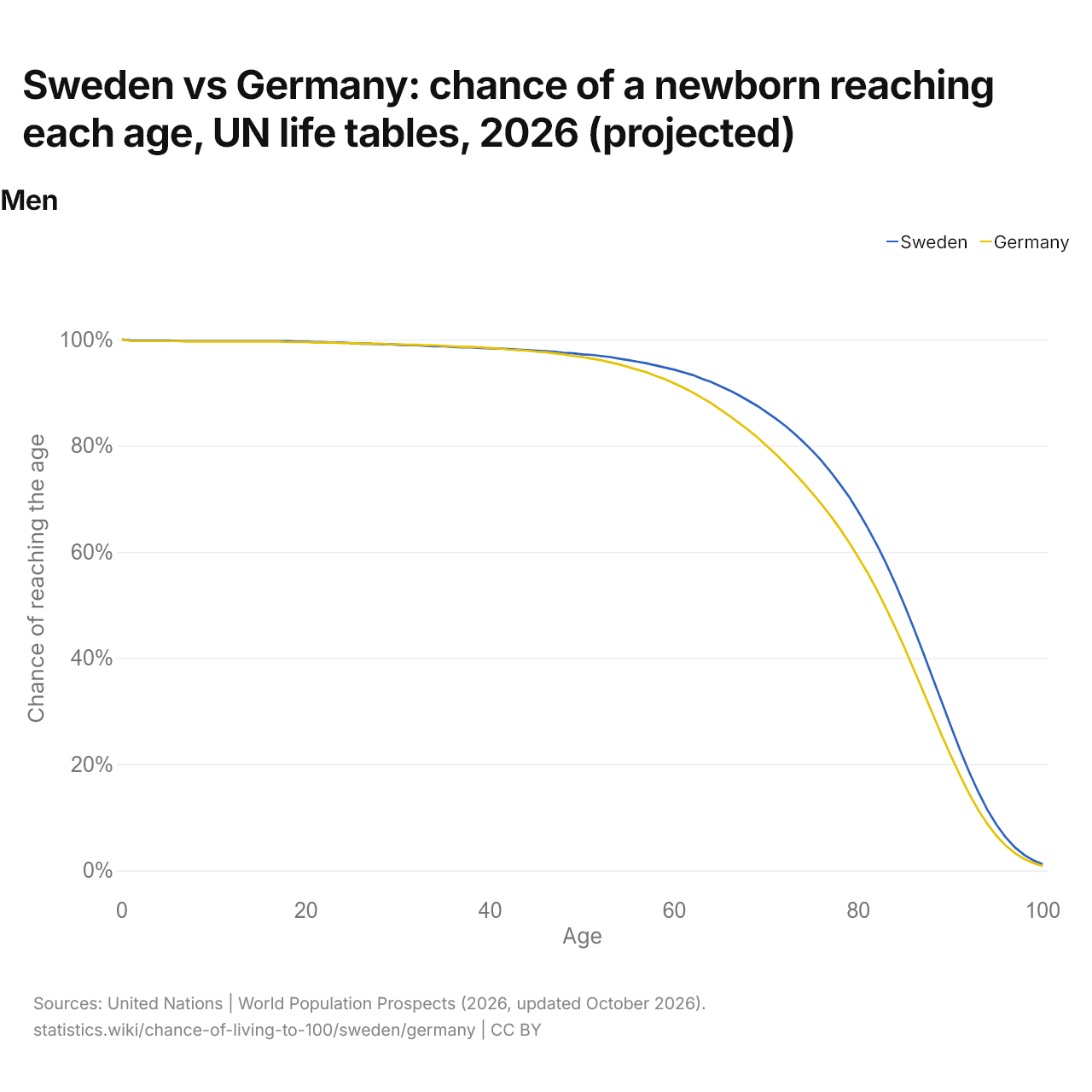
| Age | Chance of reaching the age | |
|---|---|---|
| Sweden | Germany | |
| 0 | 100% | 100% |
| 1 | 99.8% | 99.7% |
| 2 | 99.8% | 99.7% |
| 3 | 99.8% | 99.7% |
| 4 | 99.8% | 99.7% |
| 5 | 99.8% | 99.7% |
| 6 | 99.7% | 99.7% |
| 7 | 99.7% | 99.6% |
| 8 | 99.7% | 99.6% |
| 9 | 99.7% | 99.6% |
| 10 | 99.7% | 99.6% |
| 11 | 99.7% | 99.6% |
| 12 | 99.7% | 99.6% |
| 13 | 99.7% | 99.6% |
| 14 | 99.7% | 99.6% |
| 15 | 99.7% | 99.6% |
| 16 | 99.7% | 99.6% |
| 17 | 99.7% | 99.6% |
| 18 | 99.7% | 99.5% |
| 19 | 99.6% | 99.5% |
| 20 | 99.6% | 99.5% |
| 21 | 99.5% | 99.4% |
| 22 | 99.5% | 99.4% |
| 23 | 99.4% | 99.4% |
| 24 | 99.4% | 99.3% |
| 25 | 99.3% | 99.3% |
| 26 | 99.2% | 99.2% |
| 27 | 99.2% | 99.2% |
| 28 | 99.1% | 99.2% |
| 29 | 99.1% | 99.1% |
| 30 | 99% | 99.1% |
| 31 | 98.9% | 99% |
| 32 | 98.9% | 99% |
| 33 | 98.8% | 98.9% |
| 34 | 98.7% | 98.9% |
| 35 | 98.7% | 98.8% |
| 36 | 98.6% | 98.7% |
| 37 | 98.5% | 98.6% |
| 38 | 98.5% | 98.6% |
| 39 | 98.4% | 98.5% |
| 40 | 98.3% | 98.4% |
| 41 | 98.3% | 98.3% |
| 42 | 98.2% | 98.1% |
| 43 | 98.1% | 98% |
| 44 | 98% | 97.9% |
| 45 | 97.9% | 97.7% |
| 46 | 97.8% | 97.6% |
| 47 | 97.7% | 97.4% |
| 48 | 97.5% | 97.2% |
| 49 | 97.4% | 96.9% |
| 50 | 97.2% | 96.7% |
| 51 | 97.1% | 96.4% |
| 52 | 96.9% | 96.1% |
| 53 | 96.7% | 95.7% |
| 54 | 96.4% | 95.3% |
| 55 | 96.1% | 94.8% |
| 56 | 95.8% | 94.3% |
| 57 | 95.5% | 93.8% |
| 58 | 95.1% | 93.1% |
| 59 | 94.7% | 92.5% |
| 60 | 94.3% | 91.7% |
| 61 | 93.8% | 90.9% |
| 62 | 93.3% | 90% |
| 63 | 92.6% | 89% |
| 64 | 92% | 88% |
| 65 | 91.2% | 86.8% |
| 66 | 90.4% | 85.6% |
| 67 | 89.5% | 84.3% |
| 68 | 88.5% | 83% |
| 69 | 87.5% | 81.6% |
| 70 | 86.3% | 80% |
| 71 | 85.1% | 78.4% |
| 72 | 83.8% | 76.7% |
| 73 | 82.3% | 74.9% |
| 74 | 80.7% | 73% |
| 75 | 79% | 71% |
| 76 | 77.1% | 68.9% |
| 77 | 75% | 66.7% |
| 78 | 72.7% | 64.3% |
| 79 | 70.3% | 61.7% |
| 80 | 67.5% | 58.9% |
| 81 | 64.5% | 56% |
| 82 | 61.3% | 52.8% |
| 83 | 57.8% | 49.3% |
| 84 | 54% | 45.7% |
| 85 | 49.9% | 41.9% |
| 86 | 45.6% | 37.9% |
| 87 | 41.1% | 33.8% |
| 88 | 36.5% | 29.7% |
| 89 | 31.9% | 25.6% |
| 90 | 27.3% | 21.7% |
| 91 | 22.8% | 18% |
| 92 | 18.6% | 14.5% |
| 93 | 14.8% | 11.4% |
| 94 | 11.4% | 8.74% |
| 95 | 8.56% | 6.48% |
| 96 | 6.2% | 4.66% |
| 97 | 4.33% | 3.24% |
| 98 | 2.92% | 2.17% |
| 99 | 1.89% | 1.4% |
| 100 | 1.17% | 0.871% |
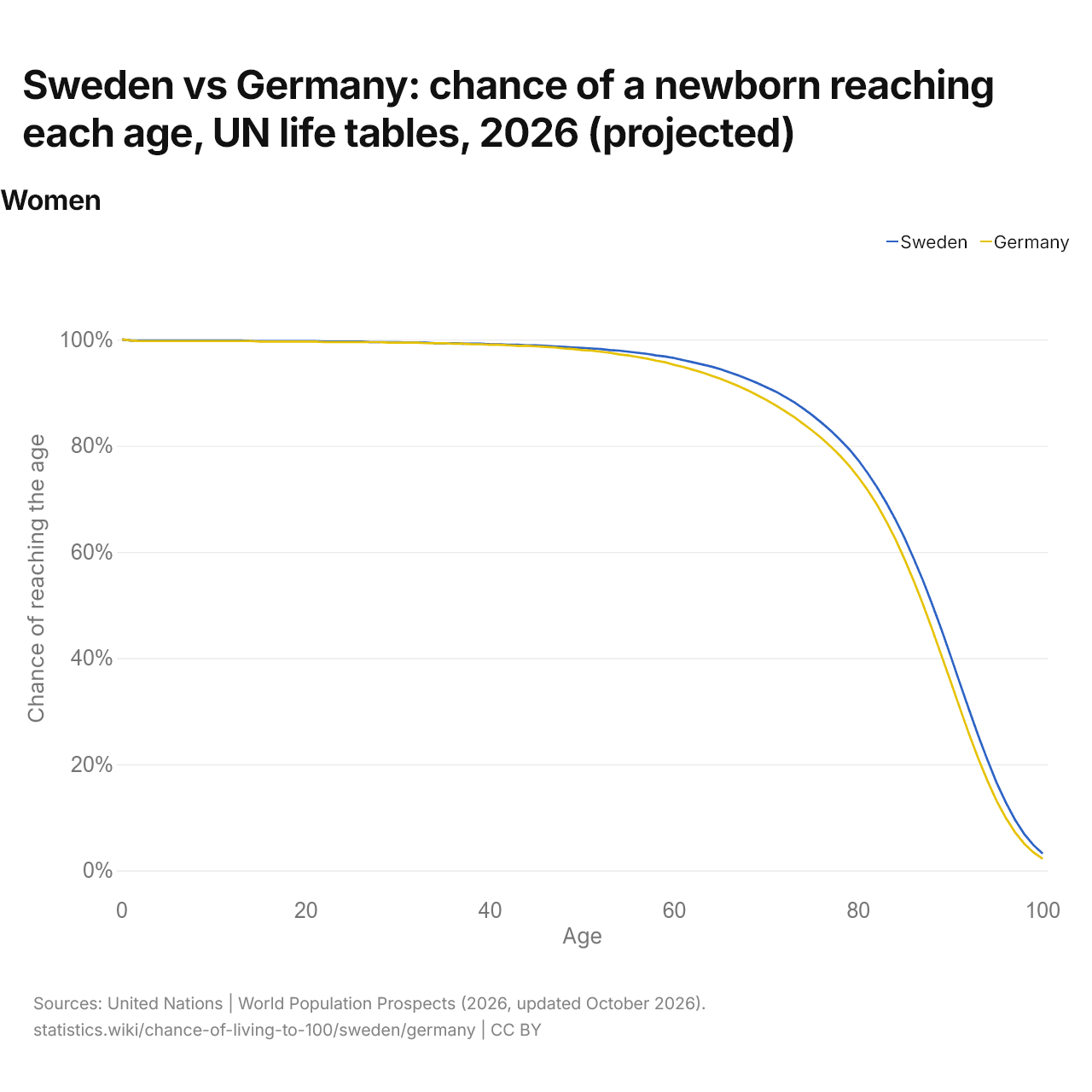
| Age | Chance of reaching the age | |
|---|---|---|
| Sweden | Germany | |
| 0 | 100% | 100% |
| 1 | 99.8% | 99.8% |
| 2 | 99.8% | 99.7% |
| 3 | 99.8% | 99.7% |
| 4 | 99.8% | 99.7% |
| 5 | 99.8% | 99.7% |
| 6 | 99.8% | 99.7% |
| 7 | 99.8% | 99.7% |
| 8 | 99.8% | 99.7% |
| 9 | 99.8% | 99.7% |
| 10 | 99.8% | 99.7% |
| 11 | 99.8% | 99.7% |
| 12 | 99.8% | 99.7% |
| 13 | 99.8% | 99.7% |
| 14 | 99.7% | 99.7% |
| 15 | 99.7% | 99.6% |
| 16 | 99.7% | 99.6% |
| 17 | 99.7% | 99.6% |
| 18 | 99.7% | 99.6% |
| 19 | 99.7% | 99.6% |
| 20 | 99.7% | 99.6% |
| 21 | 99.7% | 99.6% |
| 22 | 99.6% | 99.5% |
| 23 | 99.6% | 99.5% |
| 24 | 99.6% | 99.5% |
| 25 | 99.6% | 99.5% |
| 26 | 99.6% | 99.5% |
| 27 | 99.5% | 99.5% |
| 28 | 99.5% | 99.5% |
| 29 | 99.5% | 99.4% |
| 30 | 99.5% | 99.4% |
| 31 | 99.4% | 99.4% |
| 32 | 99.4% | 99.4% |
| 33 | 99.4% | 99.3% |
| 34 | 99.3% | 99.3% |
| 35 | 99.3% | 99.3% |
| 36 | 99.3% | 99.2% |
| 37 | 99.2% | 99.2% |
| 38 | 99.2% | 99.1% |
| 39 | 99.2% | 99.1% |
| 40 | 99.1% | 99% |
| 41 | 99.1% | 99% |
| 42 | 99% | 98.9% |
| 43 | 99% | 98.8% |
| 44 | 98.9% | 98.8% |
| 45 | 98.9% | 98.7% |
| 46 | 98.8% | 98.6% |
| 47 | 98.7% | 98.5% |
| 48 | 98.6% | 98.3% |
| 49 | 98.5% | 98.2% |
| 50 | 98.4% | 98% |
| 51 | 98.3% | 97.9% |
| 52 | 98.2% | 97.7% |
| 53 | 98% | 97.5% |
| 54 | 97.9% | 97.2% |
| 55 | 97.7% | 97% |
| 56 | 97.5% | 96.7% |
| 57 | 97.3% | 96.4% |
| 58 | 97% | 96% |
| 59 | 96.8% | 95.7% |
| 60 | 96.5% | 95.2% |
| 61 | 96.1% | 94.8% |
| 62 | 95.7% | 94.3% |
| 63 | 95.3% | 93.8% |
| 64 | 94.9% | 93.2% |
| 65 | 94.4% | 92.6% |
| 66 | 93.8% | 91.9% |
| 67 | 93.2% | 91.2% |
| 68 | 92.5% | 90.4% |
| 69 | 91.8% | 89.5% |
| 70 | 91% | 88.6% |
| 71 | 90.2% | 87.6% |
| 72 | 89.2% | 86.5% |
| 73 | 88.2% | 85.4% |
| 74 | 87% | 84.1% |
| 75 | 85.7% | 82.8% |
| 76 | 84.3% | 81.4% |
| 77 | 82.8% | 79.8% |
| 78 | 81.1% | 78.1% |
| 79 | 79.3% | 76.2% |
| 80 | 77.2% | 74% |
| 81 | 74.8% | 71.6% |
| 82 | 72.2% | 68.9% |
| 83 | 69.3% | 65.8% |
| 84 | 66.1% | 62.4% |
| 85 | 62.6% | 58.6% |
| 86 | 58.7% | 54.5% |
| 87 | 54.6% | 50.1% |
| 88 | 50.1% | 45.4% |
| 89 | 45.4% | 40.5% |
| 90 | 40.4% | 35.6% |
| 91 | 35.3% | 30.6% |
| 92 | 30.3% | 25.7% |
| 93 | 25.4% | 21.1% |
| 94 | 20.8% | 16.9% |
| 95 | 16.5% | 13.1% |
| 96 | 12.8% | 9.89% |
| 97 | 9.53% | 7.19% |
| 98 | 6.87% | 5.04% |
| 99 | 4.77% | 3.4% |
| 100 | 3.18% | 2.2% |
Half of all newborns would live to 86 or older in Sweden and to 85 or older in Germany.
Compare the chance of living to 100 in any 2 countries
Sources:
- United Nations | World Population Prospects (2026, updated October 2026)
Creative Commons Attribution (CC BY): you may copy, share, adapt and reuse this content, also commercially, as long as you credit statistics.wiki and note any changes you made. The sources listed above may have their own license terms.