
Chance of a newborn reaching each age in Cuba: UN life table, 2026 (projected)
| Age | Chance of reaching the age | ||
|---|---|---|---|
| Men | Women | Both sexes | |
| 0 | 100% | 100% | 100% |
| 1 | 99.5% | 99.6% | 99.6% |
| 2 | 99.5% | 99.6% | 99.5% |
| 3 | 99.5% | 99.6% | 99.5% |
| 4 | 99.4% | 99.5% | 99.5% |
| 5 | 99.4% | 99.5% | 99.5% |
| 6 | 99.4% | 99.5% | 99.4% |
| 7 | 99.4% | 99.5% | 99.4% |
| 8 | 99.4% | 99.5% | 99.4% |
| 9 | 99.3% | 99.5% | 99.4% |
| 10 | 99.3% | 99.5% | 99.4% |
| 11 | 99.3% | 99.4% | 99.4% |
| 12 | 99.3% | 99.4% | 99.4% |
| 13 | 99.3% | 99.4% | 99.3% |
| 14 | 99.2% | 99.4% | 99.3% |
| 15 | 99.2% | 99.4% | 99.3% |
| 16 | 99.2% | 99.4% | 99.3% |
| 17 | 99.1% | 99.3% | 99.2% |
| 18 | 99.1% | 99.3% | 99.2% |
| 19 | 99.1% | 99.3% | 99.2% |
| 20 | 99% | 99.3% | 99.1% |
| 21 | 98.9% | 99.2% | 99.1% |
| 22 | 98.9% | 99.2% | 99% |
| 23 | 98.8% | 99.2% | 99% |
| 24 | 98.7% | 99.1% | 98.9% |
| 25 | 98.7% | 99.1% | 98.9% |
| 26 | 98.6% | 99.1% | 98.8% |
| 27 | 98.5% | 99% | 98.8% |
| 28 | 98.5% | 99% | 98.7% |
| 29 | 98.4% | 99% | 98.7% |
| 30 | 98.3% | 98.9% | 98.6% |
| 31 | 98.2% | 98.9% | 98.5% |
| 32 | 98.1% | 98.8% | 98.4% |
| 33 | 98% | 98.8% | 98.4% |
| 34 | 97.9% | 98.7% | 98.3% |
| 35 | 97.8% | 98.6% | 98.2% |
| 36 | 97.7% | 98.6% | 98.1% |
| 37 | 97.5% | 98.5% | 98% |
| 38 | 97.4% | 98.4% | 97.9% |
| 39 | 97.3% | 98.3% | 97.8% |
| 40 | 97.1% | 98.2% | 97.6% |
| 41 | 96.9% | 98.1% | 97.5% |
| 42 | 96.7% | 98% | 97.4% |
| 43 | 96.5% | 97.9% | 97.2% |
| 44 | 96.3% | 97.8% | 97% |
| 45 | 96% | 97.6% | 96.8% |
| 46 | 95.8% | 97.5% | 96.6% |
| 47 | 95.5% | 97.3% | 96.4% |
| 48 | 95.1% | 97.1% | 96.1% |
| 49 | 94.8% | 96.9% | 95.8% |
| 50 | 94.4% | 96.7% | 95.5% |
| 51 | 94% | 96.5% | 95.2% |
| 52 | 93.5% | 96.2% | 94.8% |
| 53 | 92.9% | 95.9% | 94.4% |
| 54 | 92.3% | 95.6% | 93.9% |
| 55 | 91.7% | 95.2% | 93.4% |
| 56 | 91% | 94.8% | 92.9% |
| 57 | 90.2% | 94.3% | 92.2% |
| 58 | 89.3% | 93.8% | 91.6% |
| 59 | 88.4% | 93.3% | 90.8% |
| 60 | 87.4% | 92.7% | 90% |
| 61 | 86.3% | 92% | 89.1% |
| 62 | 85.1% | 91.2% | 88.2% |
| 63 | 83.9% | 90.4% | 87.1% |
| 64 | 82.5% | 89.5% | 86% |
| 65 | 81.1% | 88.6% | 84.8% |
| 66 | 79.5% | 87.6% | 83.6% |
| 67 | 77.9% | 86.4% | 82.2% |
| 68 | 76.2% | 85.2% | 80.7% |
| 69 | 74.3% | 83.9% | 79.2% |
| 70 | 72.4% | 82.5% | 77.5% |
| 71 | 70.4% | 81% | 75.7% |
| 72 | 68.2% | 79.4% | 73.9% |
| 73 | 65.9% | 77.7% | 71.9% |
| 74 | 63.6% | 75.9% | 69.8% |
| 75 | 61.1% | 73.9% | 67.5% |
| 76 | 58.5% | 71.8% | 65.2% |
| 77 | 55.8% | 69.5% | 62.7% |
| 78 | 52.9% | 67.1% | 60.1% |
| 79 | 50% | 64.5% | 57.3% |
| 80 | 47.1% | 61.8% | 54.5% |
| 81 | 44% | 58.9% | 51.5% |
| 82 | 40.9% | 55.8% | 48.4% |
| 83 | 37.7% | 52.6% | 45.2% |
| 84 | 34.6% | 49.3% | 42% |
| 85 | 31.4% | 45.8% | 38.6% |
| 86 | 28.2% | 42.2% | 35.3% |
| 87 | 25.1% | 38.6% | 31.9% |
| 88 | 22.1% | 34.9% | 28.5% |
| 89 | 19.2% | 31.2% | 25.2% |
| 90 | 16.5% | 27.6% | 22% |
| 91 | 14% | 24.1% | 19% |
| 92 | 11.6% | 20.7% | 16.1% |
| 93 | 9.55% | 17.5% | 13.5% |
| 94 | 7.69% | 14.6% | 11.1% |
| 95 | 6.08% | 11.9% | 8.94% |
| 96 | 4.69% | 9.45% | 7.04% |
| 97 | 3.53% | 7.33% | 5.4% |
| 98 | 2.58% | 5.52% | 4.03% |
| 99 | 1.83% | 4.02% | 2.91% |
| 100 | 1.26% | 2.82% | 2.03% |
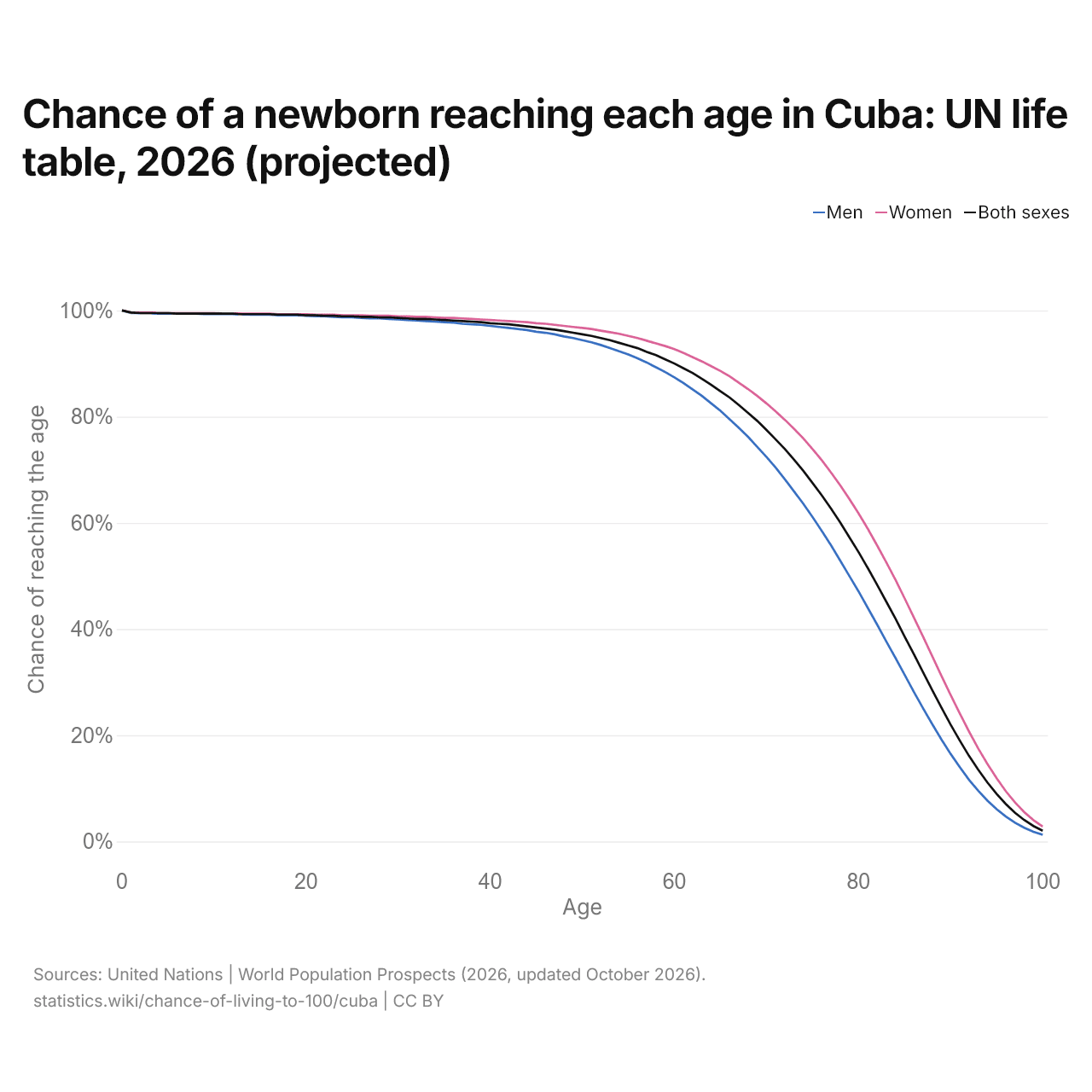
In 2026, 2.0% of newborns in Cuba would live to 100: 1.3% of boys and 2.8% of girls. Half of all newborns in Cuba would live to 81 or older.
In Cuba, half of boys would live to 79 or older, and half of girls to 83. Cuba's chance of living to 100 is the 11th highest of the 35 countries of Latin America, where it ranges from Haiti's 0.056% to Chile's 4.9%.
Chance of a newborn living to 100, 95, 90, 80 and 65 in Cuba: UN life table, 2026 (projected)
| Chance of living | Men | Women | Both sexes |
|---|---|---|---|
| To 100 | 1.3% | 2.8% | 2.0% |
| To 95 | 6.1% | 11.9% | 8.9% |
| To 90 | 16.5% | 27.6% | 22.0% |
| To 80 | 47.1% | 61.8% | 54.5% |
| To 65 | 81.1% | 88.6% | 84.8% |
Cuba in the world ranking of the chance of living to 100: UN life tables, 2026 (projected)
| Rank | Country | Both sexes | Men | Women | |
|---|---|---|---|---|---|
| 40 |
 Luxembourg |
2.1% | 1.2% | 2.9% | |
| 41 |
 New Zealand |
2.1% | 1.3% | 2.8% | vs New Zealand |
| 42 |
 Denmark |
2.1% | 0.96% | 3.0% | |
| 43 |
 Cuba |
2.0% | 1.3% | 2.8% | |
| 44 |
 Malaysia |
2.0% | 1.2% | 3.0% | |
| 45 |
 United Kingdom |
2.0% | 1.1% | 2.8% | vs UK |
| 46 |
 Finland |
2.0% | 0.98% | 2.8% |
Compare the chance of living to 100 in Cuba with other countries
Sources:
- United Nations | World Population Prospects (2026, updated October 2026)
Creative Commons Attribution (CC BY): you may copy, share, adapt and reuse this content, also commercially, as long as you credit statistics.wiki and note any changes you made. The sources listed above may have their own license terms.