
Luxembourg urban population, % of total, 1960–2025
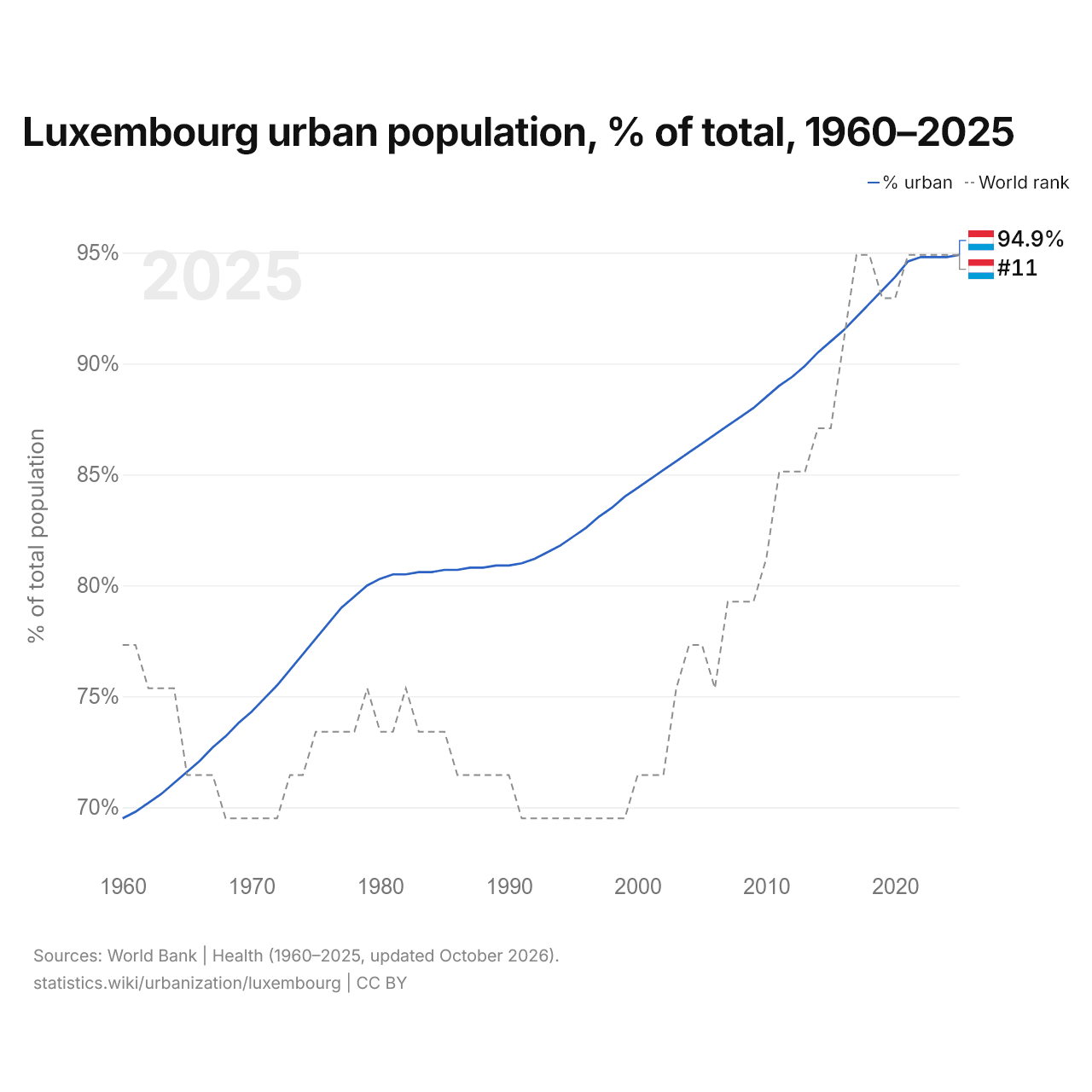
In 2025, 94.9% of Luxembourg's population lived in urban areas, compared with 69.5% in 1960. Luxembourg's share ranked 11th in the world, a rank it has held since 2021.
Luxembourg's urban share in 2025 was the 5th highest of 44 countries in Europe, where it ranged from Liechtenstein's 14.6% to Monaco's 100%. Luxembourg's urban share rose most from 1970 to 1980, by 6 percentage points; from 2015 to 2025, it rose by 3.9 points.
Luxembourg urban and rural population, 1960–2025
| Year | Population | |
|---|---|---|
| Urban population | Rural population | |
| 2025 | 651,826 | 35,144 |
| 2024 | 642,104 | 34,908 |
| 2023 | 631,786 | 34,644 |
| 2022 | 618,884 | 34,219 |
| 2021 | 605,412 | 34,652 |
| 2020 | 591,712 | 38,707 |
| 2019 | 578,207 | 41,794 |
| 2018 | 563,393 | 44,557 |
| 2017 | 549,204 | 47,132 |
| 2016 | 532,751 | 49,263 |
| 2015 | 518,279 | 51,325 |
| 2014 | 503,234 | 53,085 |
| 2013 | 488,705 | 54,655 |
| 2012 | 474,881 | 56,065 |
| 2011 | 461,102 | 57,245 |
| 2010 | 448,592 | 58,361 |
| 2009 | 438,238 | 59,545 |
| 2008 | 428,076 | 60,574 |
| 2007 | 418,473 | 61,520 |
| 2006 | 410,126 | 62,511 |
| 2005 | 401,774 | 63,384 |
| 2004 | 393,870 | 64,225 |
| 2003 | 386,553 | 65,077 |
| 2002 | 380,156 | 66,019 |
| 2001 | 374,490 | 67,035 |
| 2000 | 368,317 | 67,983 |
| 1999 | 361,539 | 68,936 |
| 1998 | 354,759 | 69,941 |
| 1997 | 348,439 | 71,011 |
| 1996 | 342,223 | 72,002 |
| 1995 | 335,844 | 72,781 |
| 1994 | 329,590 | 73,335 |
| 1993 | 323,802 | 73,673 |
| 1992 | 318,447 | 73,728 |
| 1991 | 313,567 | 73,433 |
| 1990 | 309,009 | 72,841 |
| 1989 | 304,898 | 72,202 |
| 1988 | 301,746 | 71,704 |
| 1987 | 299,409 | 71,341 |
| 1986 | 297,343 | 71,012 |
| 1985 | 295,885 | 70,821 |
| 1984 | 295,172 | 70,826 |
| 1983 | 294,692 | 70,930 |
| 1982 | 294,384 | 71,141 |
| 1981 | 293,849 | 71,376 |
| 1980 | 292,421 | 71,729 |
| 1979 | 290,240 | 72,616 |
| 1978 | 287,918 | 74,089 |
| 1977 | 285,363 | 75,995 |
| 1976 | 282,540 | 78,191 |
| 1975 | 278,640 | 80,310 |
| 1974 | 273,051 | 81,999 |
| 1973 | 267,004 | 83,446 |
| 1972 | 261,706 | 84,894 |
| 1971 | 256,431 | 85,990 |
| 1970 | 252,139 | 87,032 |
| 1969 | 249,075 | 88,425 |
| 1968 | 246,000 | 89,850 |
| 1967 | 243,521 | 91,474 |
| 1966 | 240,902 | 92,993 |
| 1965 | 237,422 | 94,078 |
| 1964 | 233,086 | 94,664 |
| 1963 | 228,966 | 95,134 |
| 1962 | 225,224 | 95,526 |
| 1961 | 221,281 | 95,564 |
| 1960 | 218,238 | 95,732 |
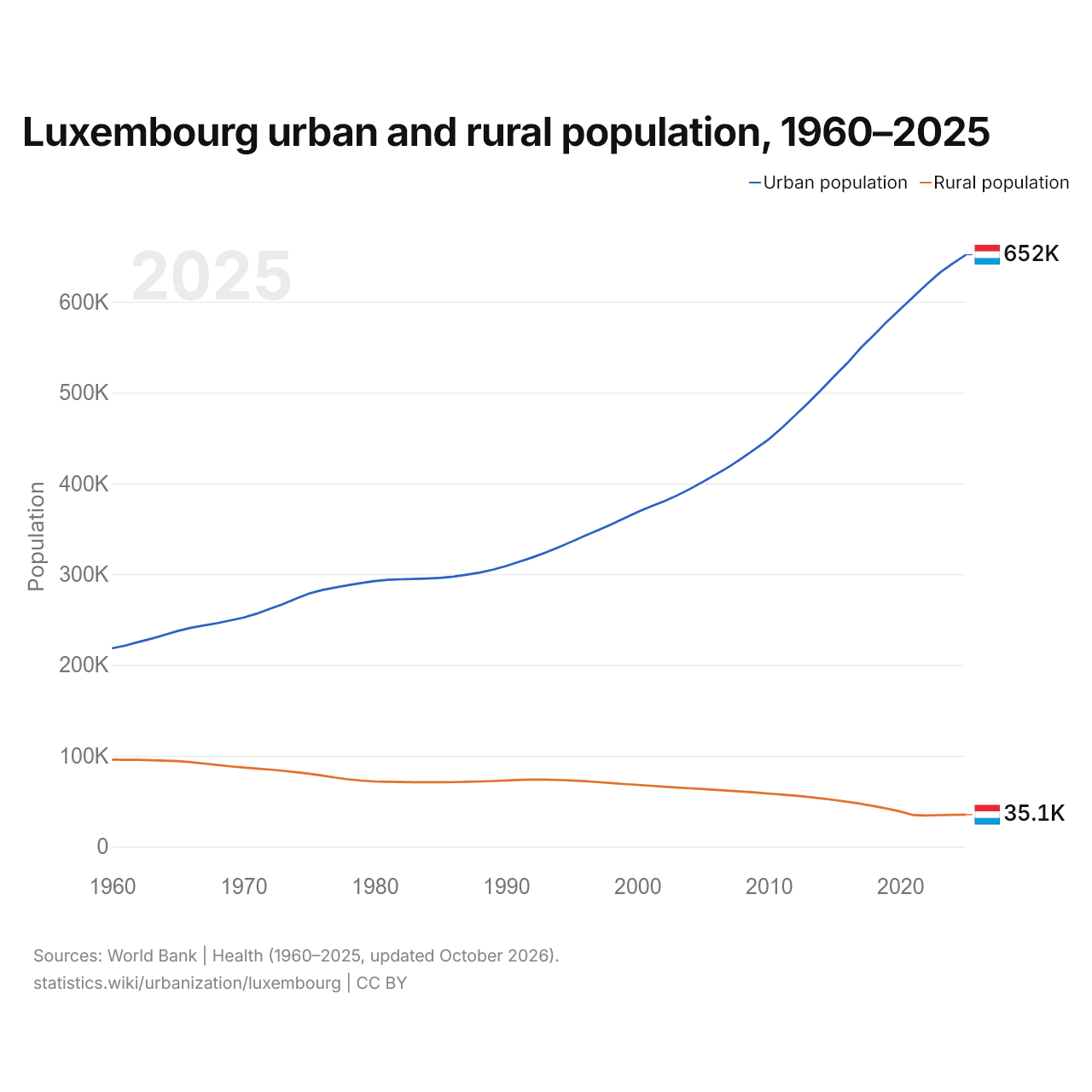
In 2025, 651,826 people in Luxembourg lived in urban areas and 35,144 in rural areas. Luxembourg's rural population peaked at 95,732 in 1960.
Luxembourg's urban population was 3 times as large in 2025 as in 1960, while its rural population fell by 63%. Luxembourg's largest city, Luxembourg City, has 137,678 people in 2026.
Luxembourg in the world ranking by urban population share, 2025
| Rank | Country | % urban | Urban population | |
|---|---|---|---|---|
| 8 |
 Netherlands |
95.9% | 17,353,020 | vs Netherlands |
| 9 |
 Malta |
95.7% | 554,664 | vs Malta |
| 10 |
 Uruguay |
95.7% | 3,237,580 | |
| 11 |
 Luxembourg |
94.9% | 651,826 | |
| 12 |
 Iceland |
94.2% | 369,715 | vs Iceland |
| 13 |
 Jordan |
93.2% | 10,738,258 | |
| 14 |
 Argentina |
92.4% | 42,344,629 |
Compare Luxembourg urban population with other countries
Sources:
- World Bank | Health (1960–2025, updated October 2026)
Creative Commons Attribution (CC BY): you may copy, share, adapt and reuse this content, also commercially, as long as you credit statistics.wiki and note any changes you made. The sources listed above may have their own license terms.