
Sierra Leone teen birth rate, 1960–2026
| Year | Births per 1,000 women aged 15–19 | World rank |
|---|---|---|
| Sierra Leone | ||
| 2026 projected | 86.7 | #23 |
| 2025 projected | 88.7 | #23 |
| 2024 | 91.2 | #22 |
| 2023 | 93.6 | #21 |
| 2022 | 95.7 | #21 |
| 2021 | 98.1 | #21 |
| 2020 | 100.2 | #20 |
| 2019 | 102.2 | #19 |
| 2018 | 104.1 | #20 |
| 2017 | 107 | #20 |
| 2016 | 111.2 | #21 |
| 2015 | 116.3 | #19 |
| 2014 | 122.3 | #17 |
| 2013 | 125.3 | #17 |
| 2012 | 128.8 | #15 |
| 2011 | 129.9 | #16 |
| 2010 | 130.4 | #16 |
| 2009 | 135.7 | #13 |
| 2008 | 138.7 | #13 |
| 2007 | 141.8 | #12 |
| 2006 | 147 | #10 |
| 2005 | 146.9 | #11 |
| 2004 | 146.8 | #9 |
| 2003 | 156 | #6 |
| 2002 | 157.1 | #7 |
| 2001 | 157.4 | #7 |
| 2000 | 160 | #7 |
| 1999 | 158.8 | #7 |
| 1998 | 157.6 | #7 |
| 1997 | 157.4 | #9 |
| 1996 | 159.2 | #9 |
| 1995 | 158.3 | #9 |
| 1994 | 163.3 | #6 |
| 1993 | 162.9 | #8 |
| 1992 | 161.3 | #8 |
| 1991 | 161.4 | #10 |
| 1990 | 160.2 | #11 |
| 1989 | 160.6 | #12 |
| 1988 | 167.8 | #10 |
| 1987 | 173.2 | #7 |
| 1986 | 177.8 | #6 |
| 1985 | 179.9 | #6 |
| 1984 | 181.8 | #7 |
| 1983 | 183.1 | #6 |
| 1982 | 184.8 | #6 |
| 1981 | 185.3 | #8 |
| 1980 | 185.2 | #9 |
| 1979 | 185.6 | #9 |
| 1978 | 189.4 | #6 |
| 1977 | 192.3 | #5 |
| 1976 | 195.6 | #5 |
| 1975 | 199.1 | #5 |
| 1974 | 202.6 | #4 |
| 1973 | 203.1 | #3 |
| 1972 | 204.7 | #3 |
| 1971 | 205.7 | #3 |
| 1970 | 206.8 | #3 |
| 1969 | 206.5 | #1 |
| 1968 | 206.2 | #1 |
| 1967 | 207.1 | #1 |
| 1966 | 206.5 | #1 |
| 1965 | 206.1 | #1 |
| 1964 | 204.9 | #1 |
| 1963 | 202.1 | #3 |
| 1962 | 199.8 | #5 |
| 1961 | 198.6 | #5 |
| 1960 | 197.1 | #6 |
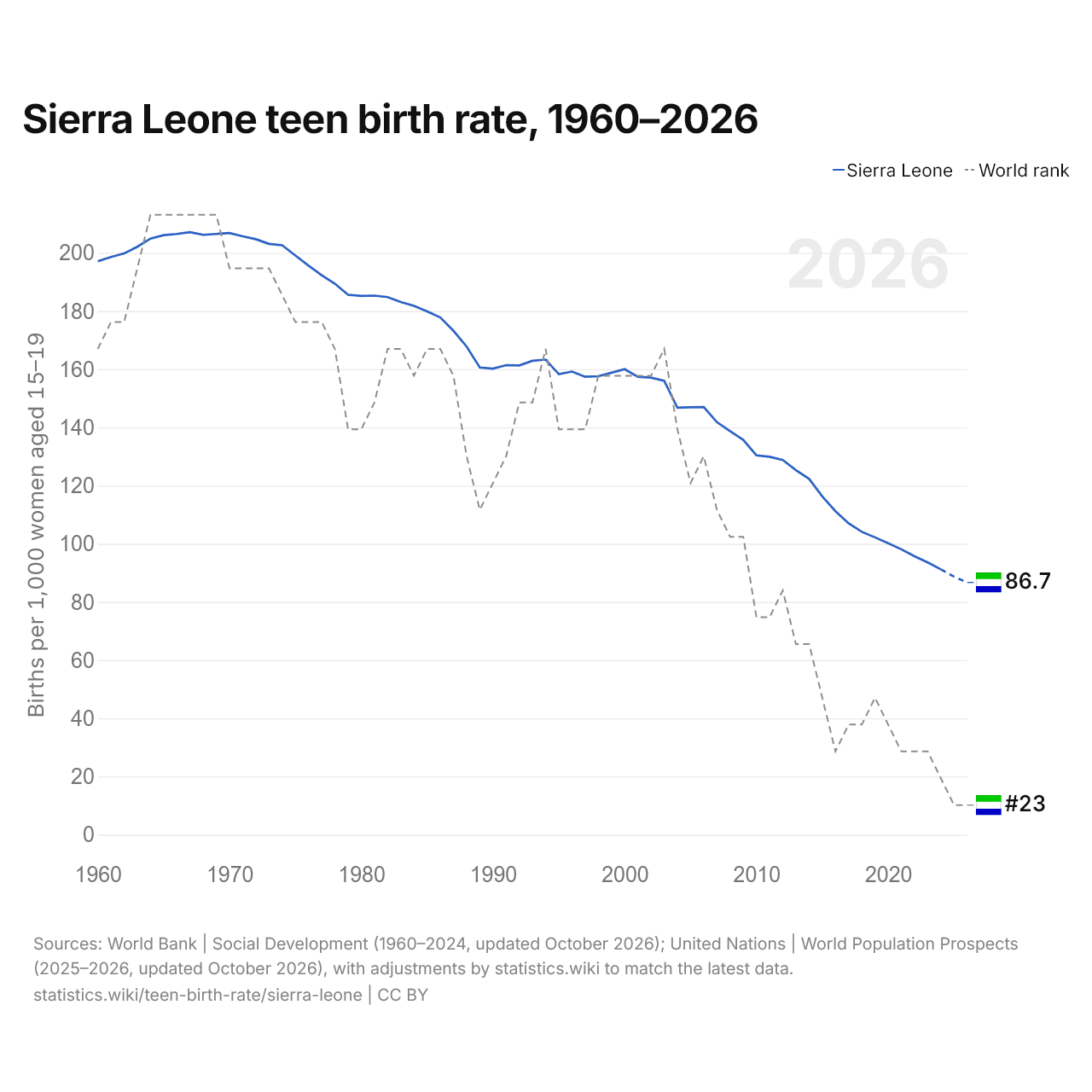
In 2026, Sierra Leone's teen birth rate is 86.7 births per 1,000 women aged 15–19, down from 197.1 in 1960. It was highest in 1967, at 207.1. It is the 23rd highest in the world, a rank it has held since 2025. Its highest rank was 1st, last held in 1969.
Compared with the world's rate of 36.9 in 2026, the rate in Sierra Leone is 2.3 times as high. Sierra Leone's teen birth rate is the 22nd highest of the 54 countries of Africa, where it ranges from Tunisia's 4.0 to the Central African Republic's 152.2. The rate in Sierra Leone fell below 90 births per 1,000 women aged 15–19 in 2025.
In 2026, 16.3% of births in Sierra Leone are to mothers aged 15–19. The fertility rate in Sierra Leone is 3.53 children per woman in 2026, the 38th highest in the world.
Sierra Leone teenage pregnancy and motherhood: women aged 15–19
| Survey year | Have given birth or are pregnant |
|---|---|
| 2019 | 21.3% |
| 2016 | 35.0% |
| 2013 | 27.9% |
| 2008 | 34.0% |
Sierra Leone in the world teen birth rate ranking, 2026
| Rank | Country | Births per 1,000 women aged 15–19 | Change since 2000 | |
|---|---|---|---|---|
| 20 |
 Zimbabwe |
91.7 | −10.6 | |
| 21 |
 Nicaragua |
91.2 | −22.9 | |
| 22 |
 Ivory Coast |
87.0 | −51.5 | vs Ivory Coast |
| 23 |
 Sierra Leone |
86.7 | −73.3 | |
| 24 |
 Gabon |
85.3 | −46.8 | |
| 25 |
 Mauritania |
84.8 | −5.1 | |
| 26 |
 Sao Tome |
81.7 | −51.6 |
Compare the Sierra Leone teen birth rate with other countries
Sources:
- World Bank | Social Development (1960–2024, updated October 2026)
- United Nations | World Population Prospects (2025–2026, updated October 2026), with adjustments by statistics.wiki to match the latest data
Creative Commons Attribution (CC BY): you may copy, share, adapt and reuse this content, also commercially, as long as you credit statistics.wiki and note any changes you made. The sources listed above may have their own license terms.