
Pakistan vs Afghanistan teen birth rate, 1960–2026
1x
| Year | Births per 1,000 women aged 15–19 | |
|---|---|---|
 Pakistan |
 Afghanistan |
|
| 2026 projected | 38.3 | 56.2 |
| 2025 projected | 39 | 58.8 |
| 2024 | 39.9 | 61.5 |
| 2023 | 41.1 | 64.1 |
| 2022 | 42.3 | 65.3 |
| 2021 | 43.4 | 66.6 |
| 2020 | 44.6 | 68.9 |
| 2019 | 45.6 | 71 |
| 2018 | 46.5 | 73 |
| 2017 | 47.1 | 75.3 |
| 2016 | 47.5 | 78.1 |
| 2015 | 48.7 | 81 |
| 2014 | 49.8 | 84.1 |
| 2013 | 50.9 | 89.3 |
| 2012 | 51.5 | 95.2 |
| 2011 | 52.3 | 101.7 |
| 2010 | 55.6 | 105.6 |
| 2009 | 56.5 | 109.7 |
| 2008 | 57.1 | 119 |
| 2007 | 58.1 | 117.8 |
| 2006 | 58.7 | 121.6 |
| 2005 | 61 | 130.8 |
| 2004 | 64.2 | 136.9 |
| 2003 | 67.2 | 143.8 |
| 2002 | 69.2 | 150.2 |
| 2001 | 72.7 | 152.5 |
| 2000 | 76.6 | 154.3 |
| 1999 | 79.3 | 156.4 |
| 1998 | 81.1 | 155.9 |
| 1997 | 82.8 | 158.8 |
| 1996 | 86.6 | 157.6 |
| 1995 | 88.2 | 158.3 |
| 1994 | 94.4 | 156.8 |
| 1993 | 97.5 | 149.5 |
| 1992 | 98.3 | 147.5 |
| 1991 | 101.5 | 145.4 |
| 1990 | 104.4 | 139.4 |
| 1989 | 108.8 | 135.8 |
| 1988 | 109.8 | 132.4 |
| 1987 | 110.8 | 127.6 |
| 1986 | 109.1 | 128.5 |
| 1985 | 107.2 | 129.2 |
| 1984 | 105.3 | 128.3 |
| 1983 | 106.7 | 127.7 |
| 1982 | 108 | 126.9 |
| 1981 | 109.2 | 129.3 |
| 1980 | 108.5 | 131.7 |
| 1979 | 107.8 | 133.1 |
| 1978 | 106.4 | 134.8 |
| 1977 | 107.3 | 135.7 |
| 1976 | 108.1 | 136.2 |
| 1975 | 111.5 | 136.9 |
| 1974 | 115.3 | 137.7 |
| 1973 | 119.2 | 138 |
| 1972 | 120.3 | 138.4 |
| 1971 | 121.8 | 138.6 |
| 1970 | 123.3 | 138.5 |
| 1969 | 124.8 | 139.3 |
| 1968 | 132 | 140.5 |
| 1967 | 137 | 141.5 |
| 1966 | 142 | 141.7 |
| 1965 | 146.2 | 140.8 |
| 1964 | 148.6 | 139.8 |
| 1963 | 150.2 | 139.4 |
| 1962 | 151.4 | 139.4 |
| 1961 | 153.1 | 139.8 |
| 1960 | 155.7 | 140.6 |
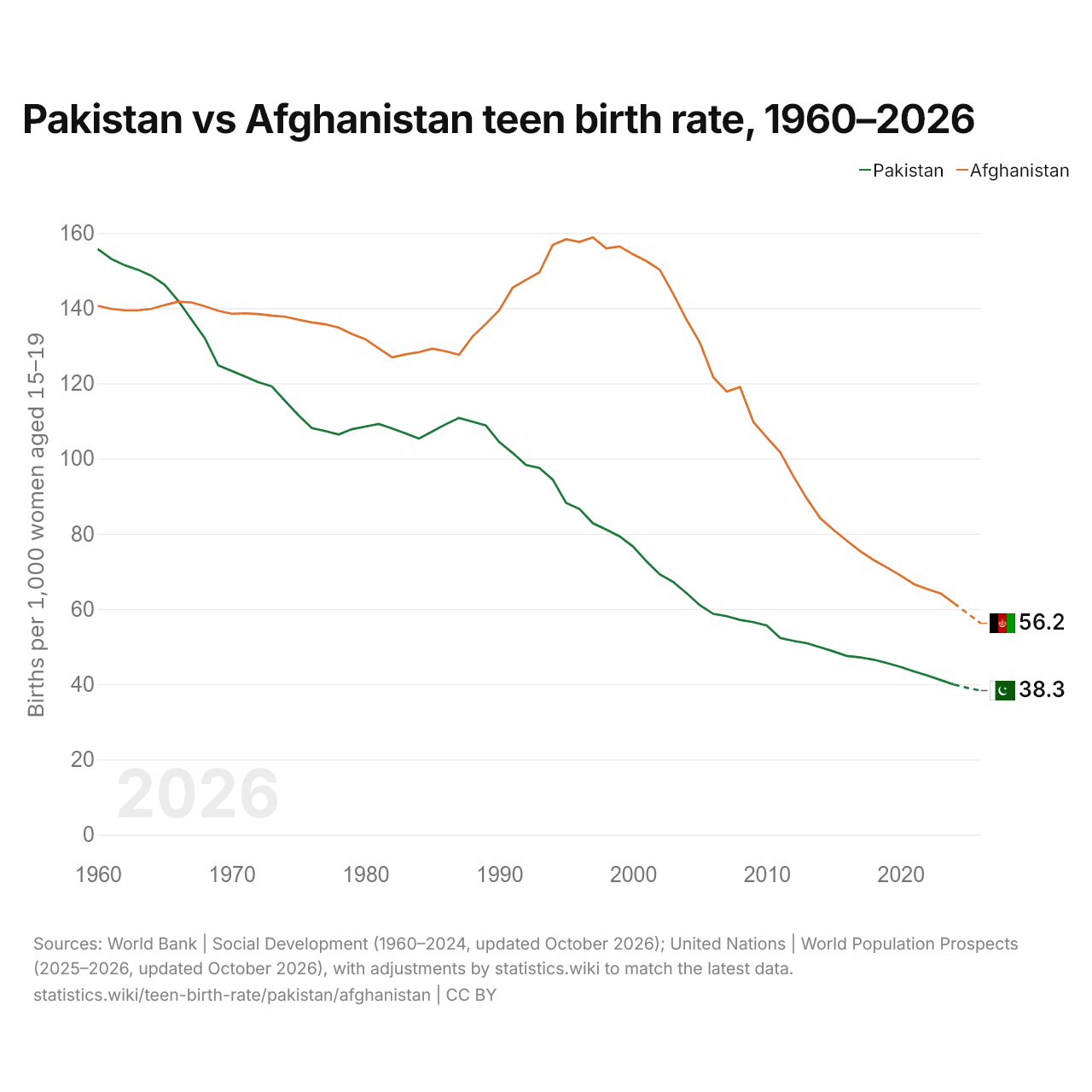
In 2026, the teen birth rate is 38.3 births per 1,000 women aged 15–19 in Pakistan and 56.2 in Afghanistan: 17.9 higher in Afghanistan. In 1960, it was 155.7 in Pakistan and 140.6 in Afghanistan, 15.1 higher in Pakistan.
Afghanistan's teen birth rate has been higher than Pakistan's every year since 1967. The gap was widest in 2002, when Afghanistan's teen birth rate was 81.0 above Pakistan's.
Pakistan vs Afghanistan: latest teen birth rates
|
Pakistan
|
Afghanistan
|
|
|---|---|---|
| Births per 1,000 women aged 15–19 | 38.3 | 56.2 |
| World rank | 83/195 | 54/195 |
| Change since 2000 | −38.3 | −98.1 |
Compare the teen birth rates of any 2 countries
Sources:
- World Bank | Social Development (1960–2024, updated October 2026)
- United Nations | World Population Prospects (2025–2026, updated October 2026), with adjustments by statistics.wiki to match the latest data
Creative Commons Attribution (CC BY): you may copy, share, adapt and reuse this content, also commercially, as long as you credit statistics.wiki and note any changes you made. The sources listed above may have their own license terms.