
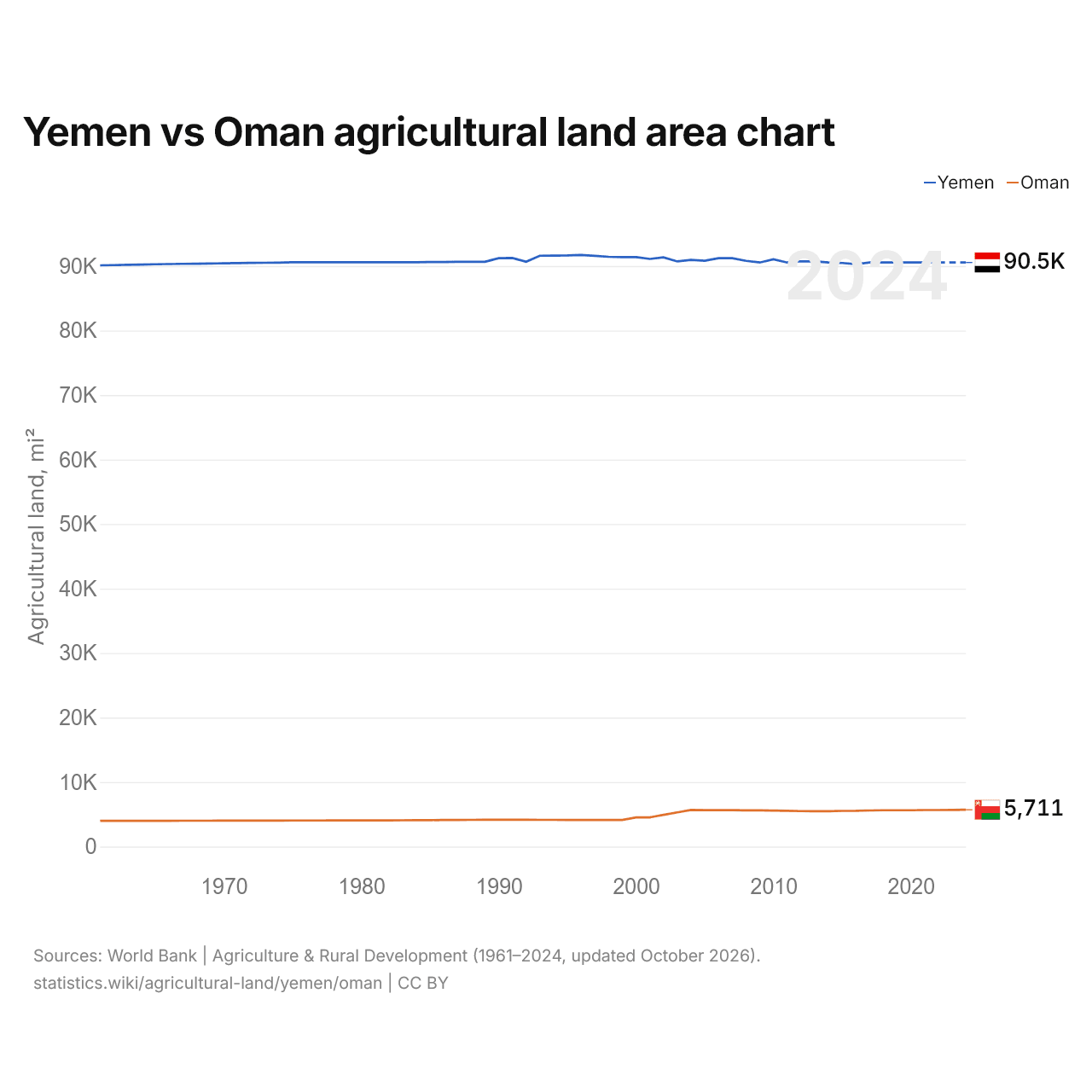
Iêmen vs Omã: gráfico da área de terras agrícolas
1x
| Ano | Terras agrícolas, km² | |
|---|---|---|
| Iêmen | Omã | |
| 2024 | 234.520 | 14.792 |
| 2023 | - | 14.717 |
| 2022 | 234.520 | 14.662 |
| 2021 | 234.520 | 14.662 |
| 2020 | 234.520 | 14.589 |
| 2019 | 234.520 | 14.589 |
| 2018 | 234.520 | 14.589 |
| 2017 | 234.520 | 14.509 |
| 2016 | 233.858 | 14.360 |
| 2015 | 234.326 | 14.340 |
| 2014 | 234.516 | 14.198 |
| 2013 | 234.990 | 14.195 |
| 2012 | 235.010 | 14.238 |
| 2011 | 234.520 | 14.368 |
| 2010 | 235.790 | 14.432 |
| 2009 | 234.520 | 14.544 |
| 2008 | 235.170 | 14.572 |
| 2007 | 236.270 | 14.650 |
| 2006 | 236.270 | 14.630 |
| 2005 | 235.230 | 14.650 |
| 2004 | 235.570 | 14.720 |
| 2003 | 234.950 | 13.730 |
| 2002 | 236.560 | 12.734 |
| 2001 | 235.950 | 11.736 |
| 2000 | 236.690 | 11.730 |
| 1999 | 236.680 | 10.710 |
| 1998 | 236.800 | 10.710 |
| 1997 | 237.200 | 10.700 |
| 1996 | 237.550 | 10.710 |
| 1995 | 237.360 | 10.710 |
| 1994 | 237.300 | 10.720 |
| 1993 | 237.250 | 10.720 |
| 1992 | 234.810 | 10.830 |
| 1991 | 236.310 | 10.800 |
| 1990 | 236.260 | 10.800 |
| 1989 | 234.810 | 10.770 |
| 1988 | 234.790 | 10.730 |
| 1987 | 234.790 | 10.700 |
| 1986 | 234.700 | 10.670 |
| 1985 | 234.700 | 10.610 |
| 1984 | 234.650 | 10.590 |
| 1983 | 234.650 | 10.550 |
| 1982 | 234.650 | 10.510 |
| 1981 | 234.650 | 10.510 |
| 1980 | 234.630 | 10.510 |
| 1979 | 234.630 | 10.510 |
| 1978 | 234.620 | 10.510 |
| 1977 | 234.600 | 10.490 |
| 1976 | 234.600 | 10.480 |
| 1975 | 234.600 | 10.470 |
| 1974 | 234.470 | 10.460 |
| 1973 | 234.420 | 10.450 |
| 1972 | 234.370 | 10.440 |
| 1971 | 234.260 | 10.420 |
| 1970 | 234.180 | 10.420 |
| 1969 | 234.130 | 10.400 |
| 1968 | 234.030 | 10.400 |
| 1967 | 233.980 | 10.380 |
| 1966 | 233.910 | 10.360 |
| 1965 | 233.800 | 10.360 |
| 1964 | 233.700 | 10.360 |
| 1963 | 233.600 | 10.350 |
| 1962 | 233.480 | 10.350 |
| 1961 | 233.370 | 10.350 |
As terras agrícolas ocupam 234.520 km² (90.549 mi²) no Iêmen e 14.792 km² (5.711 mi²) em Omã: a área agrícola do Iêmen é 16 vezes a de Omã. Em 1961, ocupavam 233.370 km² (90.105 mi²) no Iêmen e 10.350 km² (3.996 mi²) em Omã; a área agrícola do Iêmen era então 23 vezes a de Omã.
As terras agrícolas ocupam 44,4% da área terrestre do Iêmen e 4,8% da área de Omã; as terras aráveis, 2,2% e 0,3%.
Iêmen vs Omã: terras agrícolas, área e % da área terrestre
 Iêmen |
 Omã |
|
|---|---|---|
| Terras agrícolas | 234.520 km² | 14.792 km² |
| Terras agrícolas, % | 44,4% | 4,8% |
| Terras aráveis | 11.408 km² | 933 km² |
| Terras aráveis, % | 2,2% | 0,3% |
| Culturas permanentes | 3.112 km² | 359 km² |
| Culturas permanentes, % | 0,6% | 0,1% |
| Prados e pastagens | 220.000 km² | 13.500 km² |
| Prados e pastagens, % | 41,7% | 4,4% |
| Terras aráveis por pessoa | 0,03 ha por pessoa | 0,02 ha por pessoa |
| Posição mundial por terras agrícolas | 48º de 194 | 130º de 194 |
| Posição mundial por terras aráveis | 101º de 191 | 151º de 191 |
| Posição mundial por terras aráveis por pessoa | 159º de 191 | 171º de 191 |
Comparar as terras agrícolas de 2 países quaisquer
Fontes:
- Banco Mundial | Agriculture & Rural Development (1961–2024, atualizado em outubro de 2026)
Creative Commons Atribuição (CC BY): você pode copiar, compartilhar, adaptar e reutilizar este conteúdo, inclusive para fins comerciais, desde que cite o statistics.wiki e indique as alterações que fizer. As fontes listadas acima podem ter suas próprias condições de licença.