
Germany births and deaths chart
| Year | People | ||
|---|---|---|---|
| Births | Deaths | Births minus deaths | |
| 2024 | 676,484 | 1,010,550 | −334,066 |
| 2023 | 691,284 | 1,024,433 | −333,149 |
| 2022 | 740,282 | 1,064,676 | −324,394 |
| 2021 | 798,682 | 1,023,311 | −224,629 |
| 2020 | 773,396 | 989,614 | −216,218 |
| 2019 | 781,073 | 938,950 | −157,877 |
| 2018 | 787,604 | 953,416 | −165,812 |
| 2017 | 785,241 | 934,024 | −148,783 |
| 2016 | 790,547 | 914,070 | −123,523 |
| 2015 | 735,179 | 923,058 | −187,879 |
| 2014 | 712,646 | 866,512 | −153,866 |
| 2013 | 685,487 | 895,166 | −209,679 |
| 2012 | 675,576 | 868,598 | −193,022 |
| 2011 | 666,282 | 850,914 | −184,632 |
| 2010 | 678,748 | 858,657 | −179,909 |
| 2009 | 663,408 | 851,783 | −188,375 |
| 2008 | 681,513 | 845,733 | −164,220 |
| 2007 | 682,810 | 830,890 | −148,080 |
| 2006 | 675,486 | 823,764 | −148,278 |
| 2005 | 684,496 | 832,941 | −148,445 |
| 2004 | 709,639 | 816,910 | −107,271 |
| 2003 | 709,793 | 850,102 | −140,309 |
| 2002 | 717,649 | 841,382 | −123,733 |
| 2001 | 732,914 | 831,734 | −98,820 |
| 2000 | 764,567 | 838,557 | −73,990 |
| 1999 | 771,742 | 845,632 | −73,890 |
| 1998 | 787,653 | 853,290 | −65,637 |
| 1997 | 812,144 | 861,365 | −49,221 |
| 1996 | 794,573 | 884,680 | −90,107 |
| 1995 | 767,773 | 882,122 | −114,349 |
| 1994 | 773,664 | 887,677 | −114,013 |
| 1993 | 795,332 | 900,835 | −105,503 |
| 1992 | 806,245 | 886,870 | −80,625 |
| 1991 | 832,144 | 912,158 | −80,014 |
| 1990 | 905,536 | 921,423 | −15,887 |
| 1989 | 882,014 | 905,639 | −23,625 |
| 1988 | 890,848 | 898,663 | −7,815 |
| 1987 | 871,807 | 902,943 | −31,136 |
| 1986 | 847,152 | 924,873 | −77,721 |
| 1985 | 815,691 | 932,218 | −116,527 |
| 1984 | 809,730 | 918,732 | −109,002 |
| 1983 | 828,159 | 937,539 | −109,380 |
| 1982 | 861,667 | 940,000 | −78,333 |
| 1981 | 862,486 | 956,576 | −94,090 |
| 1980 | 869,003 | 955,120 | −86,117 |
| 1979 | 820,326 | 945,328 | −125,002 |
| 1978 | 812,154 | 952,720 | −140,566 |
| 1977 | 805,046 | 930,101 | −125,055 |
| 1976 | 799,036 | 963,544 | −164,508 |
| 1975 | 778,868 | 991,286 | −212,418 |
| 1974 | 805,467 | 955,505 | −150,038 |
| 1973 | 813,047 | 963,027 | −149,980 |
| 1972 | 904,917 | 967,867 | −62,950 |
| 1971 | 1,010,235 | 963,247 | 46,988 |
| 1970 | 1,047,468 | 977,116 | 70,352 |
| 1969 | 1,145,272 | 989,452 | 155,820 |
| 1968 | 1,213,520 | 973,908 | 239,612 |
| 1967 | 1,269,697 | 915,720 | 353,977 |
| 1966 | 1,317,525 | 911,543 | 405,982 |
| 1965 | 1,321,768 | 911,564 | 410,204 |
| 1964 | 1,355,730 | 873,692 | 482,038 |
| 1963 | 1,352,329 | 896,572 | 455,757 |
| 1962 | 1,317,658 | 880,906 | 436,752 |
| 1961 | 1,313,459 | 851,180 | 462,279 |
| 1960 | 1,259,697 | 873,778 | 385,919 |
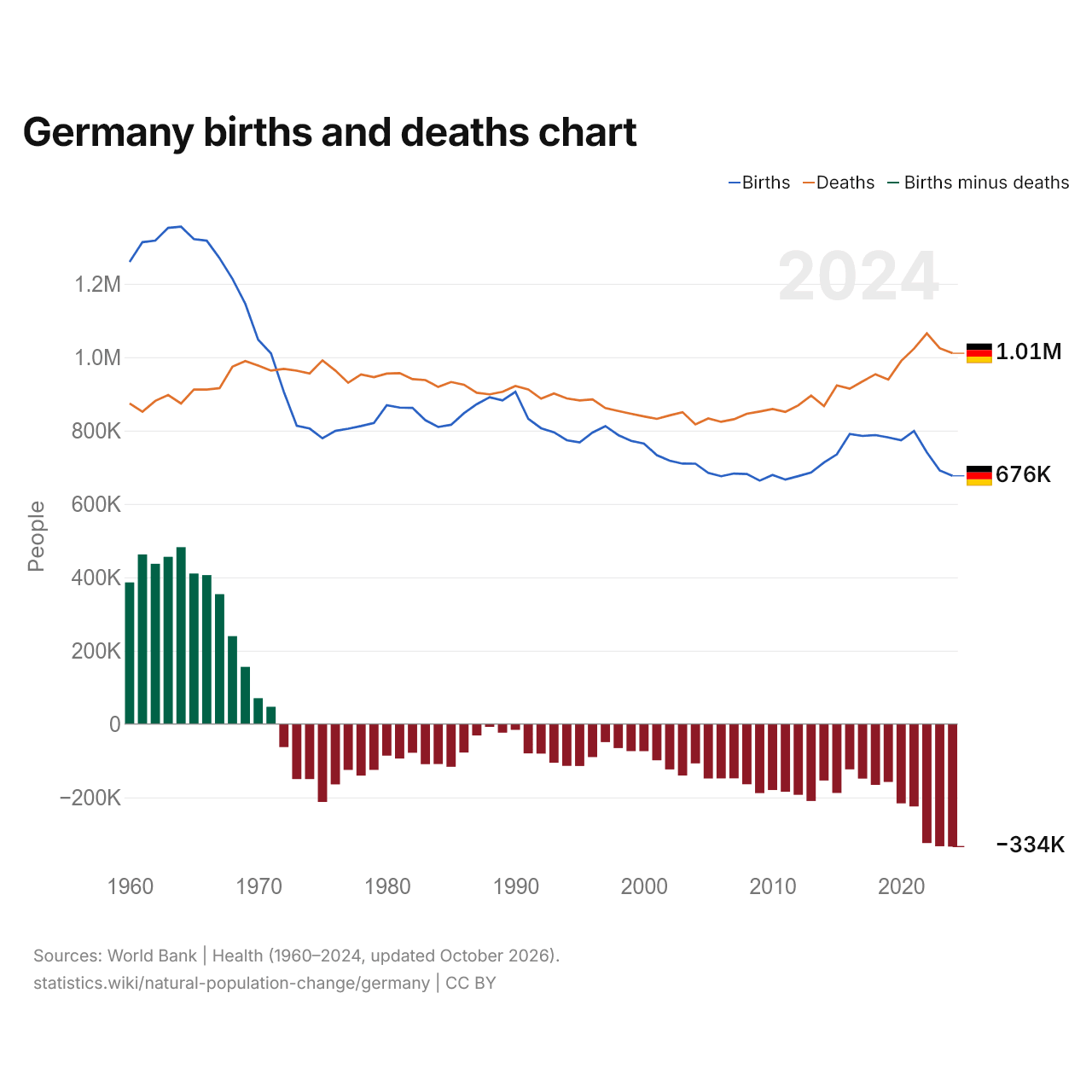
Germany's births and deaths are 676,484 and 1.01 million a year: 334,066 more deaths than births. In Germany, deaths have outnumbered births every year since 1972. Births in Germany peaked at 1.36 million in 1964.
The largest excess of births over deaths in Germany was 482,038, in 1964. Deaths in Germany were highest in 2022, at 1.06 million.
Germany births minus deaths per 1,000 people
| Year | Per 1,000 people | World rank |
|---|---|---|
| Germany | ||
| 2024 | −4 | #179 |
| 2023 | −4 | #182 |
| 2022 | −3.9 | #178 |
| 2021 | −2.7 | #170 |
| 2020 | −2.6 | #175 |
| 2019 | −1.9 | #180 |
| 2018 | −2 | #181 |
| 2017 | −1.8 | #181 |
| 2016 | −1.5 | #182 |
| 2015 | −2.3 | #182 |
| 2014 | −1.9 | #183 |
| 2013 | −2.6 | #188 |
| 2012 | −2.4 | #188 |
| 2011 | −2.3 | #186 |
| 2010 | −2.2 | #188 |
| 2009 | −2.3 | #188 |
| 2008 | −2 | #188 |
| 2007 | −1.8 | #186 |
| 2006 | −1.8 | #186 |
| 2005 | −1.8 | #185 |
| 2004 | −1.3 | #185 |
| 2003 | −1.7 | #184 |
| 2002 | −1.5 | #184 |
| 2001 | −1.2 | #184 |
| 2000 | −0.9 | #184 |
| 1999 | −0.9 | #184 |
| 1998 | −0.8 | #183 |
| 1997 | −0.6 | #185 |
| 1996 | −1.1 | #185 |
| 1995 | −1.4 | #187 |
| 1994 | −1.4 | #188 |
| 1993 | −1.3 | #189 |
| 1992 | −1 | #187 |
| 1991 | −1 | #193 |
| 1990 | −0.2 | #193 |
| 1989 | −0.3 | #194 |
| 1988 | −0.1 | #193 |
| 1987 | −0.4 | #194 |
| 1986 | −1 | #194 |
| 1985 | −1.5 | #194 |
| 1984 | −1.4 | #194 |
| 1983 | −1.4 | #193 |
| 1982 | −1 | #194 |
| 1981 | −1.2 | #194 |
| 1980 | −1.1 | #194 |
| 1979 | −1.6 | #194 |
| 1978 | −1.8 | #194 |
| 1977 | −1.6 | #193 |
| 1976 | −2.1 | #193 |
| 1975 | −2.7 | #194 |
| 1974 | −1.9 | #194 |
| 1973 | −1.9 | #194 |
| 1972 | −0.8 | #194 |
| 1971 | 0.6 | #193 |
| 1970 | 0.9 | #193 |
| 1969 | 2 | #193 |
| 1968 | 3.1 | #191 |
| 1967 | 4.6 | #187 |
| 1966 | 5.3 | #187 |
| 1965 | 5.4 | #186 |
| 1964 | 6.4 | #184 |
| 1963 | 6.1 | #185 |
| 1962 | 5.9 | #186 |
| 1961 | 6.3 | #185 |
| 1960 | 5.3 | #186 |
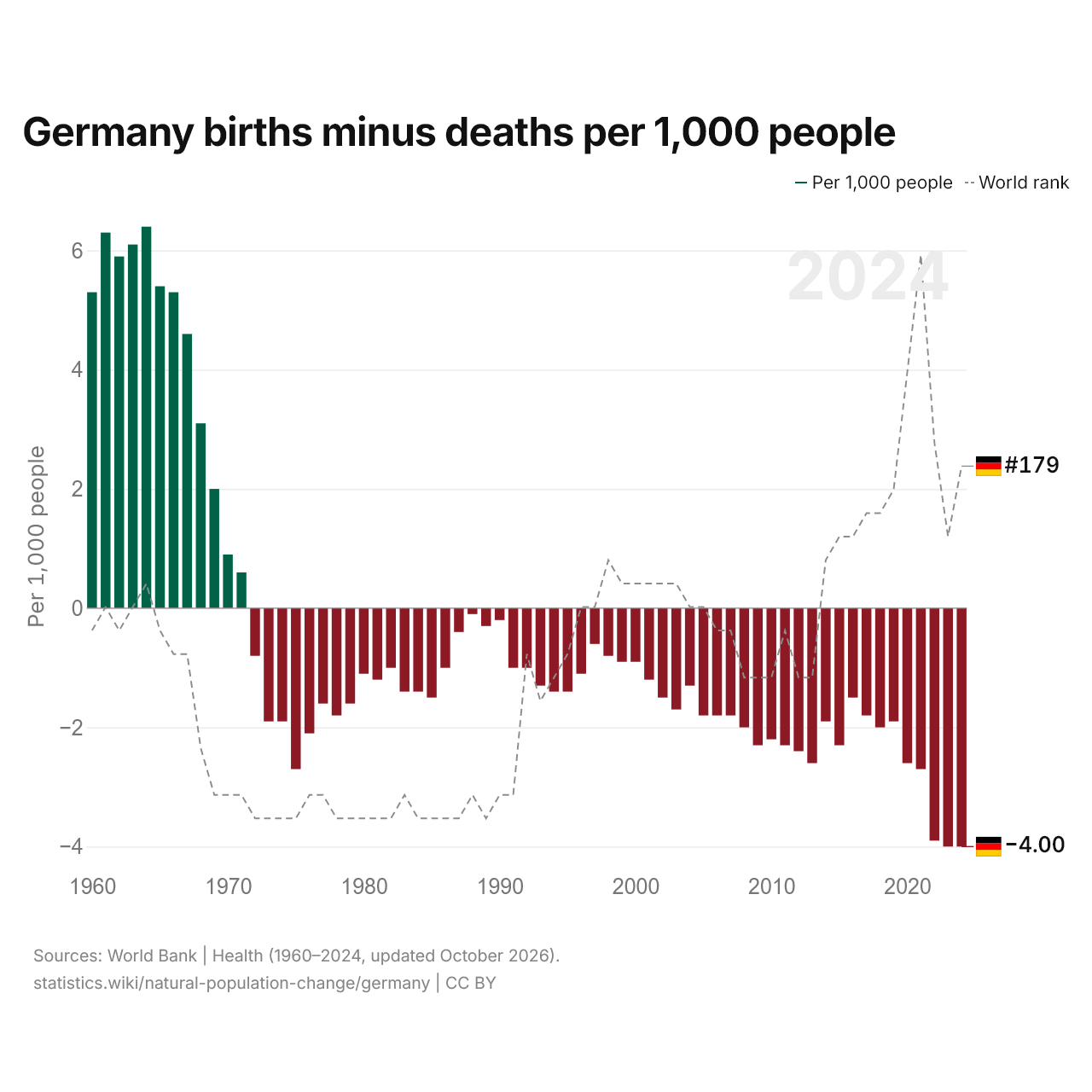
Per 1,000 people, Germany has 4.0 more deaths than births, compared with 5.3 more births in 1960. It ranks 179th in the world, up from 182nd the year before. Its highest rank was 170th, last held in 2021.
Germany's rate per 1,000 people is the 28th highest of 44 countries in Europe, where it ranges from Monaco's 10.6 more deaths than births to Iceland's 4.4 more births than deaths.
Germany births minus deaths
| Births minus deaths | −334,066 |
|---|---|
| Per 1,000 people | −4.0 |
| World rank | 179/196 |
| Yearly average, 2020–2024 | −286,491 |
| Yearly average, 2015–2024 | −221,633 |
| Deaths have exceeded births since | 1972 |
Germany in the world ranking by births minus deaths




Compare Germany births minus deaths with other countries
Sources:
- World Bank | Health (1960–2024, updated October 2026)
Creative Commons Attribution (CC BY): you may copy, share, adapt and reuse this content, also commercially, as long as you credit statistics.wiki and note any changes you made. The sources listed above may have their own license terms.