
Central African Republic life expectancy by age and sex: UN life table, 2026 (projected)
| At age 40 | Men | Women | Both sexes |
|---|---|---|---|
| Average remaining years | 27.9 | 30.7 | 29.5 |
| Average age at death | 67.9 | 70.7 | 69.5 |
| Median age at death | 68.8 | 72.0 | 70.6 |
| Chance of reaching 65 | 59.7% | 66.9% | 63.9% |
| Chance of reaching 70 | 46.8% | 55.0% | 51.6% |
| Chance of reaching 75 | 33.2% | 41.9% | 38.2% |
| Chance of reaching 80 | 20.3% | 28.8% | 24.9% |
| Chance of reaching 85 | 9.7% | 16.5% | 13.3% |
| Chance of reaching 90 | 3.2% | 6.8% | 5.1% |
| Chance of reaching 95 | 0.6% | 1.8% | 1.3% |
| Chance of reaching 100 | 0.1% | 0.3% | 0.2% |
In 2026, life expectancy at birth in the Central African Republic is 58.2 years: 56.0 for men and 60.1 for women.
Central African Republic life expectancy at 30, 40, 50, 60 and 70: UN life table, 2026 (projected)
| Age | Men | Women | Both sexes |
|---|---|---|---|
| 30 | 35.4 | 38.5 | 37.2 |
| 40 | 27.9 | 30.7 | 29.5 |
| 50 | 20.9 | 23.4 | 22.3 |
| 60 | 14.7 | 16.7 | 15.8 |
| 70 | 9.6 | 11.1 | 10.4 |
| Age | Men | Women | Both sexes |
|---|---|---|---|
| 30 | 65.4 | 68.5 | 67.2 |
| 40 | 67.9 | 70.7 | 69.5 |
| 50 | 70.9 | 73.4 | 72.3 |
| 60 | 74.7 | 76.7 | 75.8 |
| 70 | 79.6 | 81.1 | 80.4 |
At 30, men in the Central African Republic live another 35.4 years on average and women another 38.5; at 70, men another 9.6 and women another 11.1.
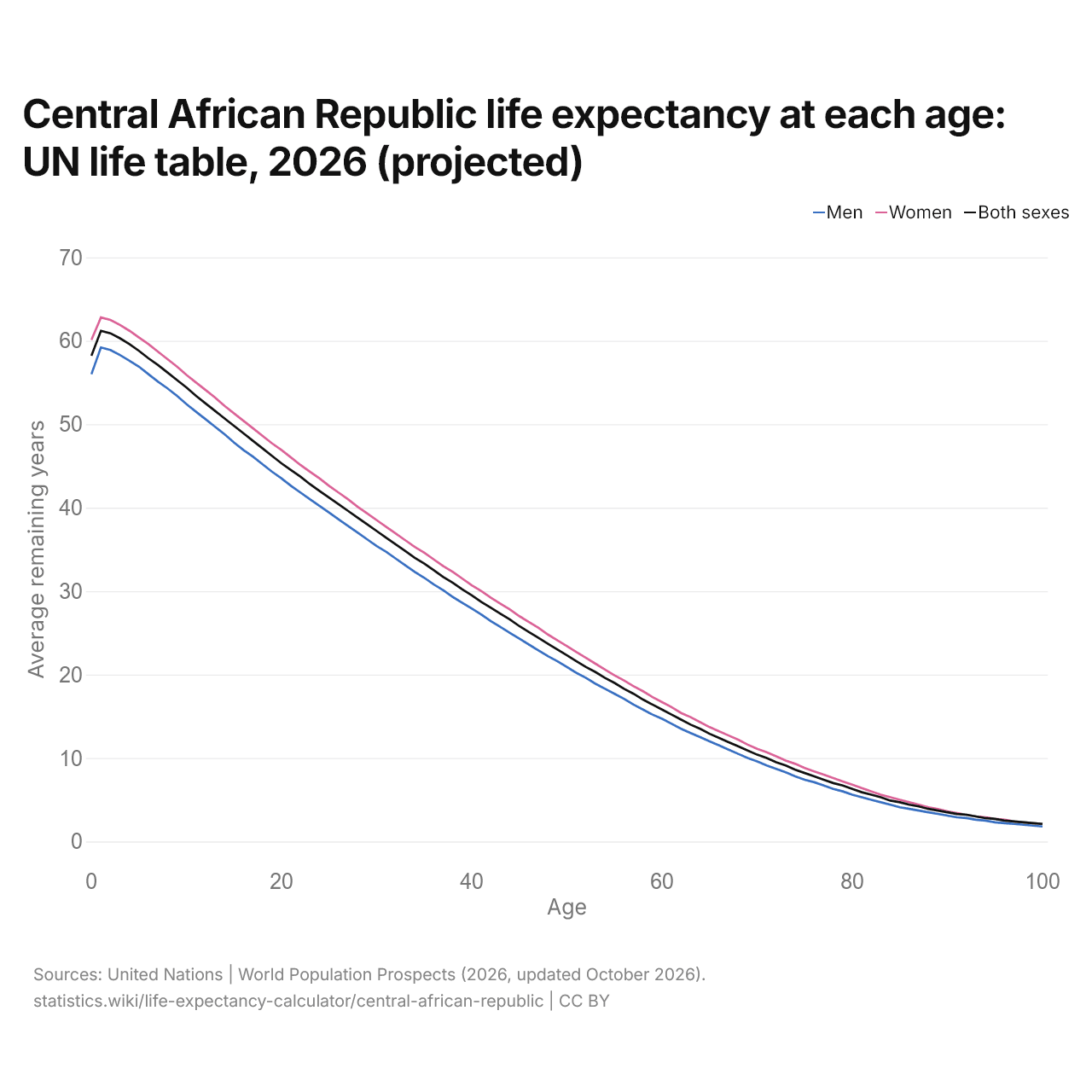
Central African Republic life expectancy at each age: UN life table, 2026 (projected)
| Age | Average remaining years | ||
|---|---|---|---|
| Men | Women | Both sexes | |
| 0 | 56 | 60.1 | 58.2 |
| 1 | 59.2 | 62.8 | 61.2 |
| 2 | 58.9 | 62.5 | 60.9 |
| 3 | 58.3 | 61.9 | 60.3 |
| 4 | 57.6 | 61.2 | 59.6 |
| 5 | 56.9 | 60.4 | 58.8 |
| 6 | 56 | 59.6 | 57.9 |
| 7 | 55.1 | 58.7 | 57.1 |
| 8 | 54.3 | 57.8 | 56.2 |
| 9 | 53.4 | 56.9 | 55.3 |
| 10 | 52.4 | 55.9 | 54.4 |
| 11 | 51.5 | 55 | 53.4 |
| 12 | 50.6 | 54.1 | 52.5 |
| 13 | 49.7 | 53.2 | 51.6 |
| 14 | 48.8 | 52.2 | 50.7 |
| 15 | 47.8 | 51.3 | 49.8 |
| 16 | 46.9 | 50.4 | 48.9 |
| 17 | 46.1 | 49.5 | 48 |
| 18 | 45.2 | 48.6 | 47.1 |
| 19 | 44.3 | 47.7 | 46.2 |
| 20 | 43.5 | 46.9 | 45.3 |
| 21 | 42.6 | 46 | 44.5 |
| 22 | 41.8 | 45.1 | 43.7 |
| 23 | 41 | 44.3 | 42.8 |
| 24 | 40.2 | 43.5 | 42 |
| 25 | 39.4 | 42.6 | 41.2 |
| 26 | 38.6 | 41.8 | 40.4 |
| 27 | 37.8 | 41 | 39.6 |
| 28 | 37 | 40.1 | 38.8 |
| 29 | 36.2 | 39.3 | 38 |
| 30 | 35.4 | 38.5 | 37.2 |
| 31 | 34.7 | 37.7 | 36.4 |
| 32 | 33.9 | 36.9 | 35.6 |
| 33 | 33.1 | 36.1 | 34.8 |
| 34 | 32.3 | 35.3 | 34 |
| 35 | 31.6 | 34.6 | 33.3 |
| 36 | 30.8 | 33.8 | 32.5 |
| 37 | 30.1 | 33 | 31.7 |
| 38 | 29.3 | 32.3 | 31 |
| 39 | 28.6 | 31.5 | 30.2 |
| 40 | 27.9 | 30.7 | 29.5 |
| 41 | 27.2 | 30 | 28.7 |
| 42 | 26.4 | 29.2 | 28 |
| 43 | 25.7 | 28.5 | 27.3 |
| 44 | 25 | 27.8 | 26.6 |
| 45 | 24.3 | 27 | 25.8 |
| 46 | 23.6 | 26.3 | 25.1 |
| 47 | 22.9 | 25.6 | 24.4 |
| 48 | 22.2 | 24.8 | 23.7 |
| 49 | 21.6 | 24.1 | 23 |
| 50 | 20.9 | 23.4 | 22.3 |
| 51 | 20.2 | 22.7 | 21.6 |
| 52 | 19.6 | 22 | 20.9 |
| 53 | 18.9 | 21.3 | 20.3 |
| 54 | 18.3 | 20.6 | 19.6 |
| 55 | 17.7 | 19.9 | 19 |
| 56 | 17.1 | 19.3 | 18.3 |
| 57 | 16.4 | 18.6 | 17.7 |
| 58 | 15.8 | 18 | 17 |
| 59 | 15.2 | 17.3 | 16.4 |
| 60 | 14.7 | 16.7 | 15.8 |
| 61 | 14.1 | 16.1 | 15.2 |
| 62 | 13.5 | 15.4 | 14.6 |
| 63 | 13 | 14.9 | 14 |
| 64 | 12.5 | 14.3 | 13.5 |
| 65 | 12 | 13.7 | 12.9 |
| 66 | 11.5 | 13.2 | 12.4 |
| 67 | 11 | 12.7 | 11.9 |
| 68 | 10.5 | 12.2 | 11.4 |
| 69 | 10 | 11.6 | 10.9 |
| 70 | 9.6 | 11.1 | 10.4 |
| 71 | 9.1 | 10.7 | 10 |
| 72 | 8.7 | 10.2 | 9.5 |
| 73 | 8.3 | 9.7 | 9.1 |
| 74 | 7.8 | 9.3 | 8.6 |
| 75 | 7.4 | 8.8 | 8.2 |
| 76 | 7.1 | 8.4 | 7.8 |
| 77 | 6.7 | 8 | 7.4 |
| 78 | 6.3 | 7.6 | 7 |
| 79 | 6 | 7.2 | 6.7 |
| 80 | 5.6 | 6.8 | 6.3 |
| 81 | 5.3 | 6.4 | 5.9 |
| 82 | 5 | 6 | 5.6 |
| 83 | 4.7 | 5.6 | 5.3 |
| 84 | 4.4 | 5.3 | 4.9 |
| 85 | 4.1 | 5 | 4.7 |
| 86 | 3.9 | 4.7 | 4.4 |
| 87 | 3.7 | 4.4 | 4.2 |
| 88 | 3.5 | 4.1 | 3.9 |
| 89 | 3.3 | 3.9 | 3.7 |
| 90 | 3.1 | 3.6 | 3.5 |
| 91 | 2.9 | 3.4 | 3.3 |
| 92 | 2.8 | 3.2 | 3.2 |
| 93 | 2.6 | 3 | 3 |
| 94 | 2.5 | 2.9 | 2.8 |
| 95 | 2.3 | 2.7 | 2.7 |
| 96 | 2.2 | 2.6 | 2.5 |
| 97 | 2.1 | 2.4 | 2.4 |
| 98 | 2 | 2.3 | 2.3 |
| 99 | 1.9 | 2.2 | 2.2 |
| 100 | 1.8 | 2.1 | 2.1 |
People aged 65 in the Central African Republic live another 12.9 years on average, and people aged 80 another 6.3.
At 80, women in the Central African Republic live another 6.8 years on average and men another 5.6, a gap of 1.2 years against 4.1 at birth.
Compare life expectancy by age in the Central African Republic and other countries
Sources:
- United Nations | World Population Prospects (2026, updated October 2026)
Creative Commons Attribution (CC BY): you may copy, share, adapt and reuse this content, also commercially, as long as you credit statistics.wiki and note any changes you made. The sources listed above may have their own license terms.