
Ivory Coast GDP, 1960–2025
| Year | GDP | World rank | |
|---|---|---|---|
| Current $ | Constant 2015 $ | ||
| 2025 | $99,773,555,666 | $81,476,260,434 | #77 |
| 2024 | $87,113,179,149 | $76,503,530,924 | #77 |
| 2023 | $80,780,312,569 | $72,159,844,126 | #78 |
| 2022 | $70,922,824,814 | $67,692,161,182 | #82 |
| 2021 | $72,794,636,654 | $63,620,521,822 | #74 |
| 2020 | $63,027,852,805 | $59,423,700,881 | #75 |
| 2019 | $60,382,894,697 | $59,010,785,541 | #83 |
| 2018 | $58,522,477,787 | $55,294,253,264 | #82 |
| 2017 | $52,512,343,997 | $52,739,979,047 | #84 |
| 2016 | $48,407,761,037 | $49,101,205,369 | #83 |
| 2015 | $45,815,005,169 | $45,815,005,169 | #86 |
| 2014 | $48,843,005,614 | $42,739,891,584 | #88 |
| 2013 | $42,760,235,485 | $39,077,544,168 | #90 |
| 2012 | $36,302,302,877 | $35,281,210,701 | #91 |
| 2011 | $36,693,710,801 | $32,783,010,325 | #88 |
| 2010 | $34,936,307,980 | $34,643,522,419 | #87 |
| 2009 | $33,886,813,250 | $32,423,167,867 | #84 |
| 2008 | $34,078,240,293 | $31,295,490,701 | #83 |
| 2007 | $28,760,090,953 | $29,867,049,486 | #83 |
| 2006 | $25,281,413,263 | $29,541,668,753 | #81 |
| 2005 | $24,036,918,703 | $28,732,677,632 | #80 |
| 2004 | $23,510,575,681 | $28,449,303,912 | #76 |
| 2003 | $21,251,754,340 | $27,571,152,176 | #75 |
| 2002 | $18,054,383,321 | $28,938,759,334 | #75 |
| 2001 | $16,810,537,044 | $29,751,121,586 | #75 |
| 2000 | $16,577,533,892 | $30,406,072,178 | #77 |
| 1999 | $18,870,992,456 | $30,487,103,687 | #70 |
| 1998 | $19,619,654,756 | $30,135,465,006 | #71 |
| 1997 | $18,047,558,038 | $28,903,065,479 | #71 |
| 1996 | $18,071,152,831 | $26,359,663,692 | #70 |
| 1995 | $11,000,146,267 | $24,468,419,439 | #82 |
| 1994 | $8,313,557,510 | $22,840,839,521 | #82 |
| 1993 | $11,045,760,288 | $22,657,044,066 | #76 |
| 1992 | $11,152,971,274 | $22,700,739,607 | #73 |
| 1991 | $10,492,628,581 | $22,756,392,780 | #76 |
| 1990 | $10,795,850,583 | $22,747,083,497 | #77 |
| 1989 | $9,757,410,645 | $22,999,132,930 | #68 |
| 1988 | $10,255,169,806 | $22,340,532,915 | #66 |
| 1987 | $10,087,654,465 | $22,089,489,410 | #64 |
| 1986 | $9,158,302,100 | $22,166,845,697 | #63 |
| 1985 | $6,977,650,644 | $21,467,156,206 | #70 |
| 1984 | $6,841,639,247 | $20,542,492,760 | #71 |
| 1983 | $6,838,184,773 | $21,112,804,815 | #71 |
| 1982 | $7,567,110,849 | $21,969,674,962 | #71 |
| 1981 | $8,432,589,942 | $21,925,643,371 | #66 |
| 1980 | $10,175,617,609 | $21,184,094,378 | #61 |
| 1979 | $9,142,933,967 | $23,791,045,073 | #59 |
| 1978 | $7,900,526,298 | $23,234,711,410 | #60 |
| 1977 | $6,265,068,189 | $20,949,261,442 | #61 |
| 1976 | $4,662,053,825 | $19,521,378,207 | #62 |
| 1975 | $3,893,839,190 | $17,288,346,644 | #64 |
| 1974 | $3,070,152,309 | $15,970,333,193 | #68 |
| 1973 | $2,508,421,426 | $15,307,901,973 | #70 |
| 1972 | $1,849,400,402 | $14,449,705,425 | #72 |
| 1971 | $1,584,128,509 | $13,862,407,214 | #70 |
| 1970 | $1,455,482,795 | $12,664,747,894 | #70 |
| 1969 | $1,361,360,293 | $11,474,286,968 | #66 |
| 1968 | $1,281,281,277 | $10,475,049,116 | #67 |
| 1967 | $1,082,922,725 | $9,307,163,144 | #68 |
| 1966 | $1,024,102,880 | $8,898,018,736 | #67 |
| 1965 | $919,771,229 | $7,974,752,908 | #68 |
| 1964 | $921,063,327 | $8,230,699,197 | #65 |
| 1963 | $761,047,198 | $6,998,115,047 | #68 |
| 1962 | $645,284,474 | $6,112,405,708 | #71 |
| 1961 | $618,245,634 | $6,038,315,905 | #69 |
| 1960 | $546,203,559 | $5,492,745,890 | #68 |
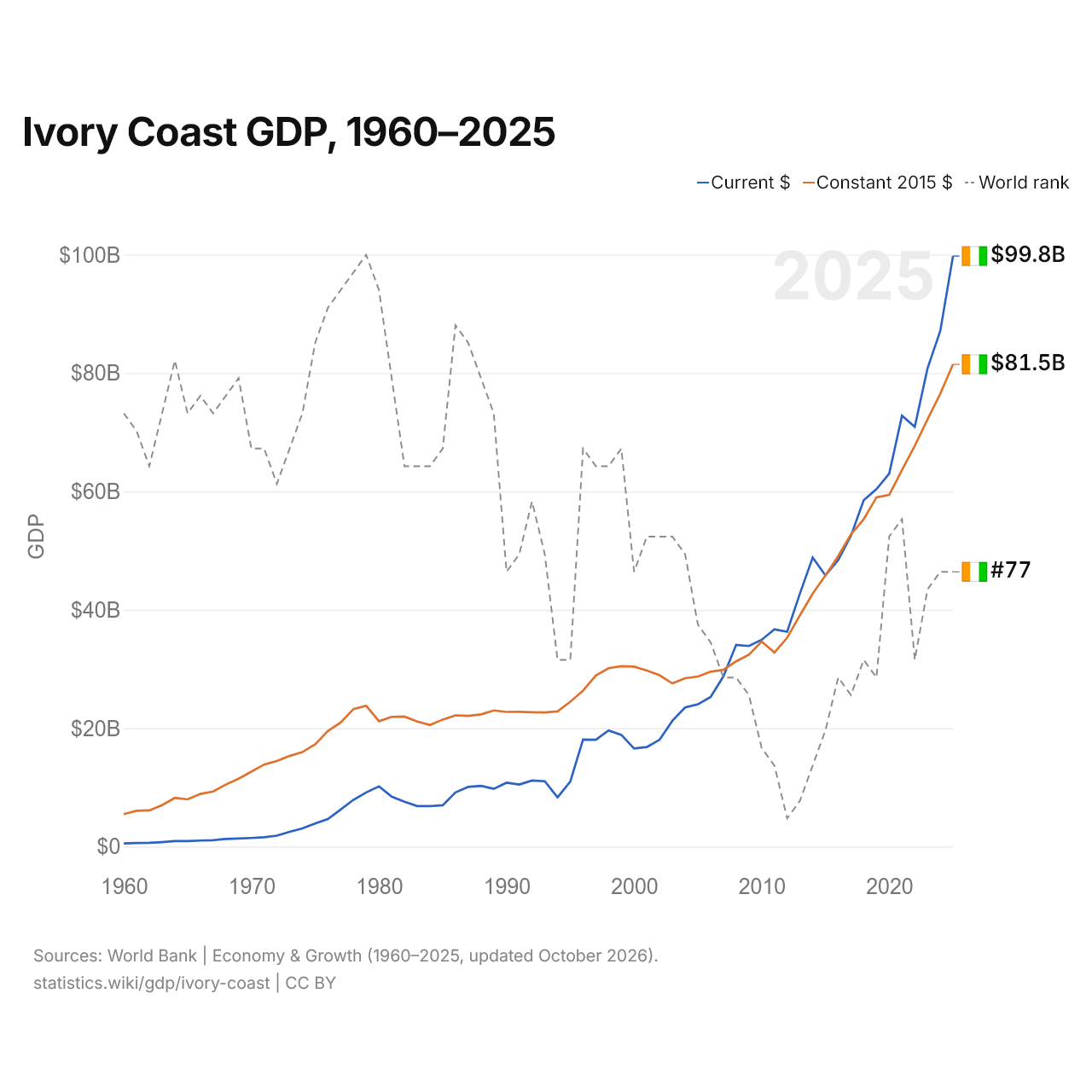
Ivory Coast's GDP was $99.8 billion in 2025, or 0.084% of world GDP. It was the 77th largest in the world, a rank it has held since 2024. Its highest rank was 59th, last held in 1979. In constant 2015 dollars, GDP grew 6.5% in 2025 and 77.8% over the ten years since 2015.
In constant 2015 dollars, Ivory Coast's GDP was 15 times as large in 2025 as in 1960, an average growth of 4.2% a year. Of the decades since 1960, growth was fastest from 1960 to 1970, at 8.7% a year, and slowest from 1980 to 1990, at 0.7% a year.
Ivory Coast's GDP was the 10th largest of the 54 countries of Africa, and 3.2% of the region's total. Its GDP per capita was $3,050 in 2025, the 145th highest in the world. At purchasing power parity, its GDP (PPP) was $269 billion in 2025, the 74th largest in the world.
Ivory Coast in the world GDP ranking, 2025
| Rank | Country | GDP | Share of world | |
|---|---|---|---|---|
| 74 |
 Costa Rica |
$103B | 0.09% | |
| 75 |
 Luxembourg |
$101B | 0.09% | |
| 76 |
 Serbia |
$100B | 0.08% | |
| 77 |
 Ivory Coast |
$99.8B | 0.08% | |
| 78 |
 Venezuela |
$99.7B | 0.08% | |
| 79 |
 Lithuania |
$95.2B | 0.08% | |
| 80 |
 Belarus |
$93.4B | 0.08% |
Compare Ivory Coast GDP with other countries
Sources:
- World Bank | Economy & Growth (1960–2025, updated October 2026)
Creative Commons Attribution (CC BY): you may copy, share, adapt and reuse this content, also commercially, as long as you credit statistics.wiki and note any changes you made. The sources listed above may have their own license terms.