
Pakistan fertility rate, 1960–2026
| Year | Children per woman | World rank |
|---|---|---|
| Pakistan | ||
| 2026 projected | 3.44 | #43 |
| 2025 projected | 3.5 | #43 |
| 2024 | 3.55 | #43 |
| 2023 | 3.61 | #42 |
| 2022 | 3.66 | #42 |
| 2021 | 3.72 | #42 |
| 2020 | 3.77 | #41 |
| 2019 | 3.81 | #41 |
| 2018 | 3.86 | #42 |
| 2017 | 3.9 | #42 |
| 2016 | 3.9 | #44 |
| 2015 | 3.99 | #43 |
| 2014 | 4.06 | #43 |
| 2013 | 4.13 | #43 |
| 2012 | 4.2 | #42 |
| 2011 | 4.31 | #43 |
| 2010 | 4.4 | #44 |
| 2009 | 4.47 | #42 |
| 2008 | 4.51 | #41 |
| 2007 | 4.55 | #42 |
| 2006 | 4.59 | #42 |
| 2005 | 4.6 | #42 |
| 2004 | 4.68 | #42 |
| 2003 | 4.89 | #41 |
| 2002 | 5.01 | #41 |
| 2001 | 5.18 | #38 |
| 2000 | 5.35 | #37 |
| 1999 | 5.46 | #37 |
| 1998 | 5.51 | #37 |
| 1997 | 5.64 | #36 |
| 1996 | 5.77 | #36 |
| 1995 | 5.89 | #34 |
| 1994 | 6.01 | #30 |
| 1993 | 6.11 | #27 |
| 1992 | 6.21 | #27 |
| 1991 | 6.29 | #27 |
| 1990 | 6.36 | #28 |
| 1989 | 6.43 | #27 |
| 1988 | 6.48 | #30 |
| 1987 | 6.52 | #31 |
| 1986 | 6.55 | #31 |
| 1985 | 6.59 | #32 |
| 1984 | 6.62 | #32 |
| 1983 | 6.64 | #33 |
| 1982 | 6.67 | #34 |
| 1981 | 6.7 | #35 |
| 1980 | 6.73 | #36 |
| 1979 | 6.76 | #36 |
| 1978 | 6.78 | #36 |
| 1977 | 6.8 | #36 |
| 1976 | 6.81 | #38 |
| 1975 | 6.81 | #39 |
| 1974 | 6.81 | #41 |
| 1973 | 6.81 | #43 |
| 1972 | 6.81 | #43 |
| 1971 | 6.8 | #43 |
| 1970 | 6.8 | #42 |
| 1969 | 6.8 | #44 |
| 1968 | 6.8 | #44 |
| 1967 | 6.8 | #47 |
| 1966 | 6.8 | #50 |
| 1965 | 6.8 | #49 |
| 1964 | 6.8 | #52 |
| 1963 | 6.8 | #54 |
| 1962 | 6.8 | #53 |
| 1961 | 6.8 | #48 |
| 1960 | 6.8 | #45 |
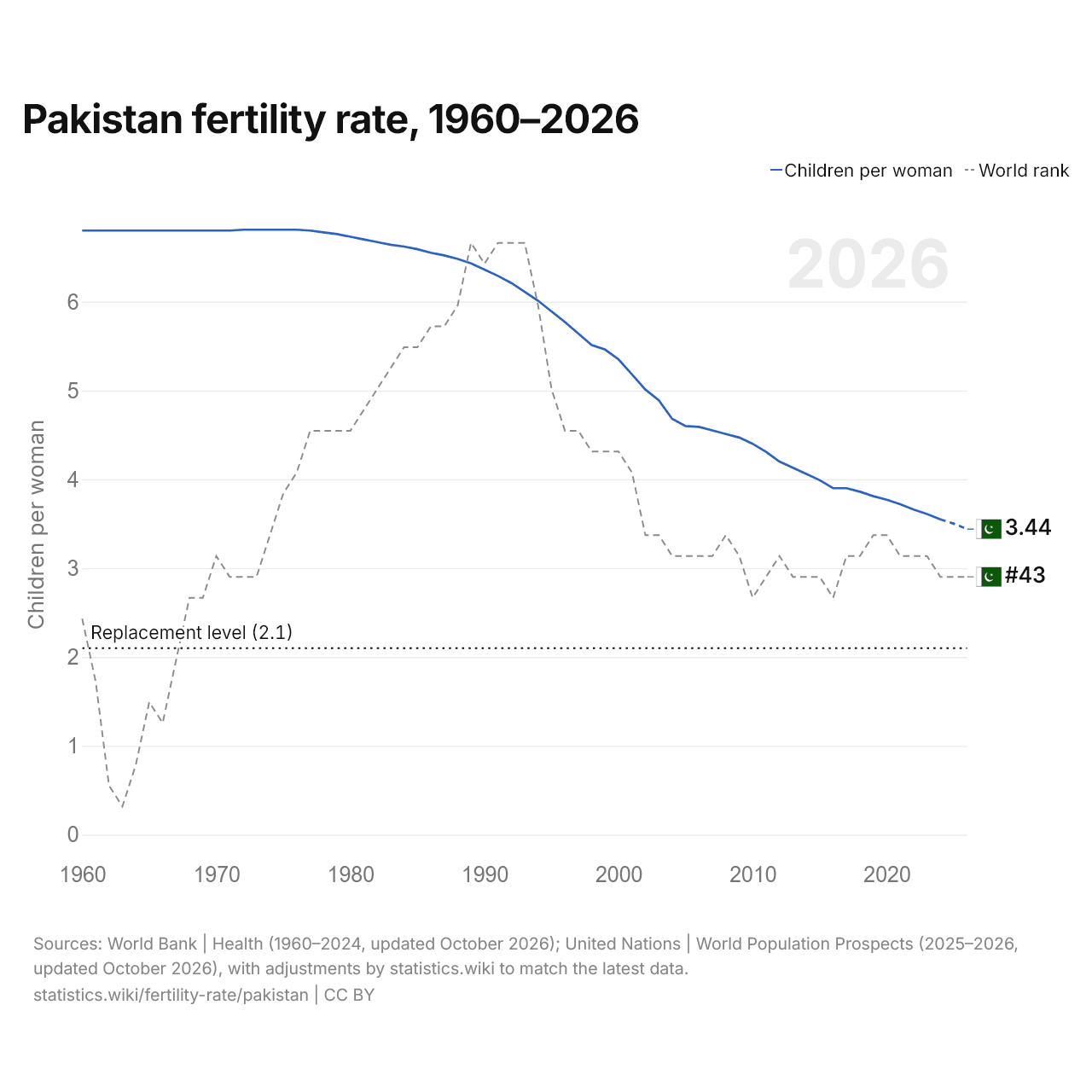
In 2026, Pakistan's fertility rate is 3.44 children per woman, down from 6.80 in 1960. It was highest in 1975, at 6.81. It is the 43rd highest in the world, a rank it has held since 2024. Pakistan's highest rank was 27th, last held in 1993.
Pakistan's fertility rate is the 3rd highest of the 48 countries of Asia, where it ranges from Taiwan's 0.70 to Afghanistan's 4.56. The largest ten-year fall in Pakistan's fertility rate was from 1990 to 2000, by 1.01 children per woman.
The average age of mothers at childbirth in Pakistan is 28.9 years in 2026, the 120th highest in the world. A modern method of contraception is used by 25.0% of married women aged 15–49 in Pakistan.
Pakistan in the world fertility rate ranking, 2026
| Rank | Country | Children per woman | Change since 2000 | |
|---|---|---|---|---|
| 40 |
 Gabon |
3.49 | −0.98 | |
| 41 |
 Sao Tome |
3.47 | −1.69 | |
| 42 |
 Malawi |
3.45 | −2.55 | |
| 43 |
 Pakistan |
3.44 | −1.91 | |
| 44 |
 Solomon Islands |
3.42 | −1.34 | |
| 45 |
 Uzbekistan |
3.4 | +0.71 | vs Uzbekistan |
| 46 |
 Ghana |
3.26 | −1.57 |
Compare the Pakistan fertility rate with other countries
Sources:
- World Bank | Health (1960–2024, updated October 2026)
- United Nations | World Population Prospects (2025–2026, updated October 2026), with adjustments by statistics.wiki to match the latest data
Creative Commons Attribution (CC BY): you may copy, share, adapt and reuse this content, also commercially, as long as you credit statistics.wiki and note any changes you made. The sources listed above may have their own license terms.