
Comercio (exportaciones + importaciones) de Omán en % del PIB por año, 1967–2025
| Año | % del PIB | Puesto mundial | ||
|---|---|---|---|---|
| Exportaciones | Importaciones | Comercio | Puesto mundial | |
| 2025 | 60,4 % | 48,5 % | 109 % | #47 |
| 2024 | 66,1 % | 48,8 % | 114,9 % | #44 |
| 2023 | 61,6 % | 44,9 % | 106,4 % | #57 |
| 2022 | 63,3 % | 42,5 % | 105,7 % | #61 |
| 2021 | 53,3 % | 42,6 % | 95,9 % | #57 |
| 2020 | 47,1 % | 44,8 % | 91,9 % | #49 |
| 2019 | 49,5 % | 37 % | 86,5 % | #72 |
| 2018 | 50,6 % | 38,7 % | 89,3 % | #68 |
| 2017 | 45,7 % | 43,2 % | 89 % | #67 |
| 2016 | 41,3 % | 41,5 % | 82,9 % | #77 |
| 2015 | 49,7 % | 46,7 % | 96,4 % | #56 |
| 2014 | 61,4 % | 40,8 % | 102,3 % | #55 |
| 2013 | 66 % | 46,5 % | 112,5 % | #38 |
| 2012 | 62,7 % | 39,4 % | 102,1 % | #58 |
| 2011 | 63,9 % | 37,7 % | 101,6 % | #55 |
| 2010 | 59,1 % | 37,3 % | 96,4 % | #52 |
| 2009 | 52,8 % | 38,8 % | 91,6 % | #52 |
| 2008 | 56,7 % | 38,1 % | 94,8 % | #64 |
| 2007 | 54,6 % | 40,2 % | 94,9 % | #60 |
| 2006 | 53,8 % | 32,4 % | 86,1 % | #71 |
| 2005 | 55,3 % | 31,5 % | 86,8 % | #65 |
| 2004 | 49,8 % | 38,8 % | 88,6 % | #59 |
| 2003 | 49,8 % | 35 % | 84,8 % | #57 |
| 2002 | 51,1 % | 32,6 % | 83,7 % | #60 |
| 2001 | 52,1 % | 32,5 % | 84,5 % | #57 |
| 2000 | 52,9 % | 28,5 % | 81,4 % | #65 |
| 1999 | 42,9 % | 33,7 % | 76,6 % | #64 |
| 1998 | 36,8 % | 43,7 % | 80,5 % | #59 |
| 1997 | 43,9 % | 27,7 % | 71,6 % | #77 |
| 1996 | 43,7 % | 25,7 % | 69,4 % | #73 |
| 1995 | 38,6 % | 25,5 % | 64,2 % | #81 |
| 1994 | 37,7 % | 25 % | 62,7 % | #77 |
| 1993 | 37,8 % | 27,3 % | 65,1 % | #66 |
| 1992 | 39,2 % | 25,5 % | 64,7 % | #63 |
| 1991 | 37,8 % | 24,9 % | 62,7 % | #61 |
| 1990 | 41,4 % | 19,8 % | 61,2 % | #62 |
| 1989 | - | - | - | - |
| 1988 | 40 % | 31,4 % | 71,4 % | #42 |
| 1987 | 48,9 % | 29,1 % | 77,9 % | #36 |
| 1986 | 39,2 % | 40,9 % | 80,2 % | #36 |
| 1985 | 49,8 % | 37,2 % | 87 % | #35 |
| 1984 | 50,3 % | 37,6 % | 87,9 % | #33 |
| 1983 | 53,7 % | 38,1 % | 91,7 % | #30 |
| 1982 | 58,5 % | 43,2 % | 101,7 % | #23 |
| 1981 | 64,7 % | 38,1 % | 102,8 % | #23 |
| 1980 | 62,7 % | 37,7 % | 100,3 % | #27 |
| 1979 | 61,1 % | 40,7 % | 101,8 % | #16 |
| 1978 | 58,3 % | 48,7 % | 107 % | #13 |
| 1977 | 58,3 % | 44 % | 102,3 % | #16 |
| 1976 | 62,3 % | 46 % | 108,3 % | #12 |
| 1975 | 67,6 % | 50,7 % | 118,2 % | #7 |
| 1974 | 73,7 % | 47,8 % | 121,5 % | #6 |
| 1973 | 67,8 % | 55,2 % | 123 % | #4 |
| 1972 | 59,4 % | 43,8 % | 103,1 % | #8 |
| 1971 | 65,8 % | 32,1 % | 97,9 % | #7 |
| 1970 | 73,7 % | 19,7 % | 93,4 % | #6 |
| 1969 | 74,6 % | 11,9 % | 86,5 % | - |
| 1968 | 70,1 % | 14,7 % | 84,9 % | - |
| 1967 | 33,8 % | 22,4 % | 56,2 % | - |
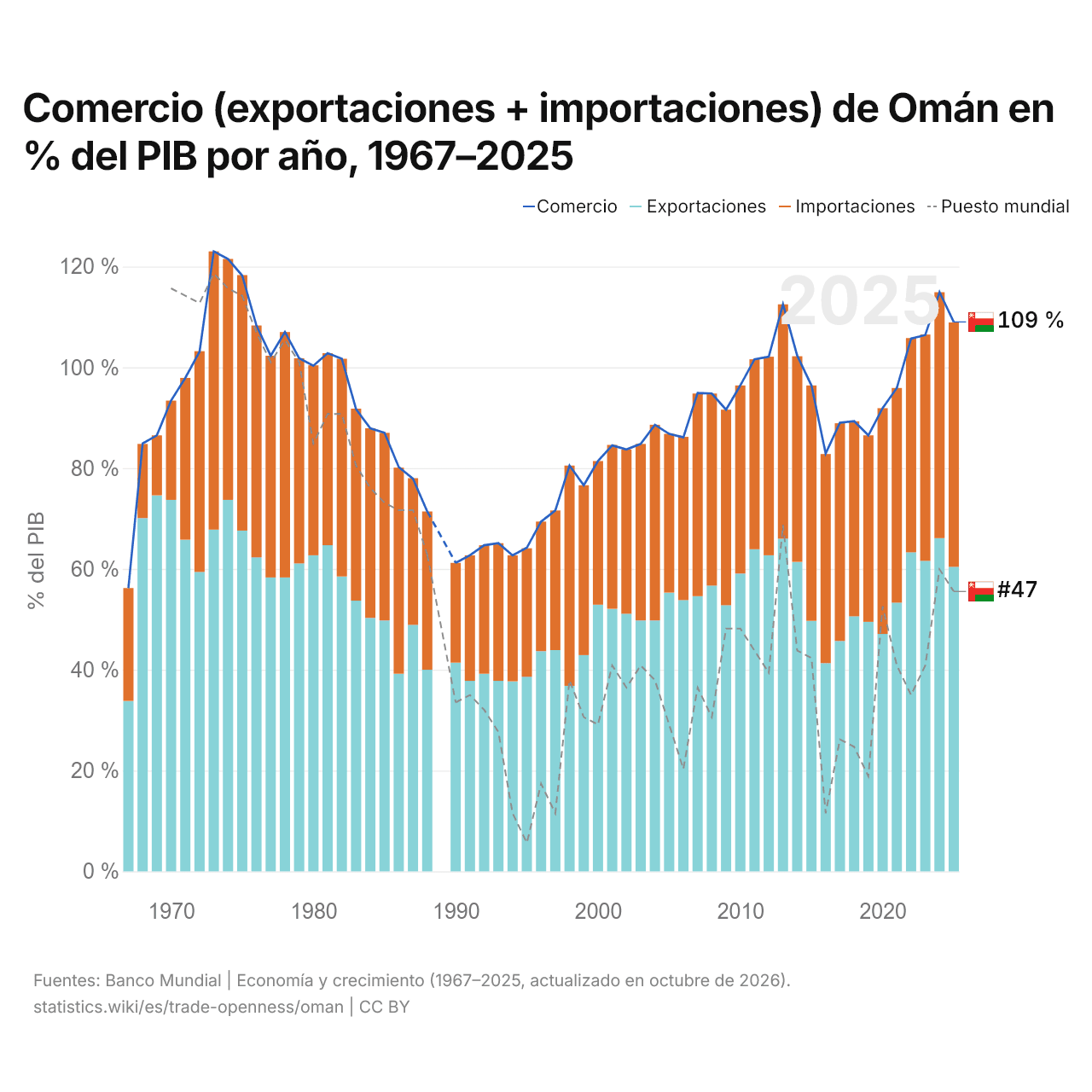
En 2025, el comercio de Omán equivalió al 109,0 % de su PIB, frente al 56,2 % en 1967. Su máximo fue del 123,0 %, en 1973. Las exportaciones representaron el 60,4 % del PIB y las importaciones, el 48,5 %. Ocupó el puesto 47 del mundo; en 2024, el 44. Su mejor posición fue el puesto 4, por última vez en 1973.
En 2025, el comercio de Omán, como porcentaje del PIB, fue el 12.º más alto de 44 países de Asia, donde iba desde 27,2 % en Pakistán hasta 320,3 % en Singapur. La mayor subida del comercio de Omán en diez años fue la de 1990 a 2000, de 20,2 puntos porcentuales del PIB; la mayor caída, la de 1980 a 1990, de 39,1 puntos.
Omán en la clasificación mundial del comercio en % del PIB, 2025
| Puesto | País | Comercio | Exportaciones | Importaciones | |
|---|---|---|---|---|---|
| 44 |
 Bielorrusia |
112,1 % | 55,1 % | 57,0 % | |
| 45 |
 Islas Salomón |
111,4 % (2024) | 40,6 % | 70,8 % | |
| 46 |
 Suazilandia |
110,9 % | 54,1 % | 56,8 % | |
| 47 |
 Omán |
109,0 % | 60,4 % | 48,5 % | |
| 48 |
 Belice |
109,0 % (2024) | 55,2 % | 53,7 % | |
| 49 |
 Namibia |
108,6 % | 44,7 % | 63,9 % | |
| 50 |
 Austria |
107,0 % | 54,7 % | 52,3 % |
Comparar la apertura comercial de Omán con otros países
Fuentes:
- Banco Mundial | Economía y crecimiento (1967–2025, actualizado en octubre de 2026)
Creative Commons Atribución (CC BY): puedes copiar, compartir, adaptar y reutilizar este contenido, también con fines comerciales, siempre que cites a statistics.wiki e indiques los cambios que hayas hecho. Las fuentes indicadas arriba pueden tener sus propias condiciones de licencia.