
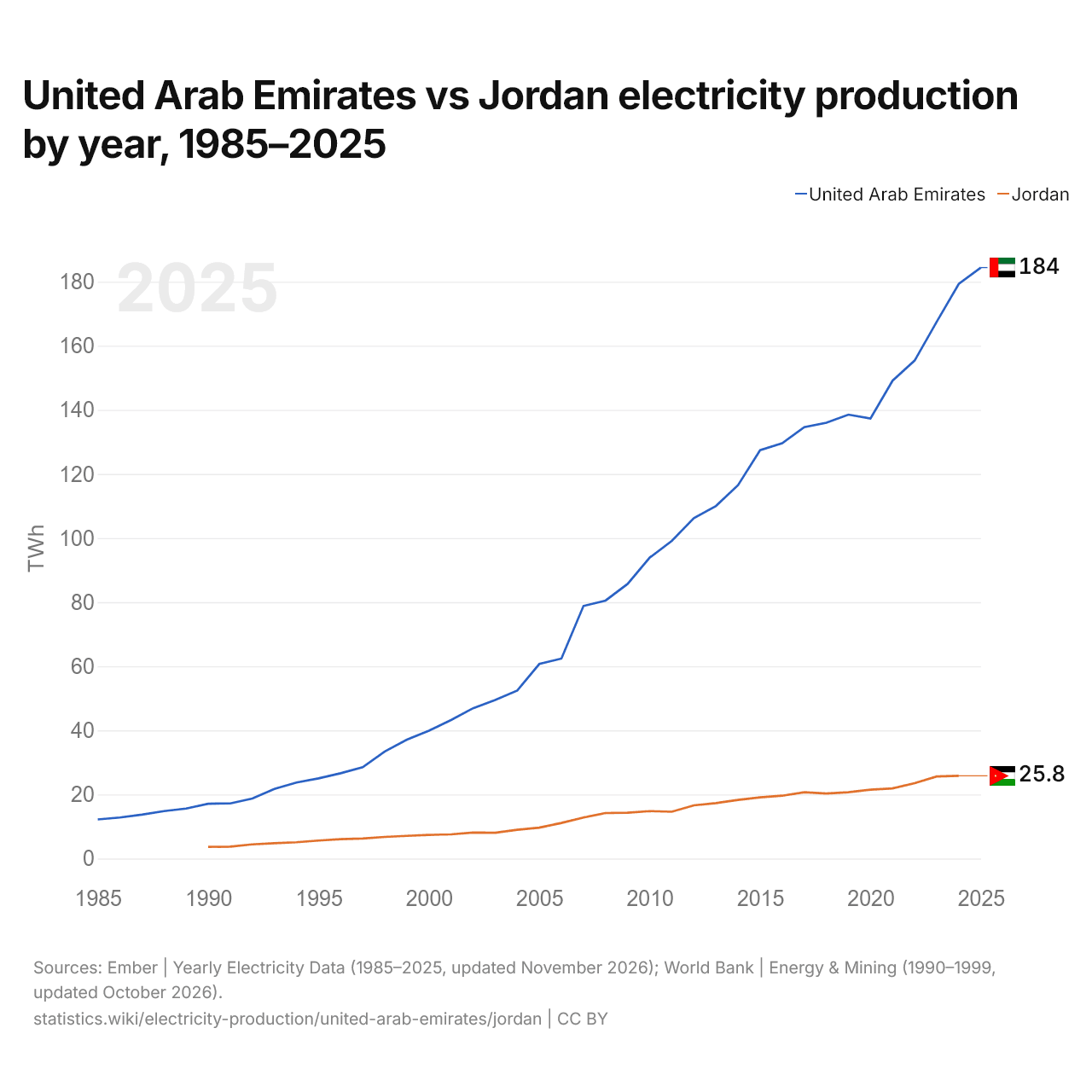
United Arab Emirates vs Jordan electricity production by year, 1985–2025
1x
| Year | TWh | |
|---|---|---|
| United Arab Emirates | Jordan | |
| 2025 | 184.4 | - |
| 2024 | 179.3 | 25.8 |
| 2023 | 167.5 | 25.6 |
| 2022 | 155.4 | 23.5 |
| 2021 | 149.1 | 21.9 |
| 2020 | 137.3 | 21.5 |
| 2019 | 138.5 | 20.7 |
| 2018 | 136 | 20.3 |
| 2017 | 134.6 | 20.7 |
| 2016 | 129.6 | 19.6 |
| 2015 | 127.4 | 19.1 |
| 2014 | 116.5 | 18.3 |
| 2013 | 110 | 17.3 |
| 2012 | 106.2 | 16.6 |
| 2011 | 99.1 | 14.6 |
| 2010 | 93.9 | 14.8 |
| 2009 | 85.7 | 14.3 |
| 2008 | 80.5 | 14.2 |
| 2007 | 78.8 | 12.8 |
| 2006 | 62.4 | 11.1 |
| 2005 | 60.7 | 9.65 |
| 2004 | 52.4 | 8.96 |
| 2003 | 49.5 | 8.03 |
| 2002 | 46.9 | 8.12 |
| 2001 | 43.2 | 7.54 |
| 2000 | 39.9 | 7.37 |
| 1999 | 37.1 | 7.08 |
| 1998 | 33.4 | 6.75 |
| 1997 | 28.5 | 6.26 |
| 1996 | 26.6 | 6.06 |
| 1995 | 25 | 5.62 |
| 1994 | 23.7 | 5.08 |
| 1993 | 21.7 | 4.76 |
| 1992 | 18.7 | 4.42 |
| 1991 | 17.2 | 3.72 |
| 1990 | 17.1 | 3.64 |
| 1989 | 15.6 | - |
| 1988 | 14.8 | - |
| 1987 | 13.7 | - |
| 1986 | 12.8 | - |
| 1985 | 12.2 | - |
Electricity production was 179 TWh in the United Arab Emirates and 25.8 TWh in Jordan: the United Arab Emirates produced 6.9 times as much. In 1990, the United Arab Emirates produced 17.1 TWh and Jordan 3.64 TWh; the United Arab Emirates produced 4.7 times as much.
The United Arab Emirates' electricity production has been larger than Jordan's every year since 1990.
United Arab Emirates vs Jordan: electricity production by source, 2025
 UAE |
 Jordan |
|
|---|---|---|
| TWh | 184 | 25.8 (2024) |
| kWh per person | 16,017 | 2,233 (2024) |
| Hydropower | 0.0% | 0.1% (2024) |
| Nuclear | 21.2% | 0.0% (2024) |
| Renewables excl. hydro | 10.4% | 30.3% (2024) |
| Fossil and other | 68.4% | 69.7% (2024) |
| World rank | 26/193 | 77/193 |
Compare the electricity production of any 2 countries
Sources:
- Ember | Yearly Electricity Data (1985–2025, updated November 2026)
- World Bank | Energy & Mining (1990–1999, updated October 2026)
Creative Commons Attribution (CC BY): you may copy, share, adapt and reuse this content, also commercially, as long as you credit statistics.wiki and note any changes you made. The sources listed above may have their own license terms.