
Pakistan current account surplus (+) or deficit (−), % of GDP, 1976–2025
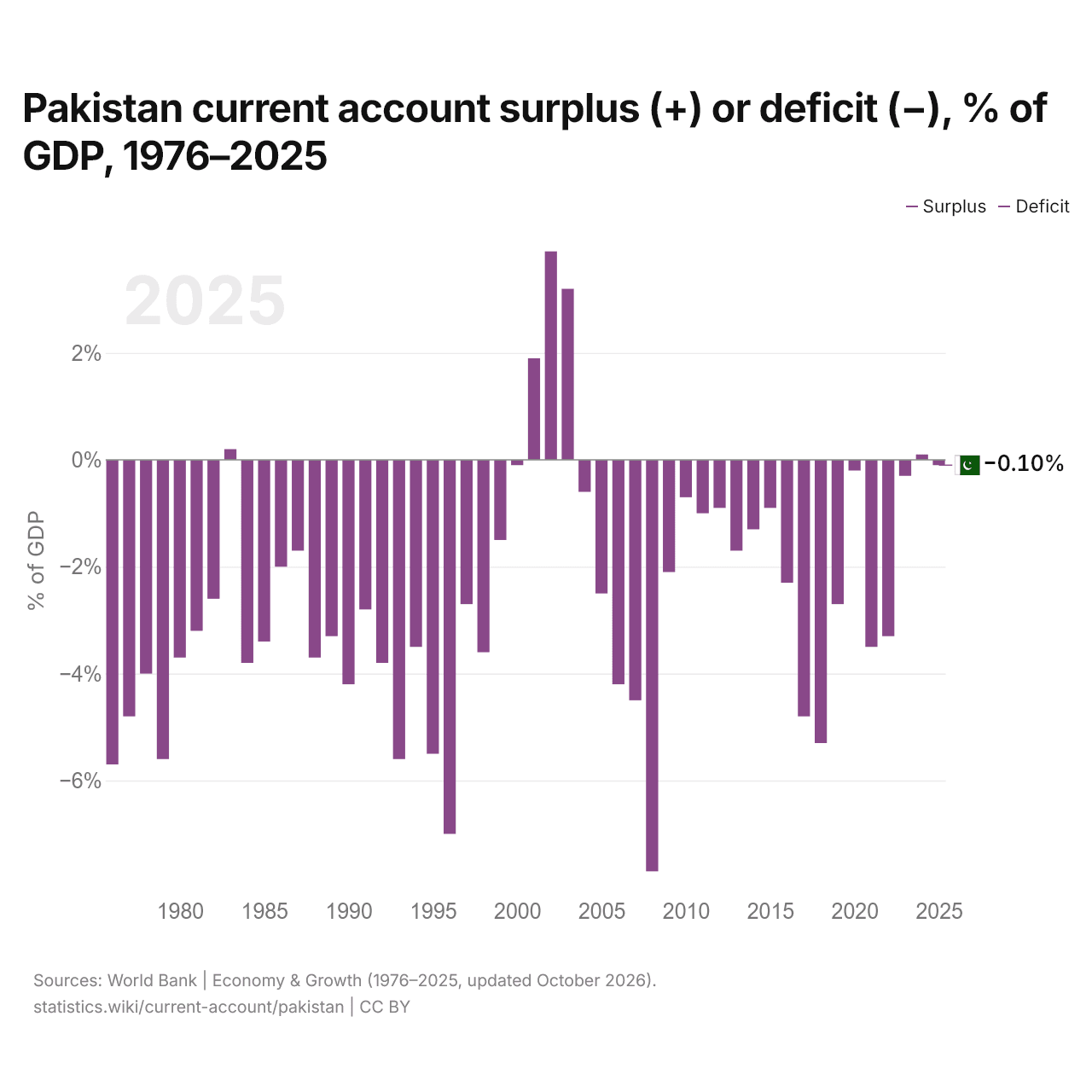
In 2025, Pakistan had a current account deficit of 0.1% of GDP, compared with a deficit of 5.7% in 1976. The largest deficit was 7.7%, in 2008, and the largest surplus 3.9%, in 2002.
Pakistan current account balance by year (US$), 1976–2025
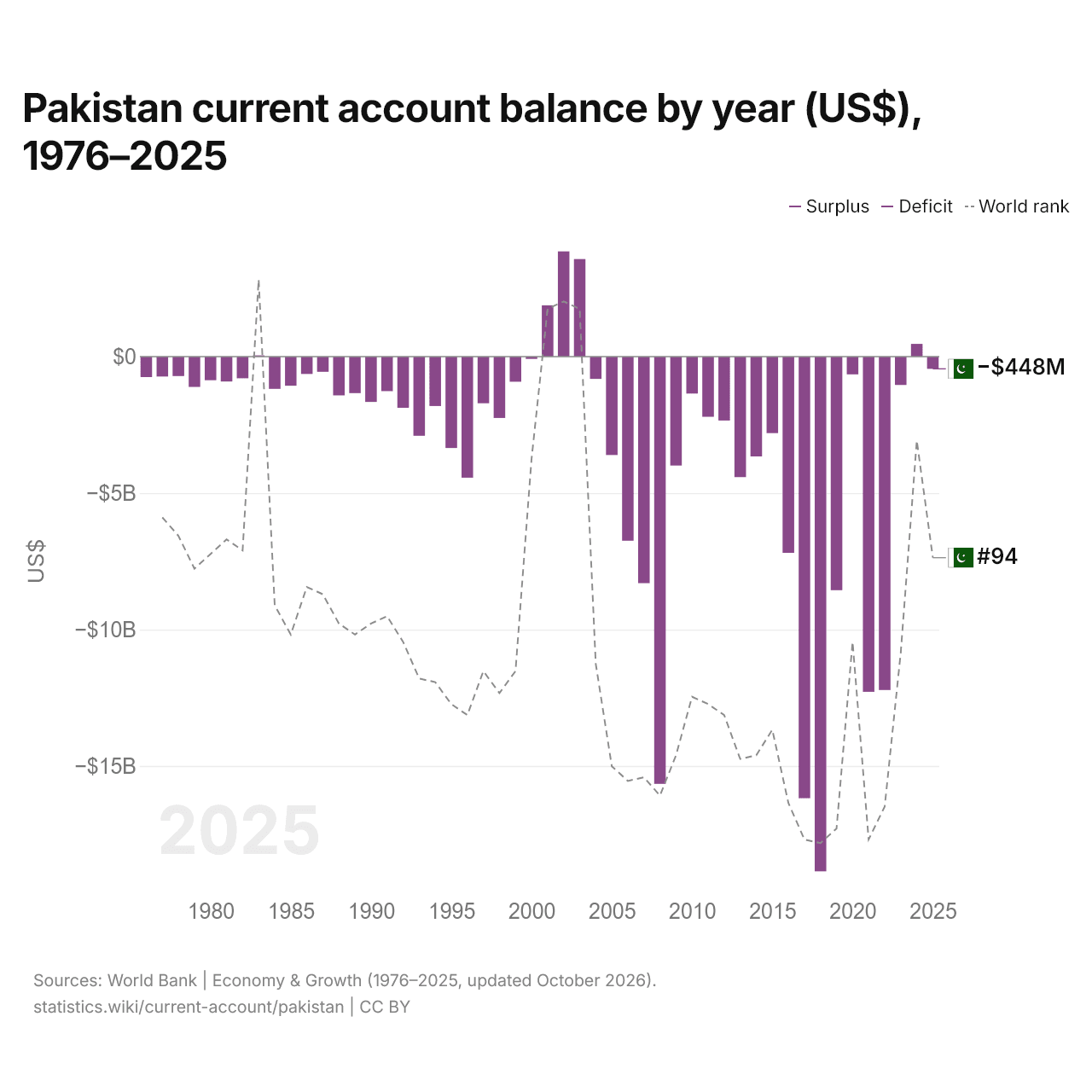
| Year | US$ | World rank |
|---|---|---|
| Current account balance | ||
| 2025 | $−447,997,400 | #94 |
| 2024 | $464,287,630 | #62 |
| 2023 | $−1,039,115,537 | #120 |
| 2022 | $−12,216,107,000 | #162 |
| 2021 | $−12,283,106,000 | #171 |
| 2020 | $−650,874,000 | #117 |
| 2019 | $−8,557,928,000 | #168 |
| 2018 | $−18,858,987,000 | #172 |
| 2017 | $−16,179,621,000 | #171 |
| 2016 | $−7,190,898,000 | #161 |
| 2015 | $−2,803,000,000 | #141 |
| 2014 | $−3,658,000,000 | #148 |
| 2013 | $−4,416,000,000 | #149 |
| 2012 | $−2,342,000,000 | #137 |
| 2011 | $−2,207,000,000 | #134 |
| 2010 | $−1,354,000,000 | #132 |
| 2009 | $−3,993,430,000 | #148 |
| 2008 | $−15,654,500,000 | #159 |
| 2007 | $−8,301,000,000 | #154 |
| 2006 | $−6,747,000,000 | #155 |
| 2005 | $−3,606,200,000 | #151 |
| 2004 | $−817,000,000 | #123 |
| 2003 | $3,573,000,000 | #26 |
| 2002 | $3,854,000,000 | #24 |
| 2001 | $1,878,000,000 | #26 |
| 2000 | $−85,000,000 | #67 |
| 1999 | $−920,000,000 | #125 |
| 1998 | $−2,248,000,000 | #131 |
| 1997 | $−1,711,627,499 | #125 |
| 1996 | $−4,436,052,633 | #137 |
| 1995 | $−3,348,753,667 | #134 |
| 1994 | $−1,812,130,082 | #128 |
| 1993 | $−2,900,570,429 | #127 |
| 1992 | $−1,876,092,233 | #117 |
| 1991 | $−1,266,420,092 | #110 |
| 1990 | $−1,661,409,655 | #112 |
| 1989 | $−1,338,030,462 | #115 |
| 1988 | $−1,422,305,787 | #112 |
| 1987 | $−556,309,627 | #104 |
| 1986 | $−636,062,432 | #102 |
| 1985 | $−1,067,173,406 | #115 |
| 1984 | $−1,183,920,882 | #107 |
| 1983 | $43,256,335 | #18 |
| 1982 | $−794,673,752 | #92 |
| 1981 | $−912,377,361 | #89 |
| 1980 | $−866,098,820 | #93 |
| 1979 | $−1,111,090,917 | #97 |
| 1978 | $−714,881,661 | #88 |
| 1977 | $−730,510,817 | #83 |
| 1976 | $−749,996,518 | - |
In 2025, Pakistan's current account deficit was $448 million, compared with a deficit of $750 million in 1976. In US dollars, the largest deficit was $18.9 billion, in 2018, and the largest surplus $3.85 billion, in 2002.
In 2025, Pakistan's current account balance was the 22nd highest of 42 countries in Asia, where current account balances ranged from Saudi Arabia's deficit of $32.7 billion to China's surplus of $735 billion. From 2016 to 2025, Pakistan's current account balances added up to a deficit of $77 billion, compared with a deficit of $51.5 billion from 2006 to 2015.
Pakistan current account balance: surplus (+) or deficit (−)
| US$, 2025 | −$448M |
|---|---|
| % of GDP, 2025 | −0.1% |
| Average, % of GDP, 2016–2025 | −2.2% |
| Years in surplus, 2000–2025 | 4 of 26 |
Pakistan in the world ranking of current account balances, 2025





Compare Pakistan current account balance with other countries
Sources:
- World Bank | Economy & Growth (1976–2025, updated October 2026)
Creative Commons Attribution (CC BY): you may copy, share, adapt and reuse this content, also commercially, as long as you credit statistics.wiki and note any changes you made. The sources listed above may have their own license terms.