
Tunisia birth rate, 1960–2026
| Year | Births per 1,000 people | World rank |
|---|---|---|
| Tunisia | ||
| 2026 projected | 12.6 | #106 |
| 2025 projected | 13 | #104 |
| 2024 | 13.4 | #104 |
| 2023 | 13.7 | #104 |
| 2022 | 14.1 | #104 |
| 2021 | 14 | #106 |
| 2020 | 15.8 | #103 |
| 2019 | 16.8 | #101 |
| 2018 | 17.3 | #98 |
| 2017 | 18.2 | #96 |
| 2016 | 19 | #94 |
| 2015 | 19.4 | #94 |
| 2014 | 19.7 | #94 |
| 2013 | 19.8 | #94 |
| 2012 | 19.6 | #100 |
| 2011 | 18.9 | #106 |
| 2010 | 17.9 | #109 |
| 2009 | 17.3 | #113 |
| 2008 | 17 | #117 |
| 2007 | 16.8 | #119 |
| 2006 | 16.6 | #120 |
| 2005 | 16.5 | #122 |
| 2004 | 16.3 | #122 |
| 2003 | 16.2 | #125 |
| 2002 | 16 | #129 |
| 2001 | 16.2 | #130 |
| 2000 | 16.5 | #129 |
| 1999 | 16.9 | #129 |
| 1998 | 17.7 | #127 |
| 1997 | 18.7 | #126 |
| 1996 | 19.8 | #125 |
| 1995 | 21 | #121 |
| 1994 | 22.4 | #120 |
| 1993 | 23.7 | #116 |
| 1992 | 24.5 | #117 |
| 1991 | 25.2 | #117 |
| 1990 | 26 | #116 |
| 1989 | 26.6 | #112 |
| 1988 | 28.2 | #107 |
| 1987 | 29.9 | #102 |
| 1986 | 31.2 | #100 |
| 1985 | 31.8 | #100 |
| 1984 | 32.2 | #99 |
| 1983 | 32.7 | #99 |
| 1982 | 33.2 | #97 |
| 1981 | 33.9 | #94 |
| 1980 | 34 | #95 |
| 1979 | 35 | #91 |
| 1978 | 36.4 | #85 |
| 1977 | 37.8 | #81 |
| 1976 | 38.8 | #81 |
| 1975 | 39.2 | #80 |
| 1974 | 39.3 | #80 |
| 1973 | 39.6 | #81 |
| 1972 | 39.7 | #82 |
| 1971 | 40.3 | #80 |
| 1970 | 41 | #80 |
| 1969 | 42.3 | #76 |
| 1968 | 43.6 | #69 |
| 1967 | 45 | #60 |
| 1966 | 46.2 | #49 |
| 1965 | 46.8 | #46 |
| 1964 | 47.4 | #40 |
| 1963 | 47.6 | #40 |
| 1962 | 47.7 | #42 |
| 1961 | 47.7 | #43 |
| 1960 | 47.7 | #44 |
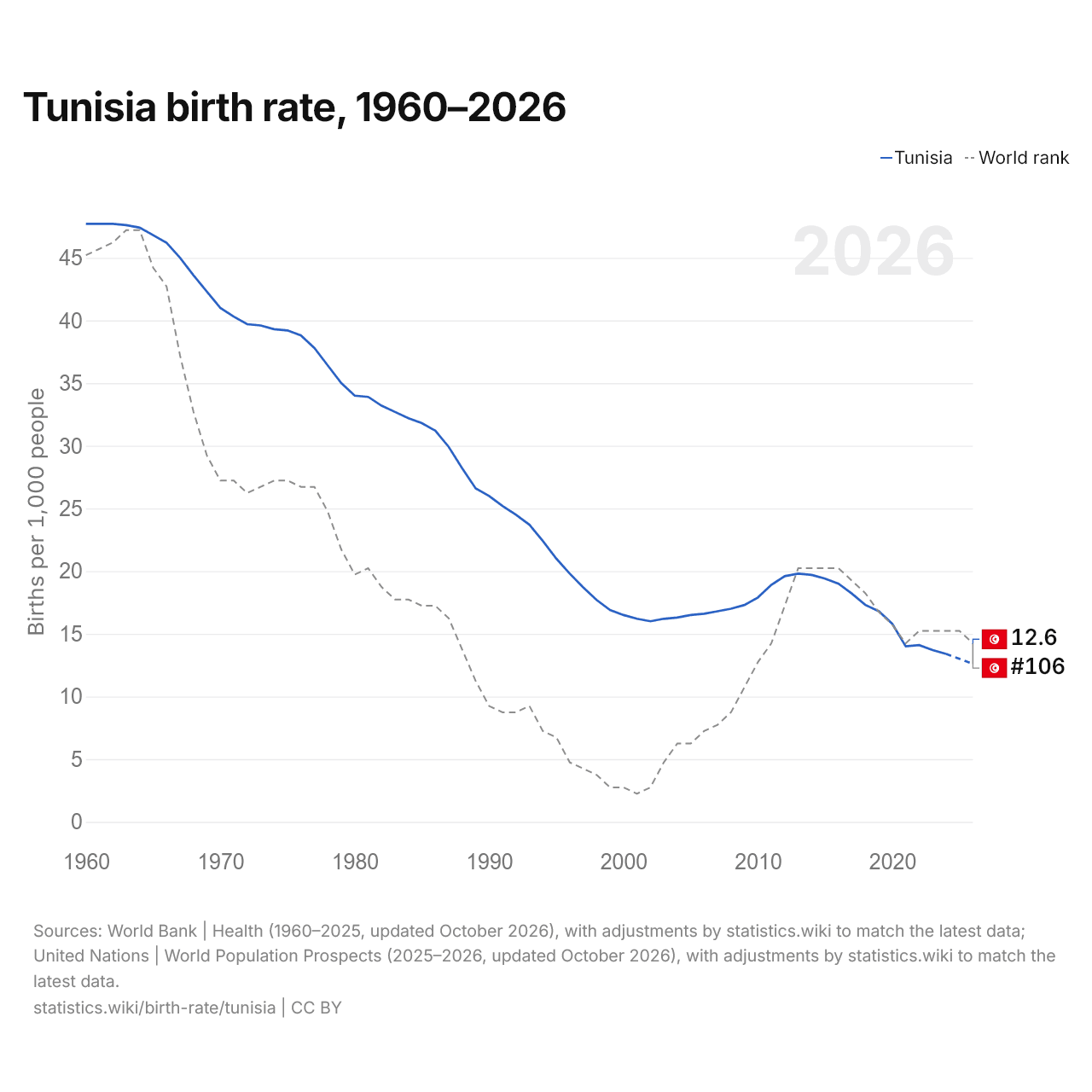
In 2026, Tunisia's birth rate is 12.6 births per 1,000 people, down from 47.7 in 1960. It is the 106th highest in the world, down from 104th in 2025. Tunisia's highest rank was 40th, last held in 1964.
Tunisia's birth rate is the 51st highest of the 54 countries of Africa, where it ranges from Mauritius' 10.0 to the Central African Republic's 44.7. The rate in Tunisia fell below 20 births per 1,000 people in 1996.
The death rate in Tunisia is 6.1 deaths per 1,000 people, the 140th highest in the world. Tunisia's population grows by 0.6% in 2026.
Tunisia in the world birth rate ranking, 2026
| Rank | Country | Births per 1,000 people | Change since 2000 | |
|---|---|---|---|---|
| 103 |
 Vietnam |
12.8 | −5.2 | vs Vietnam |
| 104 |
 Brunei |
12.7 | −7.1 | |
| 105 |
 Colombia |
12.7 | −9.6 | |
| 106 |
 Tunisia |
12.6 | −3.9 | |
| 107 |
 North Korea |
12.3 | −5.2 | |
| 108 |
 Bhutan |
12.2 | −13.0 | |
| 109 |
 Malaysia |
12.1 | −10.5 |
Compare the Tunisia birth rate with other countries
Sources:
- World Bank | Health (1960–2025, updated October 2026), with adjustments by statistics.wiki to match the latest data
- United Nations | World Population Prospects (2025–2026, updated October 2026), with adjustments by statistics.wiki to match the latest data
Creative Commons Attribution (CC BY): you may copy, share, adapt and reuse this content, also commercially, as long as you credit statistics.wiki and note any changes you made. The sources listed above may have their own license terms.