
Guyana average age of mothers, 1960–2026
| Year | Age | World rank |
|---|---|---|
| At childbirth | ||
| 2026 projected | 27.1 | #184 |
| 2025 projected | 27.1 | #185 |
| 2024 | 27 | #185 |
| 2023 | 27 | #186 |
| 2022 | 27 | #185 |
| 2021 | 27 | #185 |
| 2020 | 27 | #186 |
| 2019 | 27 | #183 |
| 2018 | 27 | #182 |
| 2017 | 27 | #181 |
| 2016 | 27 | #181 |
| 2015 | 26.9 | #179 |
| 2014 | 26.9 | #178 |
| 2013 | 26.9 | #177 |
| 2012 | 26.9 | #178 |
| 2011 | 26.8 | #180 |
| 2010 | 26.7 | #180 |
| 2009 | 26.6 | #181 |
| 2008 | 26.6 | #181 |
| 2007 | 26.5 | #181 |
| 2006 | 26.5 | #180 |
| 2005 | 26.5 | #181 |
| 2004 | 26.5 | #178 |
| 2003 | 26.5 | #178 |
| 2002 | 26.6 | #178 |
| 2001 | 26.6 | #176 |
| 2000 | 26.6 | #177 |
| 1999 | 26.6 | #175 |
| 1998 | 26.6 | #174 |
| 1997 | 26.7 | #170 |
| 1996 | 26.7 | #170 |
| 1995 | 26.6 | #168 |
| 1994 | 26.7 | #167 |
| 1993 | 26.7 | #164 |
| 1992 | 26.7 | #164 |
| 1991 | 26.8 | #161 |
| 1990 | 26.7 | #163 |
| 1989 | 26.7 | #163 |
| 1988 | 26.7 | #166 |
| 1987 | 26.7 | #163 |
| 1986 | 26.8 | #163 |
| 1985 | 26.8 | #162 |
| 1984 | 26.9 | #158 |
| 1983 | 27 | #156 |
| 1982 | 27 | #158 |
| 1981 | 27.1 | #155 |
| 1980 | 27.2 | #149 |
| 1979 | 27.2 | #151 |
| 1978 | 27.2 | #149 |
| 1977 | 27.3 | #149 |
| 1976 | 27.4 | #149 |
| 1975 | 27.4 | #147 |
| 1974 | 27.5 | #144 |
| 1973 | 27.6 | #144 |
| 1972 | 27.8 | #140 |
| 1971 | 27.9 | #142 |
| 1970 | 27.9 | #142 |
| 1969 | 27.9 | #145 |
| 1968 | 28 | #144 |
| 1967 | 28 | #142 |
| 1966 | 28 | #147 |
| 1965 | 28 | #148 |
| 1964 | 28 | #150 |
| 1963 | 28 | #151 |
| 1962 | 27.9 | #152 |
| 1961 | 27.8 | #163 |
| 1960 | 27.8 | #164 |
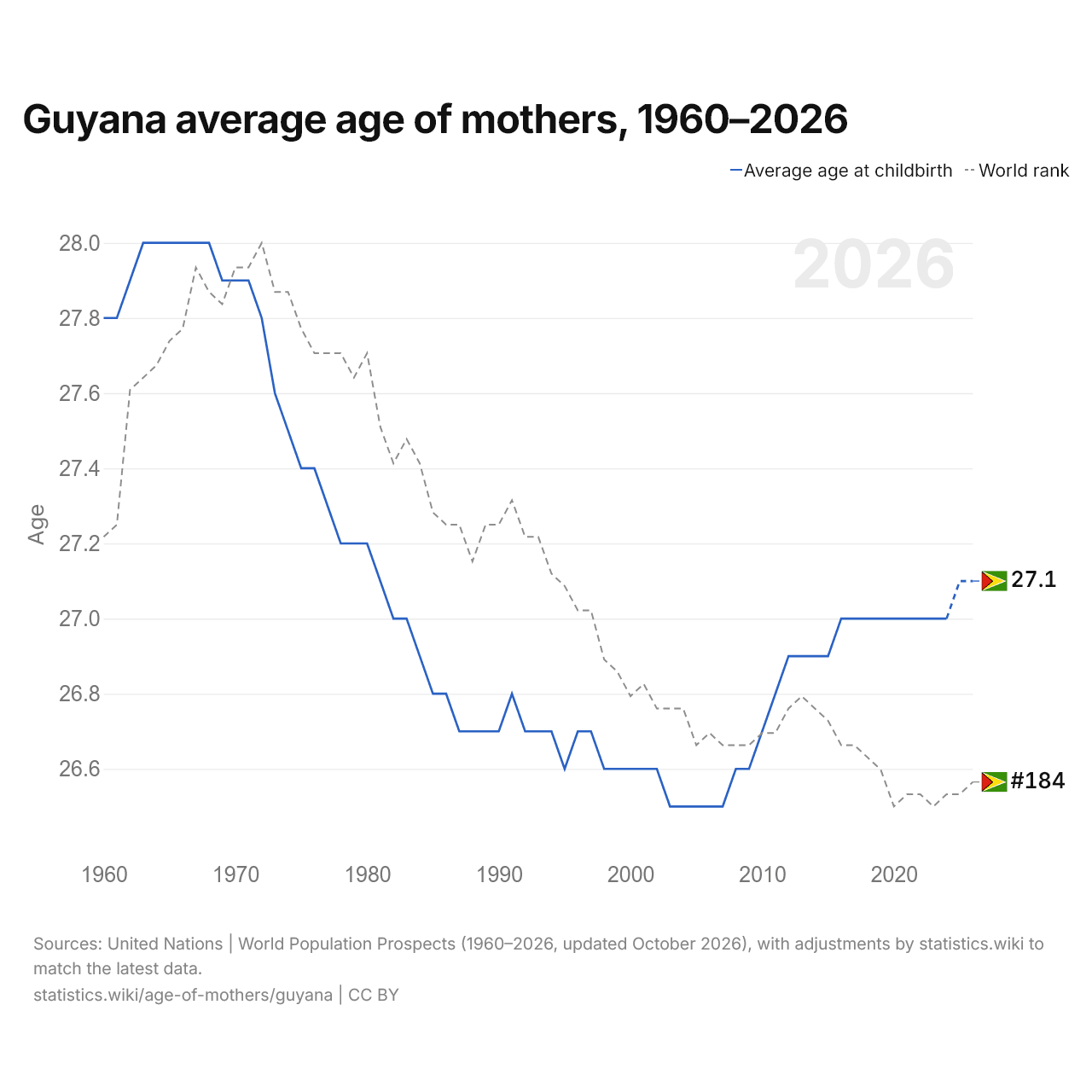
In 2026, Guyana's average age of mothers at childbirth is 27.1 years, down from 27.8 in 1960. It was highest in 1967, at 28.0. It is the 184th highest in the world, up from 185th in 2025. Its highest rank was 140th, last held in 1972.
Guyana's average age of mothers at childbirth is the 30th highest of the 35 countries of Latin America, where it ranges from Nicaragua's 26.0 to Chile's 31.7. The largest ten-year fall in Guyana's average age of mothers was from 1970 to 1980, by 0.7 years; the largest ten-year rise was from 2010 to 2020, by 0.3.
Guyana births by age of the mother, 1960–2026
| Year | Share of births | ||
|---|---|---|---|
| Aged 15–19 | Aged 20–29 | Aged 30+ | |
| 2026 projected | 15.2% | 55% | 29.8% |
| 2025 projected | 14.9% | 56.2% | 28.9% |
| 2024 | 14.7% | 57.4% | 27.8% |
| 2023 | 14.7% | 58.5% | 26.8% |
| 2022 | 14.8% | 59.3% | 25.9% |
| 2021 | 15.1% | 59.7% | 25.1% |
| 2020 | 15.6% | 59.8% | 24.5% |
| 2019 | 16.2% | 59.7% | 24.1% |
| 2018 | 17.1% | 58.8% | 24.1% |
| 2017 | 17.8% | 58.1% | 24.1% |
| 2016 | 18.5% | 57.3% | 24.2% |
| 2015 | 19% | 56.6% | 24.4% |
| 2014 | 19.3% | 55.9% | 24.8% |
| 2013 | 19.4% | 55.3% | 25.3% |
| 2012 | 19.5% | 54.9% | 25.6% |
| 2011 | 20.1% | 54.2% | 25.7% |
| 2010 | 20.5% | 53.8% | 25.7% |
| 2009 | 20.5% | 53.6% | 25.9% |
| 2008 | 20.5% | 53.6% | 25.9% |
| 2007 | 20.4% | 53.8% | 25.8% |
| 2006 | 20% | 54.1% | 25.9% |
| 2005 | 19.5% | 54.6% | 25.9% |
| 2004 | 19.2% | 55% | 25.8% |
| 2003 | 19.3% | 54.8% | 25.9% |
| 2002 | 19.3% | 54.8% | 26% |
| 2001 | 18.9% | 55.1% | 26% |
| 2000 | 19.3% | 54.9% | 25.8% |
| 1999 | 19.7% | 54.9% | 25.3% |
| 1998 | 20.1% | 55% | 24.9% |
| 1997 | 19.9% | 55.3% | 24.8% |
| 1996 | 20.3% | 55.3% | 24.4% |
| 1995 | 20.6% | 55.5% | 24% |
| 1994 | 20.5% | 55.9% | 23.6% |
| 1993 | 20.7% | 56.1% | 23.3% |
| 1992 | 20.6% | 56.3% | 23% |
| 1991 | 20.6% | 56.7% | 22.7% |
| 1990 | 20.9% | 56.9% | 22.3% |
| 1989 | 21.2% | 57% | 21.8% |
| 1988 | 21.6% | 57% | 21.4% |
| 1987 | 21.8% | 57.1% | 21.2% |
| 1986 | 21.7% | 57.4% | 20.9% |
| 1985 | 21.5% | 57.8% | 20.8% |
| 1984 | 21.3% | 58.1% | 20.6% |
| 1983 | 21.1% | 58.4% | 20.4% |
| 1982 | 21.2% | 58.7% | 20.1% |
| 1981 | 21.1% | 59% | 19.8% |
| 1980 | 20.1% | 60.1% | 19.9% |
| 1979 | 20.4% | 59.9% | 19.6% |
| 1978 | 20.8% | 59.7% | 19.6% |
| 1977 | 20.6% | 59.6% | 19.8% |
| 1976 | 20.5% | 59.3% | 20.2% |
| 1975 | 20.4% | 58.8% | 20.8% |
| 1974 | 20.3% | 58.2% | 21.5% |
| 1973 | 20.1% | 57.6% | 22.3% |
| 1972 | 19.6% | 57% | 23.4% |
| 1971 | 18.9% | 56.8% | 24.3% |
| 1970 | 18.2% | 56.6% | 25.2% |
| 1969 | 18% | 56.2% | 25.8% |
| 1968 | 17.7% | 55.3% | 26.9% |
| 1967 | 17.6% | 54.6% | 27.8% |
| 1966 | 17% | 54.5% | 28.4% |
| 1965 | 16.5% | 54.6% | 28.9% |
| 1964 | 15.9% | 54.8% | 29.3% |
| 1963 | 15.6% | 54.8% | 29.6% |
| 1962 | 15.5% | 54.8% | 29.7% |
| 1961 | 16.1% | 54.8% | 29.2% |
| 1960 | 16.5% | 54% | 29.5% |
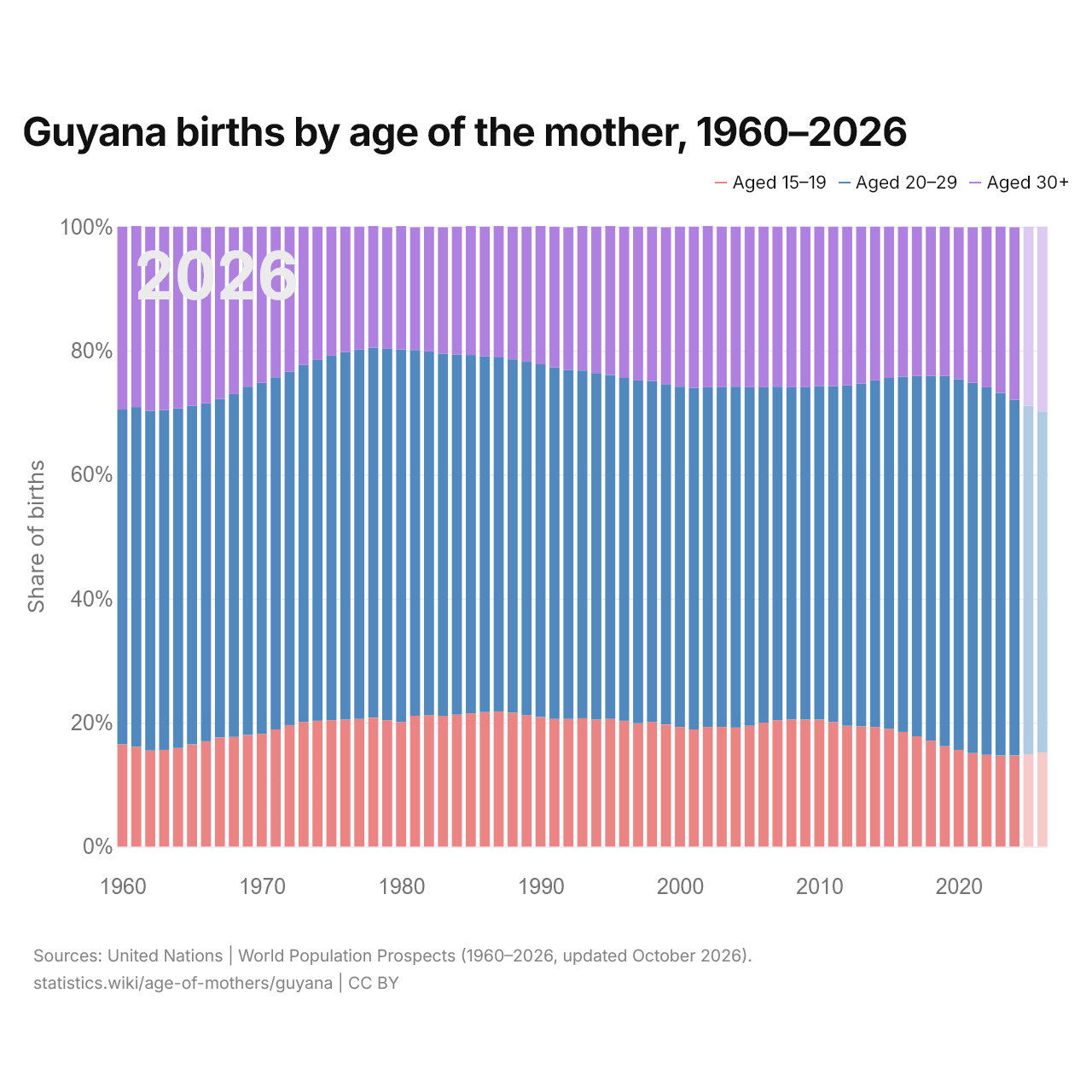
In 2026, 29.8% of births in Guyana are to mothers aged 30 and over, 55.0% to mothers aged 20–29 and 15.2% to mothers aged 15–19. In 1960, the shares were 29.5%, 54.0% and 16.5%.
Guyana in the world ranking by average age of mothers, 2026
| Rank | Country | At childbirth | At first birth | Change since 1990 | |
|---|---|---|---|---|---|
| 181 |
 Belize |
27.2 | – | −0.5 | vs Belize |
| 182 |
 Uzbekistan |
27.1 | 23.5 (2021) | −0.2 | |
| 183 |
 Nauru |
27.1 | – | −1.1 | |
| 184 |
 Guyana |
27.1 | – | +0.3 | |
| 185 |
 Marshall Islands |
27.1 | – | +0.0 | |
| 186 |
 Equatorial Guinea |
26.9 | – | −1.3 | |
| 187 |
 Mexico |
26.8 | – | −0.9 |
Compare the average age of mothers in Guyana with other countries
Sources:
- United Nations | World Population Prospects (1960–2026, updated October 2026), with adjustments by statistics.wiki to match the latest data
- United Nations Economic Commission for Europe (UNECE) (2021, updated October 2026)
Creative Commons Attribution (CC BY): you may copy, share, adapt and reuse this content, also commercially, as long as you credit statistics.wiki and note any changes you made. The sources listed above may have their own license terms.